
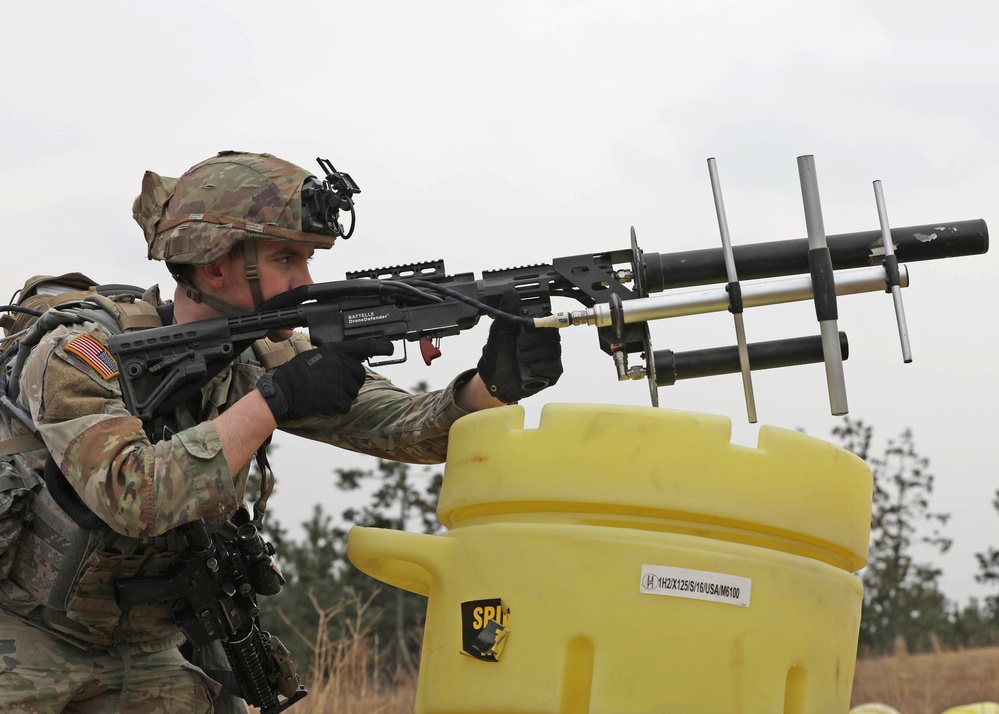
South Korea has decided that the future soldier carries two weapons: a rifle and a drone. In a June 26, 2026 announcement in Seoul, Defense Minister Ahn Gyu-back framed unmanned aircraft not as a specialist capability but as standard personal kit, declaring that every service member should be able to use a drone as a "second personal weapon." Around that idea, the Ministry of National Defense (MND) is building one of the most ambitious force-transformation programs any military has publicly committed to — and pairing it with the hardware, doctrine, and, notably, the testing standards to make it real.
The scale is the story. Seoul intends to train 500,000 "drone warriors" spread across the Army, Navy, Air Force, and Marines. It plans to field roughly 11,000 Korean-made drones in 2026 alone, ramping to about 60,000 by 2029. And it wants to acquire 20,000 low-cost reconnaissance and loitering drones — the kind of attritable, expendable systems that recent conflicts have shown can be decisive out of all proportion to their price tag.
A conscript army that is running out of conscripts
The strategic logic behind the pivot is partly demographic. South Korea's record-low birthrate is steadily shrinking the pool of young men available for conscription, a structural problem that no amount of political will can quickly reverse. A military that cannot count on ever-larger numbers of soldiers has a powerful incentive to multiply the effectiveness of the soldiers it does have. Cheap, ubiquitous drones — reconnaissance eyes, loitering munitions, and swarming attack platforms — are one way to substitute machines and software for scarce human bodies.
The MND has also been explicit about where the inspiration comes from. Officials cited the wars in Ukraine and the Middle East as proof that low-cost drones are genuine game changers on the modern battlefield, capable of reshaping tactics and imposing outsized costs on adversaries. Rather than treat that lesson as someone else's, Seoul is moving to institutionalize it inside its own force structure.
From a command to a headquarters
Organizationally, South Korea already stood up a joint Drone Operations Command — based in Pocheon and composed of Army, Navy, Air Force, and Marine personnel. Under the new plan, that command is being restructured into a Defense Drone Headquarters, signaling that unmanned warfare is graduating from a bolt-on capability to a core institutional pillar of the armed forces.
On the procurement side, the numbers break down into layers. The MND intends to buy roughly 20,000 UAVs that include short-range reconnaissance platforms and loitering munitions, described as akin to a Low-cost Unmanned Combat Attack System (LUCAS). Seoul also plans to accelerate development of the homegrown K-Lucas, a long-range strike — effectively a suicide — drone designed to reach deeper targets than the short-range expendables. Taken together, the roadmap spans everything from disposable tactical drones a squad might carry to strategic-reach loitering weapons.
The other half of the equation: shooting drones down
A military that plans to saturate the battlefield with its own drones understands, better than most, how dangerous the other side's drones are. South Korea's plan devotes serious attention to counter-unmanned aircraft systems (C-UAS), with both short-term and long-term deployment goals. Border and forward-operating-base counter-drone systems are slated to begin entering service from 2027.
The counter-drone toolkit Seoul is pursuing reads like a survey of every promising approach at once: laser weapons, high-power microwave systems, and interceptor drones — plus, on the doctrinal side, AI-enabled swarms. High-power microwave and directed-energy systems are attractive precisely because they offer a "deep magazine" against swarms, where firing an expensive interceptor missile at a cheap drone is an economically losing proposition.
Q&A: What is KS W 8100, and why does a standard matter?
What happened on June 28? Two days after the force-transformation announcement, the Korean Agency for Technology and Standards issued KS W 8100, the country's first national performance-testing standard for counter-drone systems.
What does the standard actually cover? KS W 8100 defines test methods for the sensors and effectors that make up a counter-drone system — radar, radio-frequency (RF) scanners, electro-optical/infrared (EO/IR) cameras, and electronic jammers. Together these are meant to detect, identify, and neutralize hostile drones. The standard is aimed at protecting airports, power plants, military installations, and other critical infrastructure.
Why is a testing standard a big deal? Because "counter-drone system" has, until now, been a marketing term as much as an engineering one. A vendor can claim its jammer defeats drones or its radar detects them without any common yardstick to verify the claim. A national performance-testing standard gives buyers — and the government — a repeatable way to measure whether a system does what it says. It disciplines the market, sets a floor for procurement, and creates a reference point that South Korea's own drone-heavy force will inevitably be tested against. Building an army of drone operators only makes sense if you also know, with some rigor, which defenses can stop the other side's drones.
Why It Matters
Plenty of militaries have announced drone initiatives. What distinguishes South Korea's June 2026 push is that it couples a mass-adoption ambition — half a million trained operators and tens of thousands of aircraft — with the unglamorous institutional plumbing that usually lags years behind the press release: a dedicated headquarters, a layered procurement roadmap from disposable tactical drones to the long-range K-Lucas, phased C-UAS fielding from 2027, and a formal national standard for measuring counter-drone performance. That combination is what turns "we're going all-in on drones" from a slogan into a program.
The demographic driver also makes this more than a South Korean curiosity. Aging, low-birthrate societies across the developed world face the same shrinking manpower pool, and Seoul is now road-testing one answer: substitute cheap, networked, semi-autonomous machines for scarce soldiers, and make operating them a baseline skill rather than a specialty. If the model works, it is one others will study closely. And the KS W 8100 standard is a quiet tell that South Korea is thinking past the offense — recognizing that a world where its own troops each carry a drone is also a world where every adversary drone is a threat that must be measurably, verifiably defeated.
Sources
- South Korea plans rapid expansion of UAV, C-UAS capabilities (Janes)
- South Korean military makes massive pivot to drones (Washington Times, June 26, 2026)
- South Korea sets first national standard for counter-drone systems (UPI, June 28, 2026)
- South Korea to Acquire 20,000 Low-Cost Military Drones (The Defense Post, June 27, 2026)
