
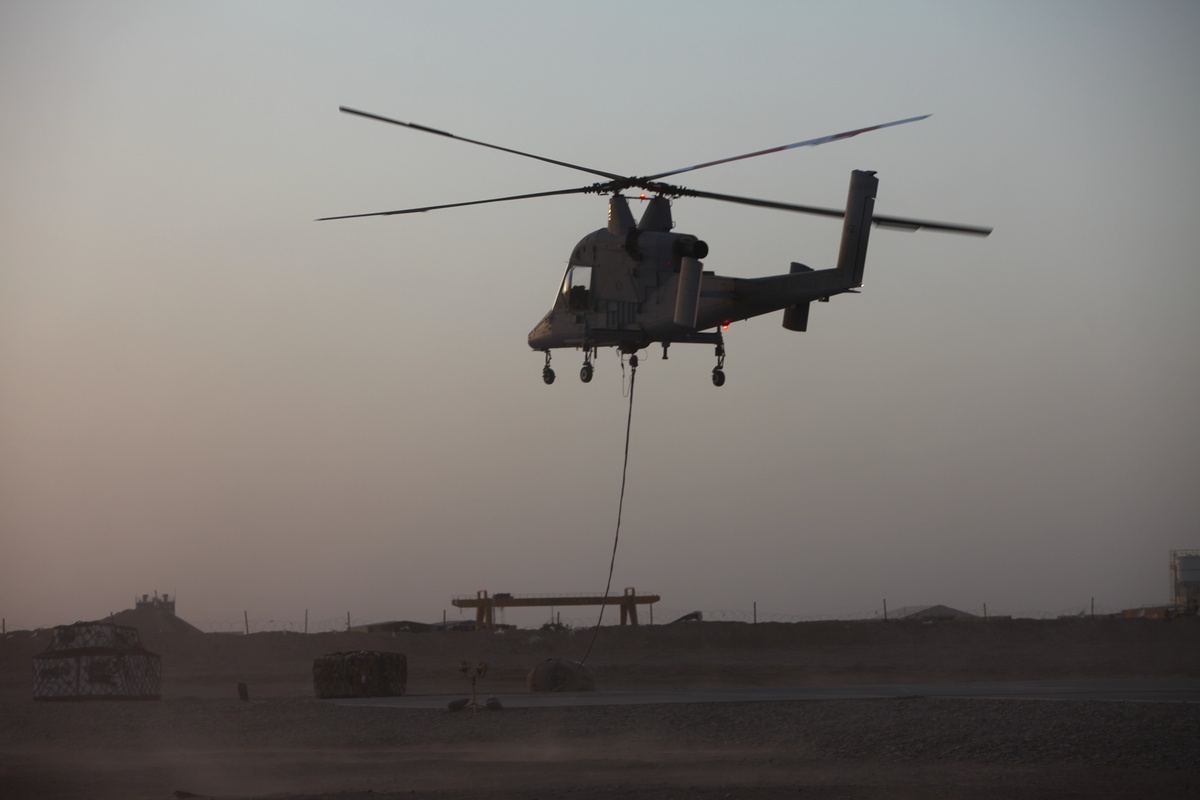
DARPA set out to find a drone that could lift four times its own weight. The winner came close — and did it with a rotor configuration that has defined production helicopters since the 1940s.
The agency's Lift Challenge concluded August 9, 2026, at the National Museum of the U.S. Air Force in Dayton, Ohio, with AVIDrone Inc. of Columbia, Maryland, taking the $1.25 million Objective category prize. The company's Katana, a conventional single-main-rotor helicopter-style drone, carried 112.4 pounds of payload on a 29.3-pound airframe — a 3.84:1 payload-to-weight ratio that fell just short of the 4:1 target DARPA had set as the competition's benchmark.
MTech Operations of Sudbury, Massachusetts, took second place at 3.64:1, earning $750,000, while Xtreme Aerial Concepts of San Jose, California, placed third at 3.45:1 for $500,000.
A Field Winnowed to 62
The scale of the winnowing behind the final results is notable. DARPA received 489 applications for the Lift Challenge. Of those, 76 teams checked in for the live event at the Air Force museum, and 62 passed the safety checks required to fly. Those teams combined for 70 official competition runs before the event wrapped, feeding into a $6.5 million total prize pool split across two categories.
DARPA Director Stephen Winchell closed the event by pointing to where he sees the program heading rather than dwelling on the drop-off, telling teams at the Aug. 9 ceremony: "We're just seeing the very beginning of the transformation that this community is going to bring to the aerospace industry. Every single team here, you are DARPA."
Objective vs. Subjective: Two Ways to Win
The Lift Challenge ran two parallel tracks. The Objective category, won by AVIDrone, scored teams purely on measured payload-to-weight performance during live flight — the number that produced the 3.84:1 headline result.
The Subjective category rewarded different qualities, and its winners point to where DARPA sees potential beyond raw lift numbers. A University of Maryland student team, the Portal Aircraft Company, and DefendTex each won $500,000. DefendTex's entry is worth flagging on the numbers alone: it posted a 9.63:1 payload-to-weight ratio, more than double AVIDrone's winning Objective-category figure. DARPA's own results note, however, that DefendTex's aircraft did not complete a scored run to achieve that number, so the figure isn't a like-for-like measurement against AVIDrone's live-flight result — DefendTex competed and was judged under different criteria than the pure Objective bracket.
The Twist: An "Old-Fashioned" Winner
Given the futuristic framing DARPA typically applies to its challenges, the win drew notice for a different reason than the ratio itself. AVIDrone's Katana uses a conventional helicopter rotor configuration — not one of the more exotic VTOL or multi-rotor concepts that competitors and observers might have expected to dominate a DARPA-branded payload competition. Coverage of the event described the outcome as "surprisingly old-fashioned" for exactly that reason: in a field built to push the envelope on lift efficiency, a decades-old rotorcraft layout came out on top.
The prize structure also reflected how close the field came to, but did not reach, DARPA's stated goal. DARPA's published rules for the Objective category pay full awards only above the 4:1 ratio threshold; because the best completed run landed at 3.84:1, the agency paid out at half the advertised amounts — $1.25 million instead of $2.5 million for first place, $750,000 instead of $1.5 million for second, and $500,000 instead of $1 million for third.
Why It Matters
Payload-to-weight ratio is one of the more unforgiving metrics in vertical-lift aircraft design: every pound of structure, motor, and battery is a pound not available for cargo, and the ratio tends to get harder to improve, not easier, as a design already gets efficient. A competition-verified 3.84:1 in live flight — with 62 independently vetted teams and 70 competition runs backing up the result — gives the uncrewed systems and cargo-drone industry a public, third-party benchmark that vendor marketing claims alone don't provide.
The result also matters for what it implies about design direction. DARPA challenges are frequently read as referenda on which technical approaches are worth pursuing, and a win by a conventional single-rotor helicopter over more novel VTOL configurations is a data point against the assumption that unconventional airframes are inherently the path to higher lift efficiency. For program offices and companies chasing heavy-cargo and logistics drone applications — a category where every fractional gain in payload ratio translates directly into fewer sorties per ton delivered — that's a meaningful signal about where near-term gains are actually available.
Finally, the gap between the winning 3.84:1 and DARPA's 4:1 target is itself informative: it suggests the four-fold threshold, while not reached, is close enough to be a realistic near-term target for the field rather than an aspirational one, and the DefendTex Subjective-category result of 9.63:1 hints that different design tradeoffs — accepting constraints the pure Objective category didn't allow, and without the requirement of a scored competition run — can push the ratio dramatically further.
