
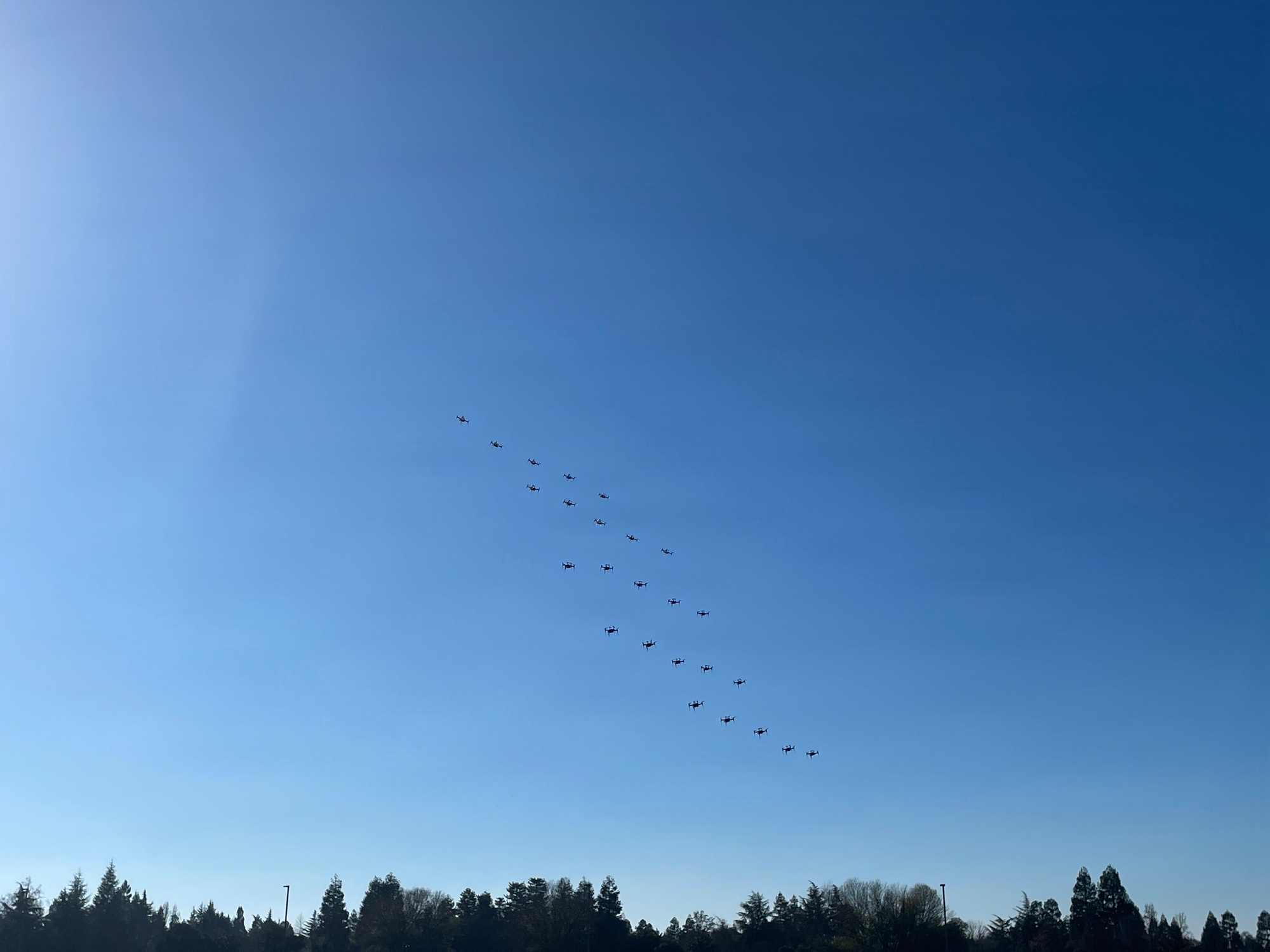
A group of Chinese university researchers has shown a small quadrotor swarm mapping unknown spaces with no central controller. Each drone decides on board where to fly, which part of the area to cover, and how to keep clear of the others. In the outdoor test, three drones mapped a stand of trees. In the indoor test, four mapped an exhibition hall. The team published the method in a peer-reviewed journal under an open license, but it is not releasing the software.
The framework is called ESCAPE, short for "an efficient and safe distributed UAV swarm exploration framework with collision avoidance perception." It appeared in Springer's journal Autonomous Intelligent Systems on December 22, 2025, under DOI 10.1007/s43684-025-00123-y and a CC BY 4.0 license, according to its Crossref record. The listed authors are Yaoyang Bao, Siyuan Du, Qingwei Jiang, Yixuan Li, Bochao Zhao, Gang Wang, Qingwen Liu and Mingliang Xiong. DroneXL, which covered the paper on November 8, reports that the authors work at Tongji University, Tianjin University and the Beijing Institute of Technology. It also reports that the work was funded by China's National Key R&D Program, the National Natural Science Foundation of China (NSFC) and two Shanghai programs.
A note on sourcing: Springer's full-text page sat behind a bot challenge when UASFeed tried to read it. The title, authors, date, license and abstract below come from the Crossref metadata. Specific experimental figures come from DroneXL's reading of the paper, and they are attributed to DroneXL.
The Problem ESCAPE Targets
Multi-drone exploration means sending several aircraft into a space nobody has mapped and having them build a map together as fast as possible. That raises two coordination problems. The drones have to split the work so they don't fly over the same ground twice. They also have to avoid hitting each other in tight, cluttered spaces.
According to the abstract, current methods handle the second problem by having drones share their planned trajectories and plan around each other's paths. The weakness is timing. Over a real radio link, communication delays can leave outdated trajectories in a drone's collision decisions. A drone that dodges where its neighbor planned to be a moment ago is not dodging where the neighbor actually is.
The paper proposes three changes: an improved global exploration strategy, collision risk prediction based on the relative distance and velocity between drones, and a multi-objective local trajectory optimizer. The authors say simulations and real-world experiments show the swarm explores safely and efficiently.
Standing on RACER's Shoulders
ESCAPE extends an existing system rather than starting from scratch. Its starting point is RACER (Rapid Collaborative Exploration with a Decentralized Multi-UAV System), a fully decentralized multi-quadrotor exploration method built for asynchronous, limited communication with no central control. RACER's authors are Boyu Zhou of Sun Yat-sen University and Hao Xu and Shaojie Shen of the Hong Kong University of Science and Technology. Their paper ran in IEEE Transactions on Robotics and was named the 2023 IEEE T-RO Best Paper. RACER's code is public on GitHub.
DroneXL reports that ESCAPE keeps RACER's frontier detection and its B-spline trajectory optimizer. Frontier detection finds the boundary between mapped and unmapped space, and the B-spline optimizer turns waypoints into smooth, flyable paths. ESCAPE's changes are in task allocation and in how drones reason about each other.
Trading grid cells
The swarm divides the area into grid cells, and drones trade cells in pairs instead of waiting for a central planner to hand out assignments. Each drone then plans its route through its cells. DroneXL reports that the team frames this as a capacitated vehicle routing problem and solves it with the Lin-Kernighan-Helsgaun (LKH) solver. The one change to RACER's routing step is a continuity penalty: when a cell's center sits inside a wall or tree trunk, the drone pays an extra cost equal to the straight-line distance to that center. DroneXL says the aim is to stop a drone from hovering in front of a large obstacle and shuttling back and forth, which the authors say RACER does when one obstacle spans several cells.
A risk score instead of a trajectory feed
The second change addresses the problem the abstract describes. ESCAPE does not depend on a neighbor's broadcast trajectory being current. Each drone computes a collision risk score from the other drone's relative distance and velocity. Per DroneXL, the score uses a 1.5-meter safety bubble, weights distance twice as heavily as the other terms, and triggers avoidance when it crosses a threshold of 1.5.
The design also sets a rule for who yields. Per DroneXL, when two drones conflict, the lower one hovers and the higher one replans around its actual position. The replanning drone adds a wider vertical margin plus small allowances for imperfect conditions: 0.01 seconds of network delay and 5 centimeters of localization error, DroneXL reports. A fixed rule for who moves avoids, in principle, both drones swerving the same way or both waiting for the other.
The Hardware and the Flights
Each drone carries an Intel NUC compact computer and a Livox Mid-360 lidar, and all decisions are made on board. DroneXL reports that the researchers narrowed the lidar's usable field of view to 86 degrees horizontally and from -10 to 60 degrees vertically. The drones flew at 1.0 m/s (about 2.2 mph).
The outdoor test used three drones to map a 12 by 20 meter area of trees up to a height of 2 meters. The indoor test used four drones in a 12 by 30 meter exhibition hall, mapped to 1.6 meters. These are small areas flown slowly by research aircraft, much like other academic exploration demonstrations. They do not show the system working at field scale or in contested conditions.
The Code Stays Home
The paper's code availability statement is unusual for open-access swarm robotics. DroneXL quotes it as saying the code is "not available for public release" because of "the confidentiality requirements of the research."
In this field, released code is how other labs check claims and build on them. ESCAPE builds on RACER, whose authors published their implementation. The new paper's text is CC BY 4.0, so the method can be read and reused. But anyone who wants to check the reported performance has to rebuild the system from the written description, and they have no reference code to show whether a difference in results comes from the algorithm or from their own implementation.
The statement does not say what the confidentiality requirement covers or who set it, and UASFeed does not speculate on either. DroneXL reports that the paper lists seven funding sources, all Chinese and all public, and the authors' decision to withhold the code is the only constraint on the record.
Why It Matters
Decentralized exploration matters because a ground station is a single point of failure. It can be jammed, located or simply moved out of range. A swarm that divides work and avoids collisions entirely on board keeps working when the link to an operator degrades or drops, and in ESCAPE's design, when links between the drones themselves are delayed. The approach in this paper is to stop trusting shared plans that may be stale and react to observed relative motion. That is a reasonable engineering answer to a problem every real radio network has.
The work also shows a familiar pattern. Ideas move freely between institutions, here from a prize-winning open-source system developed by researchers at Sun Yat-sen University and the Hong Kong University of Science and Technology to a Shanghai team's extension. The resulting software does not always move with them. In this case, the published method arrives with its implementation held back. The paper says what the system does, but outsiders cannot run it to confirm.
Sources
- DroneXL: Chinese Drone Swarm Maps Woods on Its Own, and Withholds the Code (Nov 8, 2026)
- Crossref record: ESCAPE: an efficient and safe distributed UAV swarm exploration framework with collision avoidance perception (Autonomous Intelligent Systems)
- RACER: Rapid Collaborative Exploration with a Decentralized Multi-UAV System (GitHub, Robotics-STAR-Lab)