
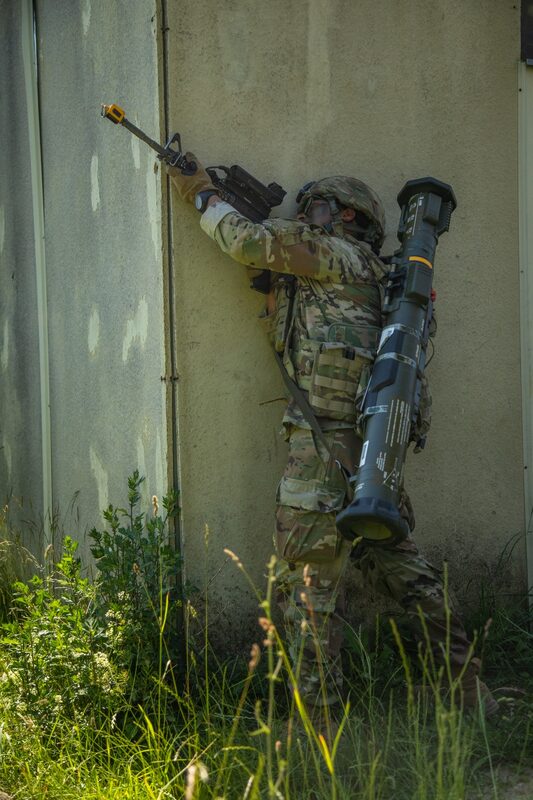
Most counter-drone hardware is big, expensive or both: radar-cued guns, directed-energy weapons, jammers and dedicated interceptors. IWI is selling a much smaller answer. Its Arbel Anti-Drone System leaves the rifle, the sights and the ammunition alone and puts a computer in the trigger.
According to Defense News, which cited an IWI announcement made last month, Thailand's Ministry of Defence has begun fielding the system. IWI told the outlet that about 25 other countries had adopted Arbel before Thailand, either as a marksmanship aid or for counter-drone work. The company has not said which countries those are, and the figure comes only from IWI.
What Arbel actually is
Arbel is a replacement lower receiver for an AR-15-pattern rifle. Global Defense Corp reports that the electronics and sensors sit in the trigger assembly and the battery sits near the buffer tube. The upper receiver, barrel and optics stay as they are.
The Defense Post lists four main parts: movement sensors, an electronic trigger mechanism, a dedicated firing mode and a replaceable battery. The unit weighs 400 g (14 oz). Global Defense Corp says the battery runs for about 60 hours.
Two other details matter for field use. The system works on its own, separate from whatever sight is mounted, so it can be used with iron sights, red dots, thermal optics or night vision. And according to Global Defense Corp it emits no RF signals. That matters because a system that radiates signals can in principle be detected, while one that gives off none has nothing for an enemy direction-finder to pick up.
How the anti-drone mode works
When IWI unveiled Arbel in 2024, the system decided when to fire based on how steady the rifle was and how far away the target was. In effect, it was a smart trigger that released a shot only when the shooter's aim settled. Defense News reports that the anti-drone mode drops those inputs and runs on timing alone, and IWI calls this approach more "predictable."
Here is how it works, according to Defense News. The first round is purely mechanical: the shooter pulls the trigger and the rifle fires. After that, while the trigger is held, the computer fires each following round at a set rate that IWI calls the optimal rate of fire. IWI says it worked out that rate from thousands of test shots against a reference target: an object 10 to 15 inches across, moving at about 60 km/h, at 150 to 200 meters.
Defense News says Arbel behaves somewhat like a fully automatic weapon, in that holding the trigger keeps it firing, but the computer meters the rounds instead of leaving the cadence to the mechanism. Global Defense Corp describes the cadence as refined through testing to improve the odds of successive rounds striking a moving target. IWI's pitch is that this leaves the operator free to focus on aiming and following the target. Defense News does not give the rate itself.
The range claims
The Defense Post reports that Arbel can reportedly improve a shooter's chances of hitting drones at up to 450 meters by day and 250 meters at night. None of the three sources gives test data behind those numbers or says who measured them. They also go well beyond the 150-to-200-meter test conditions that IWI says it used to set the firing rate. The sources include no hit-probability data, test methods or comparison against unmodified rifles. So "improves hit chances" says nothing about how big the improvement is.
IWI's argument against the alternatives
IWI's sales pitch makes a broader argument about cost and logistics. Semion Dukhan, IWI's marketing director, told Defense News that lasers, high-powered electronics, interceptors and special ammunition are "not viable in the long run," because of cost, mobility or ease of use.
That is a sales argument, and it skips over what Arbel can't do. Global Defense Corp notes that Arbel does not detect, identify or track drones on its own. The soldier remains responsible for spotting the target, estimating its flight path and applying the necessary lead. By implication it helps only at the final stage of an engagement, and only within rifle range, so it is not a replacement for layered air defense.
Why It Matters
Small drones have made every rifle squad a possible air-defense unit, whether the squad is equipped for it or not. Arbel would put some counter-drone capability in every rifle by swapping one part on a standard AR-15-pattern rifle. By IWI's account there is no special ammunition to stock, and Global Defense Corp reports the module emits no RF signals.
Global Defense Corp's headlines point to wider interest: one reported Thailand adding the system to infantry rifles on Oct. 30, 2026, and an earlier one, dated Aug. 1, 2026, reported interest from the Ukrainian Army. If IWI's figure of about 25 adopting countries is accurate, then add-on fire control for individual rifles is already a real product category, not an experiment.
The open question is how well it works. The 450-meter and 250-meter figures, and the claim that timing-only control beats an unaided shooter, still need testing by someone other than IWI. Until users or independent testers publish hit rates against real drones, Arbel is a credible idea backed by vendor numbers. None of the sources gives a price, so the cost advantage IWI implies is also unverified.
Sources
- Israeli defense company says this trigger is programmed to shoot drones (Defense News / Military Times)
- Israeli Firm Gives Rifles a Smarter Trigger for Shooting Down Drones (The Defense Post)
- Israeli firm unveils smart electronic trigger for assault rifles for shooting down drones (Global Defense Corp)
