
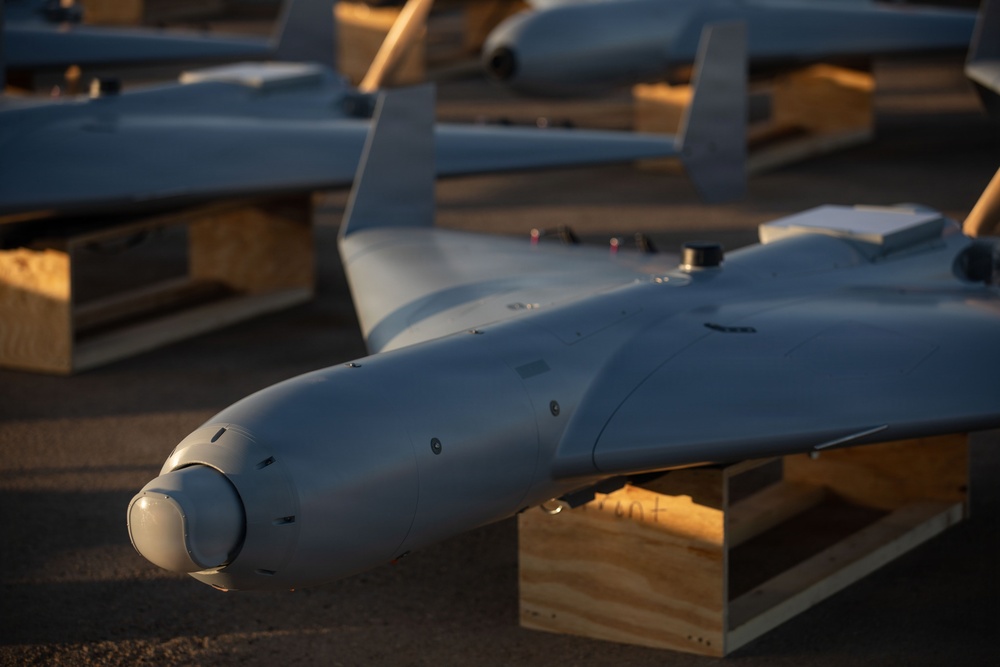
The Pentagon wants to find out whether airframes for cheap attack drones can be built close to where they will be used. The test case is Machina Labs, a California company that forms sheet metal with robots. It has an 18-month, $9 million award to show that its containerized RoboCraftsman cells can build metal airframes for LUCAS, a one-way-attack drone, in small "Edge Factories" that could eventually be set up at forward locations.
Bloomberg first reported the contract on Nov. 6, according to a summary published by Runtime Wire. On Nov. 9, Machina CEO Ed Mehr gave The War Zone (TWZ) a more detailed account of the program, covering what the cells can do, what an airframe might cost and what went wrong in early flight testing.
Where the money comes from
TWZ describes the award as coming from the Defense Department's Organic Industrial Base (OIB) Modernization Challenge. In August, America Makes and the National Center for Defense Manufacturing and Machining (NCDMM) announced the challenge's winners, sharing up to $15 million across six projects: Honeywell Aerospace, HRL Laboratories, Machina Labs, Accenture Federal Services, Stratasys and REM Surface Engineering. The challenge is funded by the Manufacturing Technology Office under the Office of the Under Secretary of War (OSW ManTech). The announcement listed Machina's project as edge factories for producing low-cost weapon systems.
America Makes Executive Director John Wilczynski framed the challenge as a way to accelerate the transition of proven technologies into the organic industrial base. Machina's project is a direct test of that idea. The question is whether a reprogrammable robotic factory can be shipped to where the government needs parts and produce them there.
What a RoboCraftsman cell actually is
Per TWZ, each RoboCraftsman cell covers 20 feet by 36 feet and weighs about 120,000 pounds fully installed. It folds and ships in two ISO containers. Inside, two robotic arms form the airframe out of metal, avoiding equipment such as dies and rolls. Payload weight, range and other requirements are entered into software designed by nTop, and the arms then shape the metal to the specification.
Removing the dies is the core of the pitch. In conventional sheet-metal production, changing a part design can mean building new tooling, which takes time and money. In a die-less cell, Mehr says, a design change is largely a matter of changing parameters in software. Runtime Wire's summary of Bloomberg describes the contract as an 18-month test of the idea that a factory should reprogram as fast as the product changes.
How fast, and how cheap?
Mehr told TWZ that each cell can make a LUCAS airframe in two to five days, depending on size. He estimated that a 12-foot airframe would cost "somewhere around $15,000 to $40,000," depending on complexity. TWZ notes that this range is relatively common for Russian Shahed-136 variants and U.S. knockoffs under the LUCAS program. Treat the range with caution. It is the CEO's own figure for a program that has not yet produced a full-scale airframe on contract.
Throughput matters as much as unit cost. At two to five days per airframe, a single cell running continuously would turn out roughly six to 15 airframes in a 30-day month. Under this contract each Edge Factory will have one or two cells, so the initial capacity is small. Mehr told TWZ the systems could make anything from a one-off to thousands of airframes, depending on how many RoboCraftsman systems are ordered, and that a deployment of 10 or more cells would come under a new contract.
What the plan covers, and what it doesn't
The contract calls for two initial Edge Factories in the continental United States, according to TWZ. The ultimate goal is to deploy them to forward locations, and Kuwait was named as an example. Moving to 10 or more cells would need a new contract. The $9 million covers a demonstration of the concept, not a production run.
Machina is also not working with SpektreWorks, the company that designed and made the LUCAS drones previously supplied to the U.S. military. SpektreWorks declined to comment to TWZ. This matters more than it might seem. Building an airframe for an existing weapon without the designer means Machina has to produce structures that match a design it does not own, and the reporting does not explain how configuration control, qualification or integration with the rest of the drone will be handled.
The crosswind problem
The program has already flown hardware, with mixed results. Machina built a six-foot, half-scale airframe and tested it at Edwards Air Force Base. Mehr told TWZ that the first design had challenges with crosswind mitigation and that the engine was moved slightly in response. He said going from one design to the next takes a couple of months, three at most.
Problems like this are normal in early flight testing, and fixing them is what test programs are for. The episode also shows a limit of the software-defined approach. A die-less cell can turn a revised design into metal quickly, but it cannot tell whether that design will fly well. Aerodynamic validation still takes flight testing, and the airframes in this program will need it like any other.
Machina's other work
The drone effort is one of several defense programs at Machina. In July the company received a qualification contract from Lockheed Martin to produce fuel tanks for the AGM-158 JASSM, according to TWZ. A media release at the time described a 200,000-square-foot facility designed to house up to 50 RoboCraftsman cells. That makes the Edge Factory concept one part of a broader strategy: large central plants for programs of record, plus small deployable cells for urgent, low-cost hardware.
Why It Matters
Low-cost one-way-attack drones are only cheap if they can be built in quantity, and the military's supply chains were designed around a few expensive platforms, not large numbers of disposable ones. The Edge Factory test asks whether some of that production can be moved out of centralized plants and into containers near the user, which could shorten supply lines and let designs change as quickly as requirements do.
The answer is not yet known. The program is small: $9 million, 18 months and two Edge Factories in the United States. Its main cost estimate comes from the vendor. Flight testing has already forced a design change, and the designer of the LUCAS drones supplied so far is not involved. If the cells reliably produce airworthy airframes at the claimed cost and pace, the result would support the case for distributed, software-driven defense manufacturing. If they don't, the program will still show the services how far container-sized manufacturing can go. In either case, a scaled deployment of 10 or more cells, at home or in places like Kuwait, will require a new contract.
Sources
- LUCAS Drones To Be Built In Containerized Robotic Micro Factories Designed To Be Forward Deployed (The War Zone, Nov. 9, 2026)
- America Makes Names Six Winners of $15M OIB Modernization Challenge (3D Printing Industry, Aug. 18, 2026)
- Pentagon gives Machina Labs $9M to try building LUCAS airframes in modular factories (Runtime Wire)
