
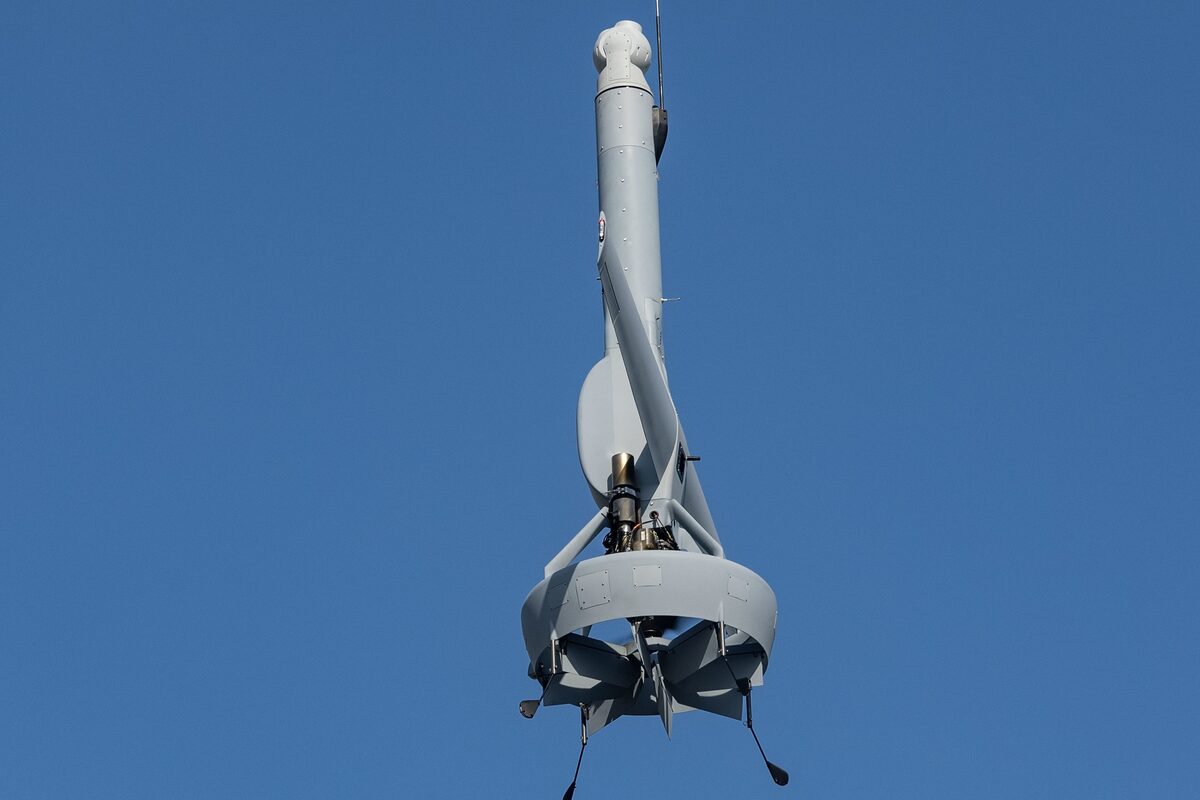
Somewhere in the long tail of 1990s fighter research sits a piece of hardware that logged 135 flight hours on an F-16 testbed, proved a point about thrust vectoring, and then went into storage for three decades. It is now back on a test stand in Peebles, Ohio, bolted to a GE Aerospace F110-GE-129E — and it is the single component that makes Shield AI's X-BAT concept physically possible.
On July 20, GE Aerospace and Shield AI announced that they had completed integration, actuation and engine light-off testing of the Axisymmetric Vectoring Exhaust Nozzle (AVEN) with the F110-GE-129E at GE's Peebles Test Operation — the first fully integrated AVEN test campaign since the original program more than three decades ago. An August 8 deep-dive from Interesting Engineering unpacked why a 1990s-era research nozzle is the linchpin of a 2026 autonomous fighter program, and the answer comes down to a control problem that no aerodynamic surface can solve.
The problem: flying where wings don't work
X-BAT is an AI-piloted VTOL fighter powered by Shield AI's Hivemind autonomy software, with a combat radius of 1,000 nautical miles. Its defining trick is taking off and landing vertically — "no airbase, no runway," in Shield AI's words — balancing on engine thrust so it can operate from ships, islands or remote sites without runways.
The catch is that during vertical takeoff, hover and landing, an aircraft has far less aerodynamic control authority. Elevons, rudders and flaperons generate control authority from airflow; in a hover, that airflow isn't there. As Interesting Engineering's explainer lays out, the remaining control effector is the engine exhaust itself. To keep a fighter-sized airframe balanced on a column of thrust, the propulsion system has to redirect that thrust in multiple directions, rapidly and precisely, in response to a continuous stream of stability commands. That is a thrust-vectoring problem — and specifically a multi-axis one.
What AVEN actually does
Earlier two-dimensional thrust-vectoring designs used relatively flat, rectangular nozzles that could redirect thrust primarily within a single plane. AVEN took the other path: it preserves the circular, axisymmetric exhaust flow of a conventional fighter nozzle while allowing the exhaust vector to be redirected in multiple directions.
That multi-directional capability was originally pursued to demonstrate enhanced maneuverability in forward flight — useful exactly where aerodynamic surfaces become less effective, at extreme attitudes and low speeds. The 2026 application is different but the physics are identical: a hovering X-BAT is, in control terms, an aircraft permanently parked at the low-speed, high-attitude edge of the envelope. Multi-axis vectoring is not an agility bonus there; it is the entire attitude-control system.
The receipts from the 1990s
What makes AVEN unusual among candidate solutions is that it isn't a paper design. Under the F-16 Multi-Axis Thrust Vectoring (MATV) program, the nozzle accumulated 73 hours of ground testing and 135 flight hours across 95 sorties on a modified F-16. The flight-test record is public: a 1994 NASA Technical Reports Server paper by Paul D. Anna and David S. Kidman of Lockheed Fort Worth, presented at NASA Dryden's Fourth High Alpha Conference, documents the envelope-expansion campaign — the test objectives and approach, the initial and revised flight control laws, the addition of nose chines, parameter-identification maneuvers, and extended-range angle-of-attack testing.
In other words, when Shield AI went looking for a way to vector the thrust of a full-scale fighter engine, there was already hardware that had done it in flight, with a NASA-archived data trail. GE and Shield AI's answer was not to redesign it but to retrieve the original AVEN hardware from storage, refurbish it, and return it to operation.
From storage shelf to light-off
The Peebles campaign took the refurbished nozzle through integration with the F110-GE-129E, actuation testing — cycling the vectoring mechanism through its commanded motions — and engine light-off. "The AVEN is what makes vertical flight possible on a platform this size and this capable," said Armor Harris, Shield AI's senior vice president of aircraft engineering, in the GE announcement, adding that vertical flight "requires fast gimbaling to maintain attitude control, a demand the original program never had to meet." GE Aerospace's Doogie Russell, vice president of Edison Works, framed the revival more broadly: "By combining our proven experience in developing propulsion systems with Shield AI's next-generation vehicle development, we are integrating the best of past, present, and future products to create a revolutionary aircraft."
Ground testing continues from here, building toward X-BAT flight testing later in 2026. And the 1990s hardware is a bridge, not the end state: per Interesting Engineering, future AVEN versions are expected to incorporate modern materials, modern guidance and control systems, and modern manufacturing techniques, with the refurbished original serving to retire integration risk now rather than wait on a clean-sheet nozzle.
Why It Matters
Runway dependence is the soft underbelly of modern airpower: a fighter that needs a long strip of concrete is a fighter that can be grounded by cratering that concrete. X-BAT's entire premise — a combat-relevant autonomous fighter that operates with no airbase and no runway, from ships, islands and remote sites — stands or falls on whether it can actually hover under control. The Peebles light-off is the first hard evidence that the enabling subsystem works as an integrated whole, not just as a line item in a briefing.
The episode is also a case study in a pattern worth watching across the defense-industrial base: mining validated, flight-proven legacy research instead of starting from zero. The MATV program answered the expensive questions — can an axisymmetric nozzle vector a fighter engine's thrust in flight, reliably, across 95 sorties? — thirty years ago, and NASA kept the paperwork. By reviving that hardware, Shield AI and GE converted three decades of shelf time into schedule: the risky new engineering can concentrate on autonomy, airframe and control laws while the nozzle rides on 1990s test credit. If X-BAT flies on schedule later this year, a good share of the credit will belong to a test team that finished its work before some of X-BAT's engineers were born.
Sources
- How a 1990s thrust-vectoring technology is helping X-BAT drone to take off vertically — Interesting Engineering (Aug 8, 2026)
- Shield AI and GE Aerospace Light Off X-BAT Engine — GE Aerospace press release (Jul 20, 2026)
- Flight test results of the F-16 aircraft modified with the axisymmetric vectoring exhaust nozzle — NASA NTRS (Jul 1, 1994)
