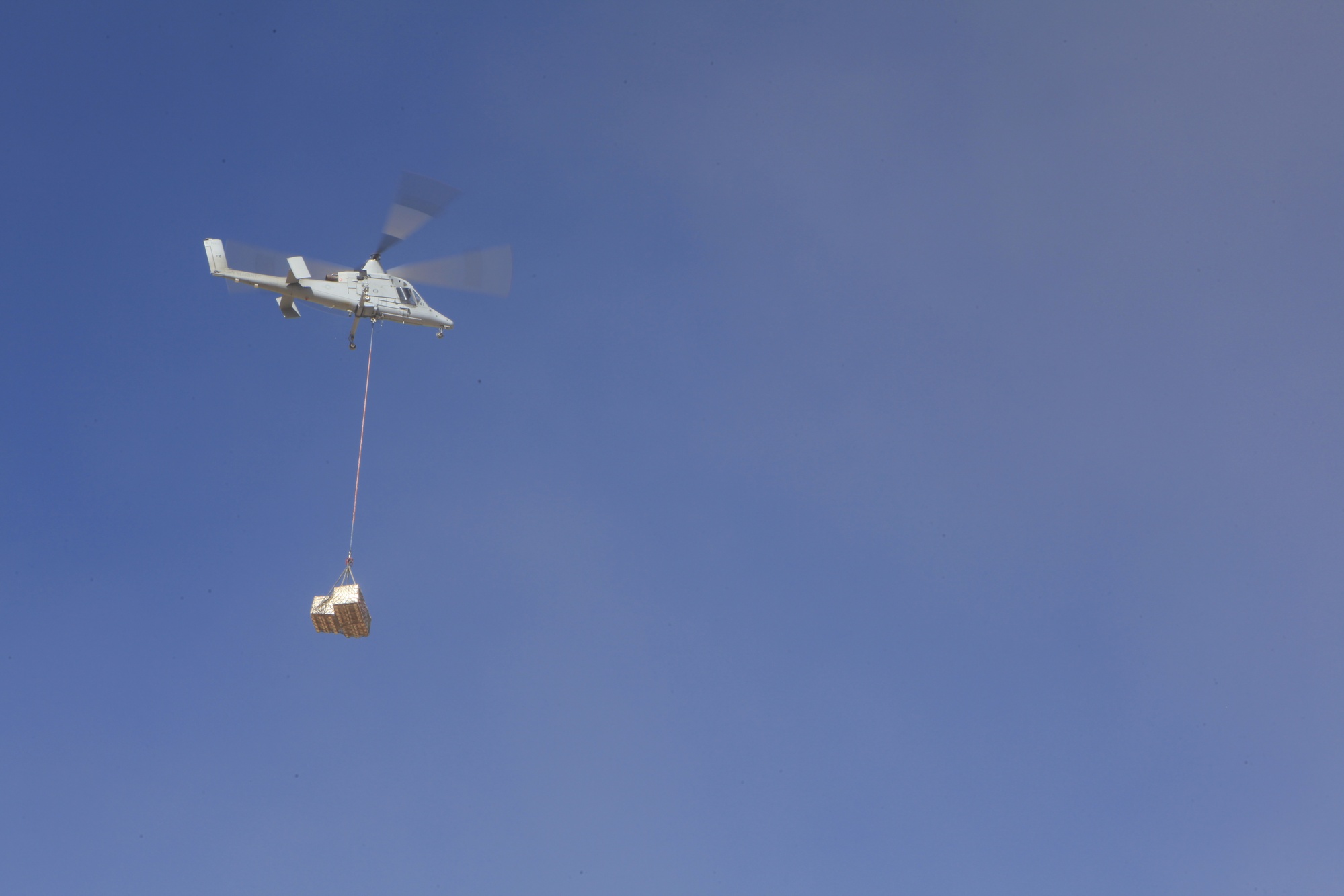
When DARPA set out to find the next generation of heavy-lift unmanned aircraft, it got an answer that would have been familiar to Igor Sikorsky. At the agency's Lift Challenge, held August 4-9 at the National Museum of the U.S. Air Force in Dayton, Ohio, the winning design wasn't a compound multirotor, a tilt-wing hybrid, or any of the other exotic configurations that dominated the field of entrants. It was a conventional single-rotor helicopter — a design pattern that has existed in essentially the same form since the 1940s.
AVIDrone Inc., a Columbia, Maryland-based company, took first place and the top prize of $1.25 million with its aircraft, nicknamed "Katana." The numbers behind the win are the real story: a helicopter weighing just 13.3 kg lifted 51 kg of cast iron ballast, a payload-to-weight ratio of 3.84:1. That means the Katana carried nearly four times its own airframe weight off the ground — a benchmark that outperformed a field of more than 70 competing teams, many of them fielding far more exotic hardware.
How the Competition Ran
The scale of the Lift Challenge was substantial. DARPA received 489 applications, and 225 teams met the technical benchmarks required to advance. From that pool, 132 teams were invited to compete, and more than 70 teams ultimately competed over the six-day event window at the Dayton air museum, which produced 70 official runs.
The scoring core was straightforward: how much cast iron ballast could a given aircraft lift relative to its own empty weight. DARPA had set a stretch target of a 4:1 payload-to-weight ratio — meaning an aircraft that could lift four times its own weight off the ground. No team reached that mark. AVIDrone's 3.84:1 finish was the closest anyone got.
Because the field fell short of the 4:1 target, DARPA cut every podium prize in half. AVIDrone's winnings dropped from a possible $2.5 million to $1.25 million. Second place went to MTech Operations, which posted a 3.64:1 ratio for a reduced $750,000, while Xtreme Aerial Concepts took third at 3.45:1 for $500,000 — also halved from its original purse.
Beyond the top-three payload rankings, DARPA also recognized three teams in subjective categories: the University of Maryland's AMAV Team, Portal Aircraft Company, and DefendTex. DefendTex's entry is worth flagging on its own merits — it reportedly achieved a 9.63:1 payload-to-weight ratio, far surpassing even AVIDrone's winning number, though that result apparently fell under a different judging category than the main ranked competition rather than displacing AVIDrone atop the primary leaderboard.
Why a 1940s Design Won
The result caught attention specifically because of what didn't win. Heavy-lift UAS development in recent years has trended toward multirotor and compound configurations — designs that split lift and thrust across multiple rotors or add fixed-wing elements to a rotorcraft base, chasing efficiency gains that a single main rotor supposedly can't match at small scale. DroneXL's coverage of the results specifically flagged AVIDrone's Katana as an unusual winner in a field that skewed toward those more exotic architectures, noting that single-rotor machines ultimately claimed two of the three podium spots.
That a conventional single-rotor helicopter beat that field on raw lift efficiency is a data point the rotorcraft engineering community will be picking apart for a while. It suggests that at the payload-to-weight ratios DARPA was probing, the aerodynamic and mechanical simplicity of a traditional design may still outperform the added complexity of distributed-lift or hybrid configurations — at least at the scale and configuration constraints this competition imposed.
DARPA's Framing
Despite no team clearing the 4:1 stretch goal, DARPA characterized the event as a success. Program Manager Phillip "Donna" Smith was quoted in the agency's results announcement: "This competition was the catalyst, but the innovation it sparked is now yours to unleash." Smith also noted that "even though we didn't hit it in an official score, we saw the path at this competition." The framing suggests DARPA views the Lift Challenge less as a single procurement decision and more as a way to seed a wider field of heavy-lift UAS development — with the halved prizes serving as a reminder that the agency's actual target remains ahead of where the field currently sits.
Aviation Week's coverage of the event characterized it as resetting the payload-to-weight benchmark for the drone industry broadly, suggesting the numbers posted at Dayton could serve as a new baseline for how future vertical-lift UAS designs are measured.
Why It Matters
Heavy lift is one of the most persistent bottlenecks in military unmanned aviation. Moving fuel, ammunition, water, and equipment to forward positions without exposing ground vehicles or manned aircraft to risk has been a standing requirement across multiple services for years, and payload-to-weight efficiency is the central constraint on how useful any given unmanned lift platform can be. A drone that can only carry a fraction of its own weight is a novelty; one that can carry multiples of its own weight starts to look like a genuine logistics tool.
The Lift Challenge results matter for two reasons. First, they establish a concrete, competition-verified performance ceiling — 3.84:1 — that the current state of the art can hit under real judged conditions, not marketing claims. Second, and more surprising, they suggest the industry's assumption that exotic multirotor and compound designs are the future of heavy-lift UAS may be premature. A 13.3 kg conventional helicopter outlifting a field of more than 70 competitors, many fielding more novel airframes, is a signal that DARPA's own halved-prize verdict makes explicit: the 4:1 target the agency wanted is still out of reach, and the path to it may run back through decades-old rotorcraft fundamentals rather than around them.