
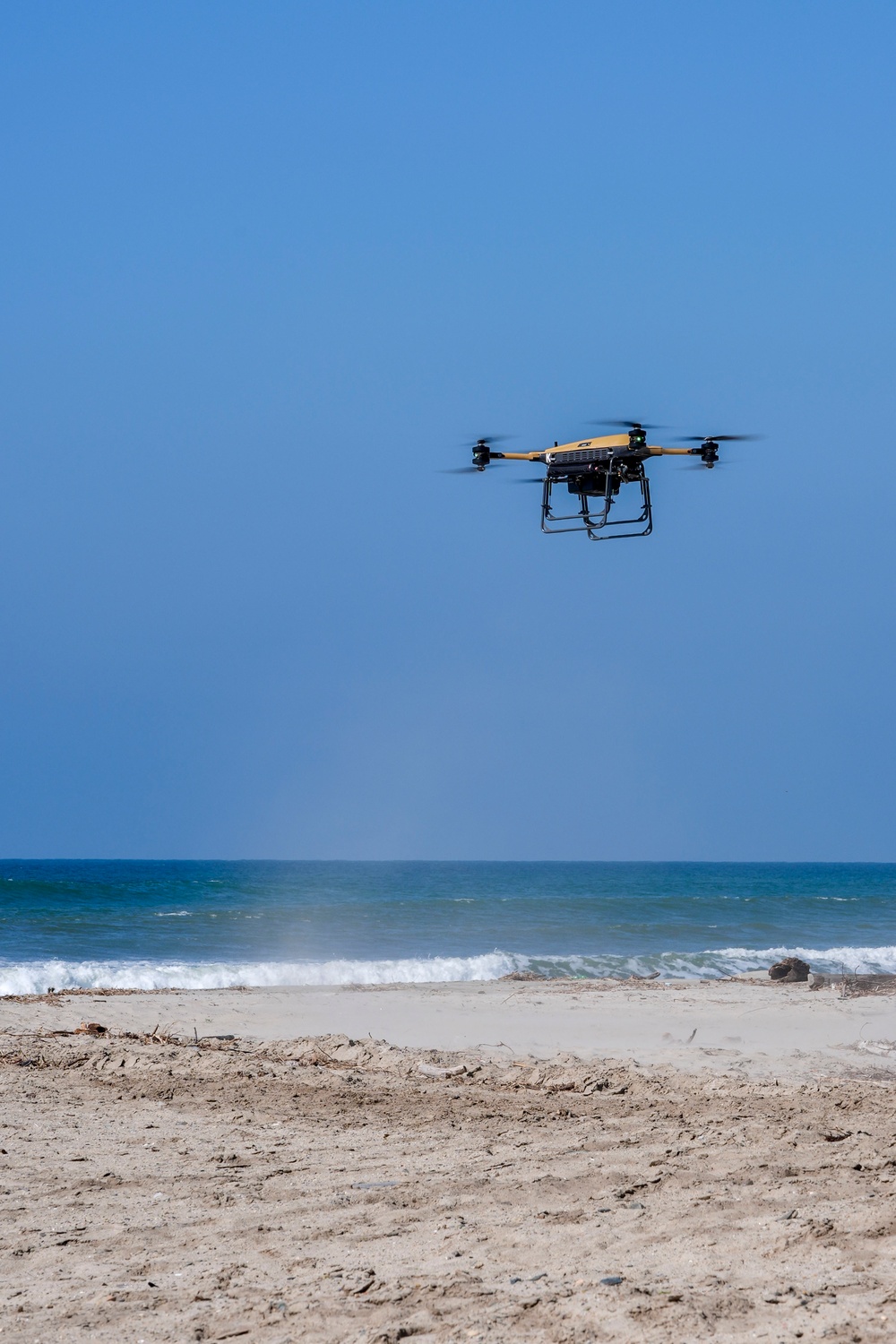
DARPA set out to quadruple how much a small drone can carry relative to its own weight. When the agency's Lift Challenge wrapped up this month at the National Museum of the U.S. Air Force in Dayton, Ohio, the winning team came close — but not quite close enough to claim the full mark.
Avidrone's entry topped the field with a payload-to-weight ratio of 3.84:1, according to Aviation Week. That's a substantial leap over conventional small unmanned aircraft, but it falls just short of the fourfold increase DARPA had challenged competitors to hit.
The event drew a large and varied field. Aviation Week put the count at more than 70 teams, while the University of Nevada, Reno — home to one of the competing squads — cited a figure of 124 teams in coverage published ahead of the event. The discrepancy likely reflects different counting points in the competition's lifecycle, from initial registration down to teams that actually made it to Dayton for the flight phase. Regardless of the exact number, the turnout speaks to how much interest DARPA's payload-efficiency problem generated across university labs, small aerospace firms, and hobbyist-adjacent engineering teams.
Dates for the event also varied slightly by account: Aviation Week reported the competition ran August 4-9, 2026, UNR's pre-event coverage listed August 2-9, and the Dayton Daily News, reporting from the ground, described a four-day contest running roughly August 6-9. Together, the sources point to a Dayton-area event that spanned the better part of a week in early August, with a multi-day flight-testing window layered on top of setup and qualification.
What the Challenge Actually Tested
The Lift Challenge wasn't a simple bench test of thrust versus weight. According to UNR's account of its own team's preparation, the flight evaluation required aircraft to fly a 1,000-foot autonomous course back and forth 15 times — a repeated-cycle endurance and control test rather than a single static lift, meant to prove that a heavily loaded airframe could still fly a precise, autonomous route reliably rather than just hover under strain for a few seconds.
UNR's own entrant, a six-arm, twelve-propeller aircraft called TITAN built from carbon fiber and aluminum, weighed in under 55 pounds and generated 444 pounds of thrust, translating to a 3.27:1 payload-to-weight ratio. The project was advised by electrical engineering associate professor Hao Xu and funded with roughly $50,000 from the Bean Space Foundation and the Department of Defense's CREDIT+ Center.
Other entrants pushed toward the extreme end of the design space. The Dayton Daily News reported on a competitor called Dreamcatcher, a 30.8-pound aircraft engineered to lift more than 220 pounds — a ratio that, if achieved in competition, would represent roughly a 7:1 payload-to-weight performance, well beyond DARPA's own 4x target. The Dayton Daily News account did not specify whether Dreamcatcher's flight results matched that design intent, only that the aircraft was built with that lift capability in mind.
A Rough Week at Wright-Patterson
The competition took place at the National Museum of the U.S. Air Force on the grounds of Wright-Patterson Air Force Base, with the Dayton Daily News noting the event was staged near Gate 28B and open to public viewing across its multi-day run.
It was not a clean week for the field. The Dayton Daily News reported multiple crashes on the first day of flight testing alone, including one aircraft that caught fire. DARPA program manager Phillip Smith told the paper the challenge had drawn interest well beyond the drone-engineering community — he described a local fire department reaching out to say the technology was "exactly what we need" to carry water, tools, or other equipment into remote environments. A DARPA spokeswoman quoted separately in the same coverage said she had watched a drone lift nearly four times its own weight during the event, calling the moment a "gamechanger."
The Prize Pool and the Field
Both the Dayton Daily News and UNR's coverage put the total prize pool at more than $6.5 million, distributed across the competition's various placements and categories. Neither source broke out the exact dollar amount that went to Avidrone for the top finish, but the scale of the purse underscores how much DARPA was willing to invest in pushing payload-carrying efficiency for small aircraft — a capability with obvious relevance to logistics, resupply, and casualty-evacuation missions where every pound of lift-to-weight improvement extends what a small drone can carry into or out of a contested area.
Why It Matters
Payload-to-weight ratio is one of the most stubborn constraints in small unmanned aircraft design. Rotors, motors, and batteries all add mass, and every additional pound of lift capacity typically comes at the cost of proportionally more structure and power system — a scaling problem that has kept small multirotor and helicopter drones well below the lift efficiency of larger, fixed-wing or crewed aircraft. DARPA's fourfold target was meant to force a break from that curve rather than an incremental gain.
Avidrone's 3.84:1 result suggests DARPA's fourfold target is within reach through near-term engineering refinement rather than requiring an entirely new class of airframe. That the winning margin came in this close — 3.84 against a 4.0 goal — is notable given the range of approaches in the field, from UNR's twelve-propeller TITAN posting a 3.27:1 ratio to designs like Dreamcatcher engineered toward an even higher lift target.
For the Pentagon, a small drone that can reliably carry three to four times its own weight over an autonomous multi-mile route has direct applications in contested logistics: moving medical supplies, ammunition, or equipment into forward positions without risking a crewed aircraft or a larger, more detectable platform. The narrow gap between Avidrone's 3.84:1 result and DARPA's 4.0x goal is likely to be treated by the agency as validation that the target is achievable — and a marker for where the next round of funding and competition will aim.
