
"Mothership" has become one of the most overworked words in defense reporting, applied to everything from a Chinese jet the size of an airliner to a Ukrainian speedboat to a shipping container parked at a rail yard. That looseness obscures something real: a genuine, cross-domain shift in how militaries deliver weapons. Instead of one expensive platform doing the whole job, forces increasingly build one platform to get close and a swarm of cheap, semi-expendable platforms to finish it. The pattern is showing up in the air, at sea, underwater, and now — with less fanfare but growing urgency — on the ground. This piece maps that landscape: what has already been demonstrated in each domain, what is new in recent months, and why the underlying logic is the same regardless of domain.
The Air Domain: Stacking Range from Altitude
Air-launched effects are the most mature branch of the mothership concept, and UASFeed has already covered the major programs in depth: DARPA's Gremlins recoverable drone, the US Army's layered Air-Launched Effects ecosystem running from Apache-launched Eaglets to the stratospheric HADES system aboard a Bombardier jet, and China's newly flown Jiutian mothership, which debuted in December 2025 with a payload bay built to release swarms mid-flight. A full breakdown of those programs is available here; this piece will not re-tread that ground except to use it as the baseline case study for the comparison below.
The Sea Domain: Kamikaze Boats, Robot Subs, and a New Navy Marketplace
UASFeed has separately covered how Ukraine's Security Service converted its Sea Baby unmanned surface vessel from a one-way explosive boat into a genuine mothership — carrying six to eight FPV drones and thermobaric rockets hundreds of miles offshore before launching them at close range, a conversion credited with helping push Russia's Black Sea Fleet back to Novorossiysk and with an underwater variant that reportedly disabled a docked Kilo-class submarine. That reporting is here for the full account.
The concept is not confined to Ukraine's improvised wartime engineering. The US Navy has three parallel efforts underway that reflect the same mothership logic applied to a much larger, better-funded fleet. The most literal is underwater: in March 2026 the Navy selected Anduril's Dive-XL, an extra-large uncrewed undersea vehicle built under the Combat Autonomous Maritime Platform effort, to serve as a submerged mothership for smaller autonomous systems. Dive-XL is a 27-foot, free-flooding hull rated to 20,000 feet of depth with roughly 2,000 nautical miles of range, and it is designed to deploy smaller vehicles — including the Copperhead AUV and the Seabed Sentry seabed-monitoring robot — plus torpedoes, from swappable payload modules. Unlike a pressure-hulled submarine, its modular construction is explicitly built for lower cost and faster manufacturing, the same expendability logic driving air and ground programs.
Separately, shipbuilder NASSCO has pitched the Navy on converting its Expeditionary Sea Base vessels — large, flat-decked ships already supporting Marine and special operations missions — into dedicated drone motherships, using a Rotary UUV Launch and Recovery System to clandestinely launch and recover larger underwater drones such as Boeing's Orca, plus a dedicated aft flight deck for uninterrupted UAV operations. Future ESBs under construction through 2027 are the leading candidates if the Navy adopts the plan.
The third piece is administrative rather than technical, but consequential: in March 2026 the Navy opened a new acquisition "marketplace" for Medium Unmanned Surface Vessels, moving away from bespoke, single-purpose drone-boat prototyping toward mature, already-flying designs that can move straight into production. The effort — tied to a broader "Golden Fleet" concept pairing unmanned vessels with next-generation surface combatants — set an April 2026 proposal deadline and on-water testing through the summer, with first production deliveries targeted for fiscal year 2027. Taken together, the undersea mothership, the surface-ship conversion pitch, and the acquisition reform point toward a Navy trying to institutionalize, at fleet scale, an approach Ukraine has already proven works with a few hundred thousand dollars and a fiberglass hull.
The Ground Domain: Robots That Carry Robots
The newest and least-covered branch of the mothership concept runs on tracks and wheels. UASFeed has reported on KNDS's Drone Launch Container, the ISO-container-based swarm launcher unveiled at Eurosatory in June 2026 that pairs Helsing HX-2 loitering munitions with Tytan METIS interceptors in a single self-contained box disguised as ordinary freight; that system is detailed here. KNDS was not alone at that show, and the broader ground-launch category extends well beyond containers into vehicles proper.
Ground-Vehicle-Launched Systems
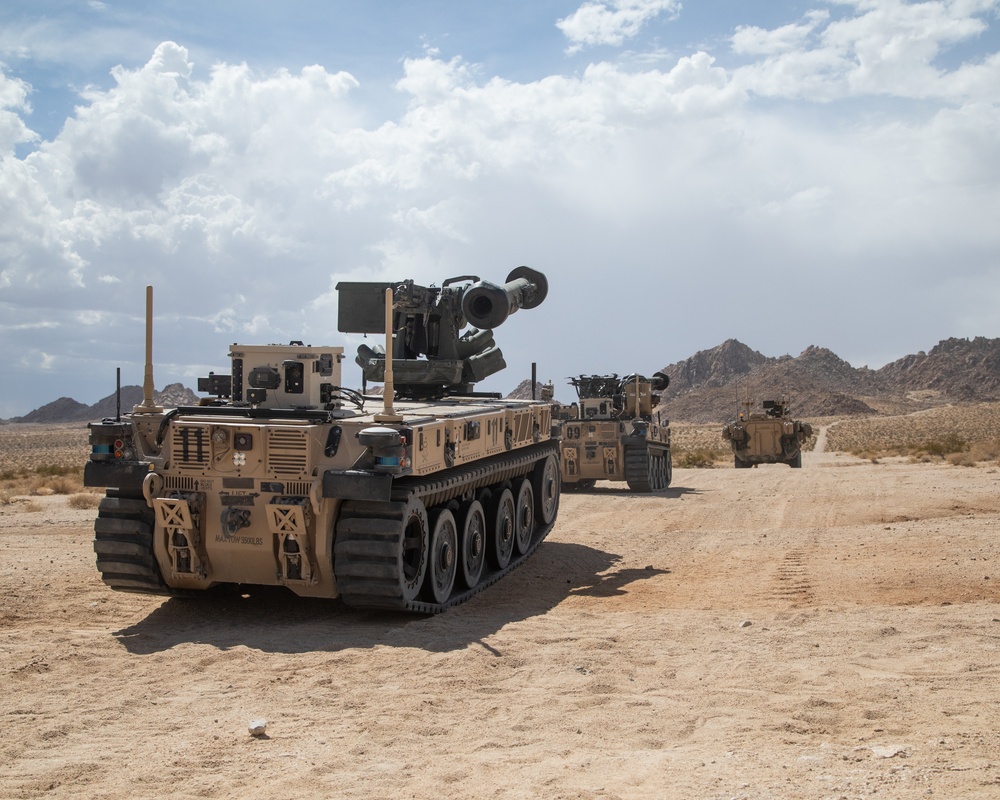
The clearest illustration of the concept sits inside the US Army's long-running Robotic Combat Vehicle (RCV) program, tracked by the Congressional Research Service since 2021 as part of the Army's Next Generation Combat Vehicle family. The RCV was originally conceived as three variants — Light, Medium, and Heavy — meant to scout and screen ahead of manned formations while remaining expendable enough to lose in combat; per the most recent CRS update, the Army has since consolidated the effort around a single common chassis built primarily from the medium-class concept, still short of a formal acquisition decision. General Dynamics Land Systems' entrant, the Tracked Robot 10-Ton (TRX), shows how far the drone-carrier idea can go: at AUSA in 2021 the company displayed a TRX variant bristling with 50 AeroVironment Switchblade loitering munitions across four launch-tube arrays — 26 larger Switchblade 600s for anti-armor strikes and 24 smaller Switchblade 300s — turning a 10-ton unmanned chassis into a mobile loitering-munition magazine. GDLS kept iterating: at AUSA 2025 it paired the TRX chassis with Epirus's Leonidas high-power microwave system to counter incoming drone swarms, and separately partnered with AeroVironment on PERCH, a Switchblade launcher mounted directly on an M1A2 Abrams tank, extending the same logic onto a crewed vehicle.
Europe is moving in parallel. At Eurosatory 2026, Renault Group and Thales unveiled 4 TROOP, a hybrid 4x4 tactical vehicle built on Renault's commercial VCMR platform and fitted with Thales's Combat Digital Platform for jam-resistant connectivity. Renault engineering VP Franck Naro called it "an agile, resilient capability that can be mobilised immediately," while Thales EVP Christophe Salomon said it "transforms tactical data into actionable understanding of the environment to anticipate developments, decide and act with greater agility." Unlike the KNDS or Rheinmetall containers, 4 TROOP is not a munitions magazine — it is a command-and-control mothership built to deploy and coordinate aerial and ground drones from a vehicle that looks, from a distance, like an unremarkable SUV. Rheinmetall showed a more conventional option at the same event: a 20-foot container holding 18 FV-014 loitering munitions, each with 100 km of range, 70 minutes of endurance, and a 4-kilogram warhead, ejected by rocket-assisted launch and towable to the front by ordinary truck. Germany has already committed roughly €300 million to the FV-014 under an April 2026 contract, putting Rheinmetall ahead of KNDS's still-unfunded prototype in production terms.
Ukraine, characteristically, has fielded a scrappier version of the same idea under fire. Ukrainian firm Temerland's Gnom-DC, reported in March 2026, is a mobile ground robot with a hybrid wheel-and-track chassis that functions as a forward base station for FPV drones, letting operators launch strikes deep behind Russian lines while staying physically removed from the front. It is the ground-domain equivalent of Sea Baby: an inexpensive, attritable carrier whose entire value proposition is getting a short-range weapon within range of a target its operators could never safely approach directly.
China has pursued the concept at the largest scale of any ground program disclosed so far. Its Atlas swarm system, built around a wheeled vehicle called Swarm-2 that first appeared publicly at Airshow China in 2024 and was demonstrated in a full operational sequence in March 2026, can carry and launch 48 fixed-wing drones from a single vehicle, with a companion command vehicle capable of controlling up to 96 drones simultaneously at three-second launch intervals. The demonstrated sequencing — reconnaissance drones first, then electronic-warfare drones to suppress air defenses, then strike drones — shows a ground-launched system designed to run an entire find-fix-strike chain autonomously from a vehicle that never needs to leave friendly territory.
Why It Matters
Strip away the domain-specific hardware and every mothership program is solving the same equation. A crewed aircraft, a warship, a submarine, or a manned combat vehicle is expensive to build, expensive to crew, and catastrophic to lose — so it stays outside the range of enemy defenses. A small drone or loitering munition is cheap enough to risk, sometimes cheap enough to lose in bulk, so it goes into the defended zone instead. The mothership's own range or standoff distance stacks on top of the sub-drone's shorter range, extending the effective reach of the whole system well beyond what either platform could achieve alone — that is the arithmetic behind HADES launching effects from above 41,000 feet, Sea Baby launching FPVs 930 miles offshore, and a TRX chassis launching Switchblades from a position no infantry unit would risk occupying.
The cost asymmetry compounds the range advantage. A Sea Baby costs a few hundred thousand dollars against a warship worth hundreds of millions; a Switchblade 300 costs a small fraction of the Abrams tank that might launch it under the PERCH concept; KNDS and Rheinmetall's containers are built explicitly to be indistinguishable from ordinary freight, trading a warship's or aircraft's inherent signature for near-total concealment. In every domain, the defender is forced into a losing trade: intercepting a $50,000 drone with a $500,000 missile, or diverting scarce air-defense radar time to track a dozen simultaneous low-value targets while a single high-value mothership sits safely out of engagement range. Air defenses, point-defense naval systems, and ground-based counter-drone networks were all built to defeat a small number of expensive threats, not a large number of cheap ones arriving from a direction the defender cannot economically cover.
What differs across domains is the physics of launch and recovery, which shapes the architecture each service bets on. Air-launched systems like Gremlins chase reusability because altitude and airspeed are expensive to regenerate — a recovered drone saves an entire flight profile, which is why DARPA spent years solving the docking problem rather than accepting attrition. Maritime systems split the difference: Sea Baby's FPVs are expendable, but the boat carrying them is reusable, while the Navy's ESB and Dive-XL concepts lean toward recoverable, multi-mission carriers precisely because a submarine-hull-class asset is too costly to treat as attritable. Ground systems are the most expendable-forward of the three: a TRX, a Gnom-DC, or a KNDS container is built assuming the launched effector never comes back, and in the container systems especially, the launch platform itself is cheap and camouflaged enough that losing it is tolerable too. Payload capacity follows the same logic in reverse: China's Swarm-2 vehicle carries 48 airframes because a ground chassis has volume and weight budget an aircraft wing station does not, while HADES is limited to a handful of larger effects because every kilogram has to fly at over 400 knots for seven hours.
None of these architectures is complete yet. The RCV program still has no formal acquisition decision after five years of prototyping; KNDS's container has no price or production contract; the Navy's MUSV marketplace only opened for proposals in March 2026. But the direction across all three domains is unmistakable and mutually reinforcing: expensive platforms are being redesigned to stay out of the fight, and the fight itself is increasingly being fought by whatever they carry.
Sources
- Congressional Research Service — The Army's Robotic Combat Vehicle (RCV) Program
- The War Zone — New Tracked Unmanned Vehicle Bristles With A Whopping 50 Switchblade Suicide Drones
- Breaking Defense — GDLS to Roll Out Drone-Killer Robot, Tank-Launched Switchblades, More at AUSA (October 2025)
- Renault Group — Eurosatory 2026: Renault Group and Thales Unveil 4 TROOP
- Defense News — Rheinmetall Pitches Shipping Container That Can Spit Out Swarms of Attack Drones (June 2026)
- The Defense Post — Ukraine Introduces Ground-Based Drone Mothership (March 2026)
- Army Recognition — China's New Atlas Drone Swarm System Demonstrates How Algorithm-Driven Warfare Becomes Operational (March 2026)
- New Atlas — US Navy Picks Robot Sub 'Mothership' to Unleash Underwater Drone Swarms (March 2026)
- The War Zone — Navy's Huge Expeditionary Sea Bases Could Become Drone Motherships
- DefenseScoop — Navy Creating New Marketplace for Maritime Drones as It Looks to 'Surge Capacity' for Golden Fleet (March 2026)
