
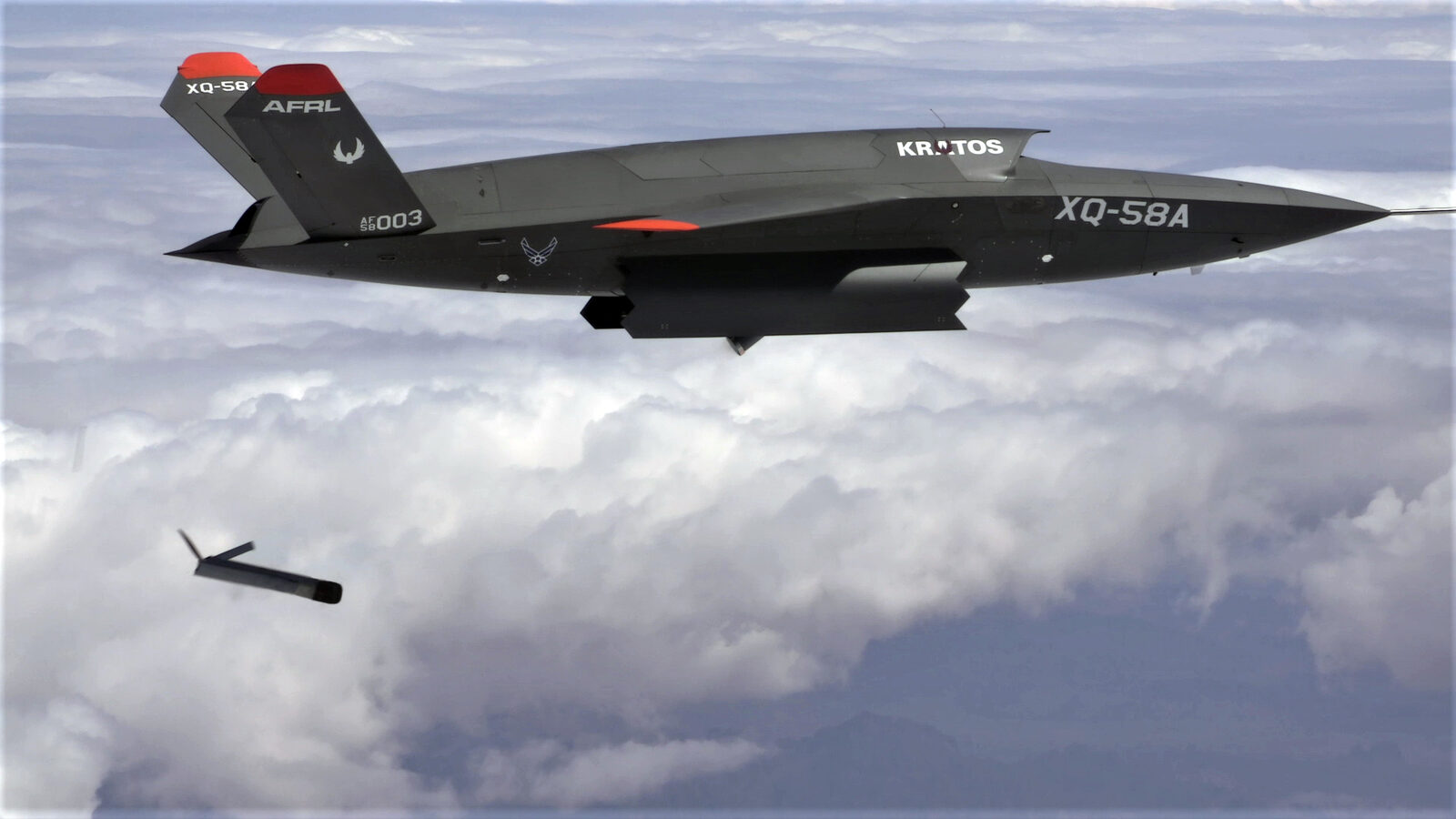
The fundamental arithmetic of air-launched effects is seductive in its simplicity: put a drone aboard a crewed or uncrewed aircraft, fly that aircraft as close to the threat as it can safely go, then release a smaller platform that travels the rest of the distance. The mothership's range stacks on top of the sub-drone's own range. The mothership never enters the defended zone. The sub-drone, cheap enough to risk and potentially expendable, does. That equation is driving one of the more consequential structural changes in airpower doctrine since the cruise missile.
DARPA's Gremlins: Proving the Recovery Problem
The foundational engineering challenge in any reusable air-launched drone program is not the launch — dropping something out of an aircraft is straightforward — but the recovery. DARPA's Gremlins program, built around the X-61 Gremlin Air Vehicle (GAV) developed by Dynetics (now a Leidos subsidiary) under a 2018 contract worth $32 million, was conceived specifically to crack that problem. The vision was a drone that could be deployed in swarms from bombers, cargo planes, or fighters, complete its mission, then return to a mothership, dock, be refurbished, and fly again — targeting a 20-flight service life per airframe.
For most of 2020, the recovery mechanism defeated them. Nine retrieval attempts during October of that year all ended with Gremlins parachuting safely to the ground, autonomy unable to complete the final docking sequence. Then, on October 29, 2021, at Dugway Proving Ground in Utah, one X-61A finally flew formation behind a C-130 cargo aircraft, autonomously docked with a bullet-shaped port lowered on a tether, folded its wings into its body, and was retrieved by a mechanized arm and stowed inside the aircraft. The recovered drone was refurbished and reflown within 24 working hours.
"This recovery was the culmination of years of hard work and demonstrates the feasibility of safe, reliable airborne recovery." — Lt. Col. Paul Calhoun, Gremlins program manager, DARPA
The success was partial. One X-61A was destroyed during the first of four October 2021 test flights due to an unexpected power system failure before parachute deployment. But the core architecture had been validated. Tim Keeter, Dynetics program manager, was blunt about the significance: "That one airborne recovery is the biggest hump to get over." Post-recovery, drones were planned to fly in formation behind the mothership — in the words of Gremlins avionics lead Morgan Kim — "like ducks behind their mother" before autonomous docking. The next milestone called for recovering four drones within 30 minutes at an operationally relevant rate, Each X-61A was designed to carry a 68-kilogram payload.
The Army's ALE Ecosystem: From Apache to Stratosphere
While DARPA was demonstrating recoverable drones from cargo aircraft, the US Army was building out a broader air-launched effects program with a different emphasis: not reuse, but saturation and survivability across a layered platform stack. Initiated approximately two years before May 2022, the Army ALE program set out to develop smaller drones deployable from larger aircraft in networked swarms, specifically designed for operation inside integrated air defense system (IADS)-dense environments where crewed platforms cannot safely loiter.
The hardware executing this concept spans a wide range of form factors and launch platforms. General Atomics Aeronautical Systems developed the Eaglet for the program: a sub-200-pound drone with pop-out wings spanning 10.5 feet, a maximum airspeed of 115 knots, a service ceiling of 15,000 feet, approximately 700 km of range or eight hours of endurance, and 20–30 pounds of payload capacity. Its low-observable design — flush exhaust port, chined fuselage, sloped sides, V-tail — is not incidental. Eaglet is designed to operate from MQ-1C Gray Eagle ER and MQ-9 Reaper UAVs, keeping those motherships at safe standoff distances while the sub-drone penetrates defended airspace. "It's a survivable, air-launched effect (ALE) designed for use with the MQ-1C Gray Eagle ER or MQ-9 Reaper," said C. Mark Brinkley, Senior Director of Strategic Communications at General Atomics Aeronautical Systems. The missions on offer include multispectral sensing, electronic warfare, kinetic strike, and threat disruption.
At the rotary-wing end of the stack, March 5, 2026 brought a significant demonstration at Yuma Proving Ground, Arizona: the Army launched an ALE drone from an AH-64E Apache helicopter during the Cross Domain Fires 26 (CFWE26) Concept Focused Warfighting Experiment, conducted by Army Futures Command and DEVCOM. Apache-launched effects extend the helicopter's strike and reconnaissance range while keeping the aircraft outside threat envelopes — prior demonstrations have featured the Altius-700 family, developed by Area-I, now an Anduril Industries subsidiary.
The Altius line extends to the Altius-600, a fixed-wing, tube-launched UAV compatible with C-130, P-3 Orion, AC-130J, UH-60, ground vehicles, and sea-based platforms. The ALTIUS-600M variant carries a high-explosive or shaped-charge warhead for loitering munition missions.
At the high end of the altitude stack sits HADES — the High Accuracy Detection and Exploitation System — which received its first unit in November. HADES operates launched effects from a Bombardier Global 6500 executive jet flying above 41,000 feet at speeds exceeding 400 knots, sustaining more than seven hours of endurance while enduring air temperatures as low to -65°F (-54°C). Larger ALE drones from the HADES platform reach up to 650 km with an hour of endurance; smaller drones cover approximately 150 km. Andrew Evans, Army ISR Task Force director, described the cascading effect: "These drones would extend the reach and capabilities of the HADES system, increasing its operational effectiveness."
The Army is simultaneously exploring even higher-altitude launch platforms, including balloons and solar-powered stratospheric fixed-wing aircraft. For medium-range ALE, the Army selected Anduril's Altius 700 platform as air vehicle, Collins Aerospace/Raytheon Technologies for the mission system, and Aurora Flight Sciences as system integrator. The Army is seeking 200–600 fieldable medium-range prototypes at a $100–200 million funding level, with contract award expected October 2026 and deliveries running through September 2031. For short-range capability, AEVEX's Atlas Precision Strike System was selected.
Why IADS Can't Simply Track Its Way Out
The tactical logic of air-launched effects goes beyond range extension. ALEs fundamentally complicate the calculus of integrated air defense by presenting the defending system with a dilemma it cannot efficiently solve. A swarm of inbound drones can include platforms performing deception (false radar returns to simulate a larger attacking force), electronic attack (jamming the defender's sensors and communications), and kinetic strike — simultaneously. The defending IADS must allocate intercept resources across a volume of simultaneous targets that may exceed its engagement capacity, while some of those targets are actively degrading the sensors it depends on to track the rest.
Air-launch amplifies this problem. A drone launched from a platform at 41,000 feet and 400 knots arrives in the defended zone with both altitude and energy already banked. The mothership — whether a Global 6500, a C-130, or an MQ-9 — never enters the zone at all, so the defender cannot eliminate the threat by engaging the launch platform without first extending its own reach to match. The range-stacking effect is a force multiplier specifically against layered defense architecture.
China's Jiutian: The Concept at Scale
If the US programs represent methodical doctrinal development, China's Jiutian drone mothership represents a statement of intent at a different order of magnitude. Developed by the Aviation Industry Corporation of China (AVIC), Jiutian made its first flight on December 11, 2025, from Pucheng County, Shaanxi Province. Its specifications are striking: 16.35 meters long, 25-meter wingspan, 16 metric tons maximum takeoff weight, 6,000 kg of payload capacity, 7,000 km of range, up to 12 hours of endurance, a 15,000-meter (49,200-foot) service ceiling, and a speed envelope of 108–378 knots from a single dorsal-mounted jet engine.
The Jiutian's modular swarm-launch payload bay enables drone swarm launch via side-hinged doors. Concept videos released alongside the aircraft's debut depict hundreds of coordinated attack drones released mid-flight, including sequences showing swarms overwhelming US Navy carrier strike groups. The aircraft can also carry eight pylons loaded with PL-12 radar-guided air-to-air missiles, TL-17 land-attack cruise missiles, PL-15 air-to-air missiles, and precision-guided bombs — making it a strike platform in its own right, not merely a drone tender.
Taken together, the US ALE program and China's Jiutian trace the same underlying logic toward the same destination: an airpower architecture in which the platform bearing the pilot, or bearing the most expensive sensors, stays outside the threat ring while forward-deployed, expendable or semi-expendable systems do the close-in work. The technology to make that architecture function — reliable mid-air recovery, autonomous formation flying, tube-launch compatibility across diverse host platforms — has progressed from theoretical to demonstrated. The question facing air defense planners worldwide is no longer whether air-launched effects will be operationally significant, but how fast they will scale.
Sources
- The War Zone — Eaglet Air-Launched Drone Aims to Help Its Mothership Survive in Army Tests (May 2022)
- Defense News — DARPA Nabs Gremlin Drone in Midair for First Time (November 5, 2021)
- Breaking Defense — A Mothership Finally Recovers DARPA's Gremlins Drone, But It's Not All Good News (November 2021)
- Aerospace America (AIAA) — After One Gremlin Airborne Recovery, DARPA Plans for More (November 2021)
- The War Zone — China's High-Flying Swarm Mothership Drone Has Flown (December 2025)
- The Aviationist — China Jiutian Drone Mothership (December 11, 2025)
- Defense News — US Army Wants Spy Drones to Launch from High-Altitude Motherships (January 10, 2025)
- Army Recognition — US Army Leverages Launched Effects from High-Altitude Platforms to Revolutionize Aerial Surveillance (2025)
- Army Recognition — US Army Launches Air-Launched Effect Drone from AH-64E Apache Helicopter During CFWE26 Test (March 2026)
- The Defense Post — US Army Launched Effects (January 13, 2026)
- DARPA — Gremlins Program Demonstrates Airborne Recovery
