
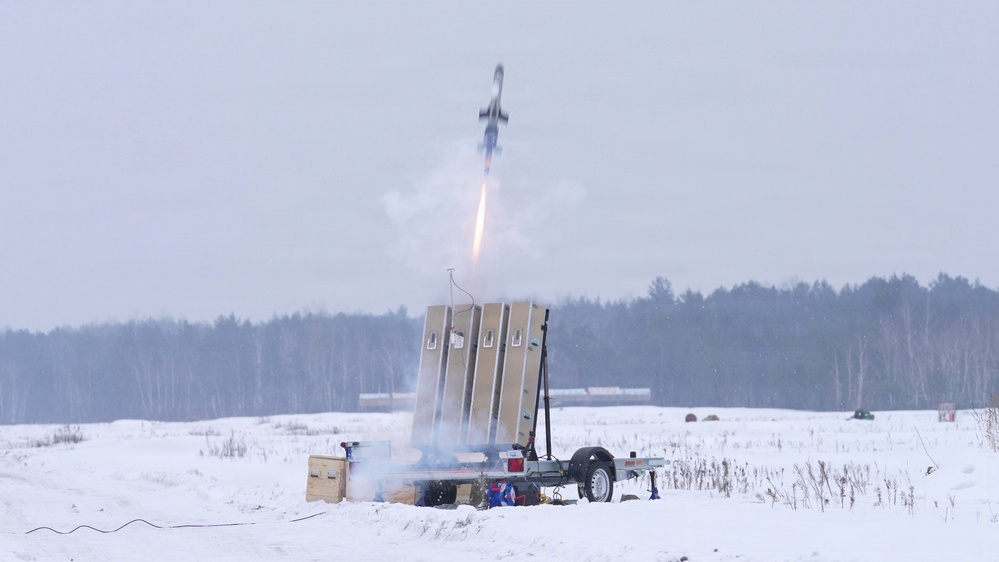
One year after Ukraine's Operation Spiderweb demonstrated that truck-mounted shipping containers could launch coordinated drone strikes against heavily defended Russian airbases, Europe's largest tank and artillery manufacturer has drawn the obvious lesson. On June 17, 2026, at Eurosatory in Paris, KNDS Group unveiled a prototype of what it calls its Drone Launch Container — a self-contained swarm launcher, air defense node, and command hub packed inside a standard 20-foot ISO shipping container.
The system is not yet fielded. But the prototype's debut marks the first time a major Western defense prime has translated the container-launch concept — previously the domain of improvised Ukrainian ingenuity — into an integrated, networked product with a named software stack and named partner companies.
One Box, Two Missions
The central design choice is what sets KNDS's system apart from simpler tube-launcher concepts: the container is meant to handle offensive and defensive missions simultaneously, from the same footprint.
On the strike side, the container carries Helsing HX-2 loitering munitions. The HX-2 is a 12-kilogram effector capable of 220 km/h and a 100-kilometer operational range, fitted with anti-tank or anti-structure warheads. Critically, Helsing designed the HX-2 for AI-supported GPS-denied operation — a requirement that has moved from theoretical to mandatory across every serious drone program since Russian EW forces demonstrated the ability to disrupt satellite navigation at scale. The HX-2's onboard autonomy is managed through Helsing's Altra AI software suite.
On the defensive side, the same container integrates Tytan METIS interceptors from TYTAN Technologies. The TI-2 variant — the higher-performance model — reaches 375 km/h, covers a 60-kilometer engagement range, and operates up to a 5,000-meter ceiling. The METIS line is described as autonomous and hit-to-kill, meaning it does not rely on fragmentation warheads but instead physically intercepts and destroys incoming threats. Together, the HX-2s and METIS interceptors form what KNDS describes as a distributed sensor-shooter architecture: the container can push drones outbound toward a target set while simultaneously protecting itself and nearby assets from aerial attack.
The system is designed to carry a modular mix of strike and intercept munitions, with the exact configuration depending on mission requirements and the relative ratio of offensive to defensive effectors loaded.
The Box Itself
A 20-foot ISO container measures roughly 6.1 meters long, 2.4 meters wide, and 2.6 meters high — approximately 33 cubic meters of internal volume. That footprint is unremarkable. It is exactly the size of the intermodal containers stacked at every port and on every freight train in the world, which is precisely the point.
KNDS has engineered the container to be operationally self-sufficient: it includes independent power generation, environmental controls to manage temperature and humidity for sensitive electronics and munitions, and organic network connectivity. No external support vehicles are required to bring it online. It can be transported by truck, rail, or ship, and once positioned, it disappears into the visual and logistical noise of commercial freight infrastructure.
This ambiguity is not incidental — it is a core part of the system's survivability argument. A battery of KNDS containers positioned near a logistics hub, a port, or a rail yard is indistinguishable from commercial cargo by satellite imagery or casual ground observation. An adversary attempting to target the system must first find it.
The entire system is managed through the KNDS Mission Operating System and its iC2 mission core, providing the command-and-control layer that orchestrates both the strike and intercept munitions, manages sensor feeds, and connects the container into broader battlespace networks.
The Ukraine Precedent
Context matters here. On June 1, 2025 — almost exactly one year before KNDS's Eurosatory announcement — Ukraine executed Operation Spiderweb. The operation involved 117 FPV drones launched from concealed, truck-carried containers targeting four Russian strategic airbase complexes: Belaya, Olenya, Dyagilevo, and Ivanovo. Reported results were striking: Ukrainian sources and subsequent damage assessments attributed the destruction of eight Tu-95MS strategic bombers, twelve Tu-22M3 supersonic bombers, two A-50 AWACS aircraft, and one An-12 transport to the raid, with a possible Il-78M refueling aircraft also among the losses.
The operational logic was the same as what KNDS is now formalizing: conceal the launcher among commercial traffic, position it at strategic range, and saturate the target with a coordinated drone salvo before the defender can react. Ukraine executed that concept with improvised hardware. KNDS is proposing to productize it at industrial scale, with professional software integration, NATO-compatible command links, and a mixed strike-intercept capability Ukraine's containers lacked.
Mathias Noehl, KNDS's Executive Vice President for Digitalisation, is named as the executive associated with the program — reflecting the company's framing of the container system as fundamentally a software and integration problem as much as a hardware one.
Why It Matters
The Drone Launch Container represents a meaningful shift in how large Western primes are thinking about force structure and survivability. For decades, the dominant model for delivering firepower at range involved expensive, crewed platforms — aircraft, helicopters, artillery — that required elaborate basing infrastructure and were themselves high-value targets. That model is under pressure from two directions simultaneously: the proliferation of cheap drones that can destroy expensive platforms, and the demonstrated effectiveness of mass drone strikes that overwhelm point-defense systems.
A containerized swarm launcher addresses both problems at once. It eliminates the high-value platform signature. It distributes firepower across dozens or hundreds of expendable effectors rather than concentrating it in a single crewed aircraft. And by integrating intercept capability into the same container, KNDS is arguing that the system can defend itself and nearby assets without requiring a separate air defense battery — compressing the logistics tail further.
The modular architecture also matters for procurement. NATO armies operating 24 European armed forces are customers of KNDS across its existing product lines — Leopard tanks, Caesar wheeled howitzers, and associated ammunition and support systems. A containerized drone system that slots into the KNDS Mission Operating System and connects to existing command networks offers an upgrade path that does not require standing up entirely new logistics chains. The container arrives, connects, and operates.
The competitive landscape is real. KNDS is not alone in pursuing this concept. Multiple defense contractors across Europe, the United States, and Israel have active programs exploring containerized or distributed drone launch infrastructure. But KNDS's combination of scale — €4.4 billion in 2025 revenue, a €33.1 billion order backlog, roughly 11,000 employees, and trusted supplier status with more than 40 armies — gives it a procurement credibility that smaller specialists lack. When KNDS shows a prototype at Eurosatory, army acquisition offices pay attention.
The system is still a prototype. No price has been disclosed, no production contract announced, and no delivery timeline specified. The meaningful test of the concept will come when a NATO army signs a contract and the containers move from the exhibition floor to field trials. But the underlying logic — conceal, distribute, combine strike and intercept, eliminate the high-value basing signature — is sound, and Ukraine proved it in combat 12 months before the prototype appeared in Paris.
Sources
- KNDS Group Official Press Release — KNDS Showcases First Drone Launch Container Prototype at Eurosatory 2026
- Army Recognition — KNDS Unveils Containerized Drone Launcher Concept One Year After Ukraine's Operation Spiderweb Success
- C4ISRNET: French Army Shows Leclerc Tank With Anti-Drone Cage at Eurosatory 2026
