
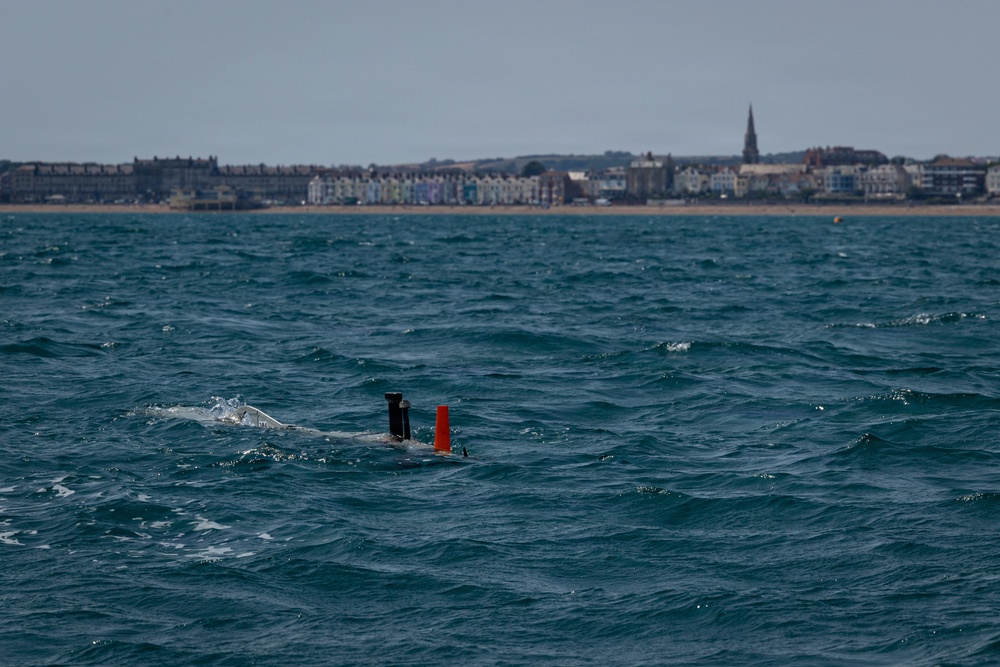
The counter-drone fight has a well-worn playbook above the waterline: a sensor spots an incoming unmanned aircraft, software fuses the track, and a human decides what to do about it. At the U.S. Navy's Lanternfish 2026 exercise, two defense firms tried to prove that the same loop can be closed on the seabed - against machines that are far harder to see, hear or shoot at than anything flying.
Ultra Maritime and Anduril Industries used the exercise to demonstrate an integrated undersea threat-detection chain that detected, tracked and classified medium- and large-diameter unmanned underwater vehicles (UUVs), along with smaller autonomous underwater systems - and pushed those tracks to operators without a person sitting in the sensing loop. It is an early, concrete proof point for what amounts to the underwater mirror of counter-UAS: robots hunting robots, beneath the surface.
What Actually Got Demonstrated
The demonstration stitched together three named pieces of hardware and software, each supplied by one of the two companies.
At the sensing end sat Ultra Maritime's Sea Spear, a deployable sonar. Its job in the chain was persistent acoustic sensing - listening for the acoustic signatures of underwater vehicles and generating real-time track data rather than a batch of recordings to be analyzed after the fact. In the exercise, Sea Spear consistently detected, tracked and classified medium- and large-diameter UUVs.
That sensor was deployed on Seabed Sentry, Anduril's autonomous undersea platform, and fed its tracks into Lattice, the company's battle-management software. Lattice is the layer that fuses incoming tracks and turns raw acoustic contacts into actionable objects - separating a medium- or large-diameter UUV or a small autonomous system from the general background of the ocean, and then alerting operators.
Crucially, that alerting was described as operator-free. Seabed Sentry generated and routed alerts into the Navy's Unmanned Operations Center (UOC), via the Navy's command-and-control system, without a human manning the sonar console and manually calling out contacts. In other words, the automation ran from the hydrophone to the watch floor, with the human entering at the decision stage rather than the detection stage. The result, per Anduril, was a live feed of every subsea and surface asset moving through the exercise area, visible to Navy operators in real time.
The whole thing was demonstrated as an end-to-end integration with the Navy's cUxV system - the counter-unmanned-vehicle command-and-control framework the service is standing up to coordinate these kinds of engagements. The point was not simply that a sonar can hear a UUV. It was that a commercial sensor and a commercial autonomy stack could plug directly into the Navy's own operations plumbing and deliver classified tracks where the Navy wants them.
Why the Underwater Problem Is Different
It is tempting to read this as counter-UAS with the altitude flipped, and the analogy holds at the level of the kill chain: detect, track, classify, alert, decide. But the undersea environment makes each of those steps materially harder.
There is no radar underwater in any useful sense; the medium that carries radio waves through the air swallows them almost immediately in saltwater. Detection leans on acoustics, and acoustics are noisy, ambiguous and heavily dependent on water conditions. A quiet, slow-moving UUV is a genuinely difficult target to separate from biological noise, shipping traffic and the ocean itself. That is precisely why the classification step - deciding that a given contact is a medium- or large-diameter UUV rather than clutter - is the hard, interesting part of what this sensing chain was doing, and why persistent sensing from Sea Spear matters more than a single lucky ping.
The threat itself is also maturing. Large-diameter UUVs are no longer laboratory curiosities; they are the kind of platform navies increasingly expect adversaries to use for surveillance, seabed infrastructure reconnaissance and one-way attack. If those systems proliferate the way small aerial drones did over the past decade, navies will face the same volume problem underwater that they now face in the air - too many cheap, autonomous threats for a human-paced detection process to keep up with. Automating the sensing-to-alert path is the direct answer to that problem.
Who Was In the Room
Lanternfish 2026 was a U.S. Navy exercise, and the demonstration was explicitly framed as feeding the Navy's Unmanned Operations Center. But it was not a solely American affair: participants included Australia, the United Kingdom and the United States - the three AUKUS partners, whose trilateral pact has undersea capability and autonomy as central pillars.
That participant list is worth pausing on. Counter-UUV sensing that plugs into a shared command-and-control architecture is exactly the kind of interoperable, autonomy-heavy capability the three governments have said they want to co-develop. A demonstration that shows commercial sensors and autonomy stacks slotting into the Navy's cUxV framework is as much a statement about coalition plumbing as it is about any single piece of hardware.
The Vendor Angle - and the Caveats
Both companies have obvious commercial reasons to publicize this. Anduril has built its business on Lattice as a general-purpose battle-management and sensor-fusion layer, and every new domain it can credibly claim - air, ground, and now the seabed - widens that pitch. Ultra Maritime is an established undersea-sensing supplier looking to show its hardware plays well inside modern autonomy stacks rather than legacy combat systems.
So the usual caveats apply. A structured exercise is not a contested operational environment; a demonstration that a chain "detected, tracked and classified" targets says nothing about false-alarm rates, performance against a genuinely quiet adversary UUV, or how the system behaves when acoustic conditions turn hostile. Those are the numbers that separate a compelling demo from a fielded capability, and they are not the kind of thing that surfaces in an exercise readout. What Lanternfish 2026 established is narrower and still meaningful: that the integration works end to end, from a deployable sonar through a commercial autonomy layer into the Navy's own operations center, with the human moved off the detection step.
Why It Matters
The center of gravity in unmanned warfare has been in the air, where counter-UAS has become a defining problem for every modern military. Lanternfish 2026 is a marker that the same dynamic is arriving underwater - and that the industrial answer is shaping up to look similar: persistent sensors feeding an autonomy layer that classifies threats and alerts operators faster than humans can. If UUVs proliferate the way small aerial drones did, the navies that win will be the ones that have already automated detection and classification, because human-paced sensing simply will not scale to the threat volume. Demonstrating that a commercial sonar and a commercial autonomy stack can plug straight into the Navy's cUxV architecture and Unmanned Operations Center - across a three-nation exercise, no less - is an early signal of how that undersea counter-autonomy fight is going to be built, and by whom.
