
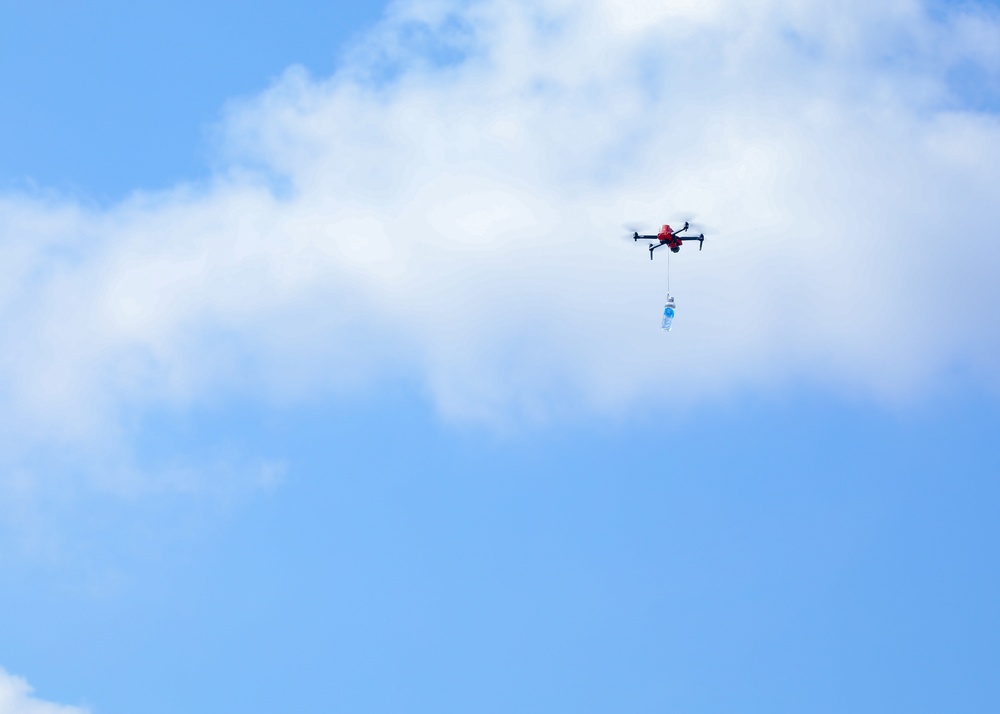
A normal multirotor steers by changing the speed of four or more motors against each other. Joshua Bird's latest build has only one. It has no servos, no tail rotor and no second propeller. A single 6-inch prop on a hinged hub carries the aircraft, and it still hovers and steers. DroneXL reported that the catch is where it flies: for now, only in Bird's bedroom.
The aircraft is a working example of an under-actuated drone, meaning it has fewer actuators than the motions it needs to control. The way Bird got there says a lot about how much of a drone's flying ability now comes from firmware and control timing, and how little comes from the hardware itself.
How One Motor Can Steer
The design depends on the propeller hub. Each blade sits on a 45-degree hinge. Tom's Hardware explains that when the motor accelerates, one blade pitches up to produce more lift while the other pitches down and produces less. Accelerating and decelerating the motor as needed changes the drone's pitch and roll, which replaces the swashplate a helicopter uses.
The changes in speed have to be extremely fast. According to DroneXL, the prop turns at almost 20,000 RPM while the motor speeds up and slows down 300 times per second. Yaw is a separate problem because there is no second rotor to cancel torque. Tom's Hardware notes that 3D-printed stabilizing fins, combined with motor speed adjustments, produce yaw control.
The Firmware Problem
Hobby electronics were not built for this. DroneXL reports that a standard electronic speed controller (ESC) lost sync once it was asked for more than 50 accelerations per second, which is far below the 300 the design needs. Bird switched to an mjbots moteus r4 servo controller and rewrote its firmware so that it talks directly to the flight controller.
The direct link was needed because of timing. According to DroneXL, routing commands through a separate microcontroller left them about 20 degrees of rotation late, by Bird's count; at 20,000 RPM the propeller completes a turn every 3 milliseconds. Tom's Hardware describes the custom flight-controller and motor-controller firmware as reacting in under 0.2 milliseconds.
The project repository lists both firmware forks, jyjblrd/ardupilot and jyjblrd/moteus. The flight-controller side is therefore a modified ArduPilot rather than a control stack written from scratch.
Strobe Lights, Stiff Blades and an Infrared Beacon
Several other problems came up during development, and Bird solved each with workshop methods. DroneXL reports that he found a 160 Hz vibration using a homemade strobe camera, and that stiffer blades fixed it. The hub is printed in carbon-fiber-filled PPA.
Heading was harder. A compass cannot work on this aircraft, according to DroneXL, so Bird gets heading from an infrared beacon through his ArduPilot fork. That choice ties the drone to an environment where a beacon is set up, which is one reason it has not left the room it was built in. Tom's Hardware describes the testing as taking place over his bed.
Not the First, but Smaller
Single-motor flight has been done before. In May 2023, the University of Hong Kong announced PULSAR, developed by Dr Fu Zhang's team. HKU describes it as a single-actuator, swashplateless aerial robot with LiDAR sensing that performs perception, mapping, planning and control onboard. DroneXL notes that the work was published in Science Robotics in 2023.
The two projects aim at different things. PULSAR was presented as a full autonomous robot with its own sensing and mapping. Bird's build focuses on a much smaller propeller. Bird claims more than six times less propeller area than PULSAR, according to DroneXL. UASFeed has not independently verified that comparison.
Open Files
Bird has published the design. The GitHub repository, titled "Under-actuated drone with only one motor," contains Fusion 360 and STEP files for the body, the prop plate, and two versions of the propellers, along with links to the firmware forks. When UASFeed read the page, the repository had 413 stars and 70 forks, so there is clear interest from other builders.
Why It Matters
On its own, a one-motor drone that only flies in one bedroom is a curiosity. The engineering behind it is more important. The build shows that control authority usually provided by extra motors or servos can come from timing alone: a motor whose speed is shaped within each revolution, and firmware fast enough that commands land at the correct point in the rotation. The project's main obstacles, as reported, were off-the-shelf ESCs losing sync, command latency measured in degrees of rotation, and vibration.
HKU says PULSAR's single-actuator design reduces energy conversion loss, and Bird says one motor could make drones smaller and cheaper, though DroneXL's editor is not yet sold on cheaper, since the removed mechanical parts came back as custom firmware and a $94 moteus servo drive. Bird's version still has clear limits, including its reliance on an infrared beacon for heading and its indoor-only flight. It is not ready for field use. Because the CAD and firmware are public, though, other builders can reproduce the experiment, test it and improve on it.
Sources
- Joshua Bird's One-Motor Drone Flies, but Only in His Bedroom (DroneXL, Oct 20, 2026)
- Engineer builds tiny 3D-printed single-motor drone in their bedroom (Tom's Hardware)
- jyjblrd/single-propeller-drone (GitHub)
- Introducing PULSAR: HKU Team Develops Revolutionary Unpiloted Aerial Vehicle (HKU, May 29, 2023)
