
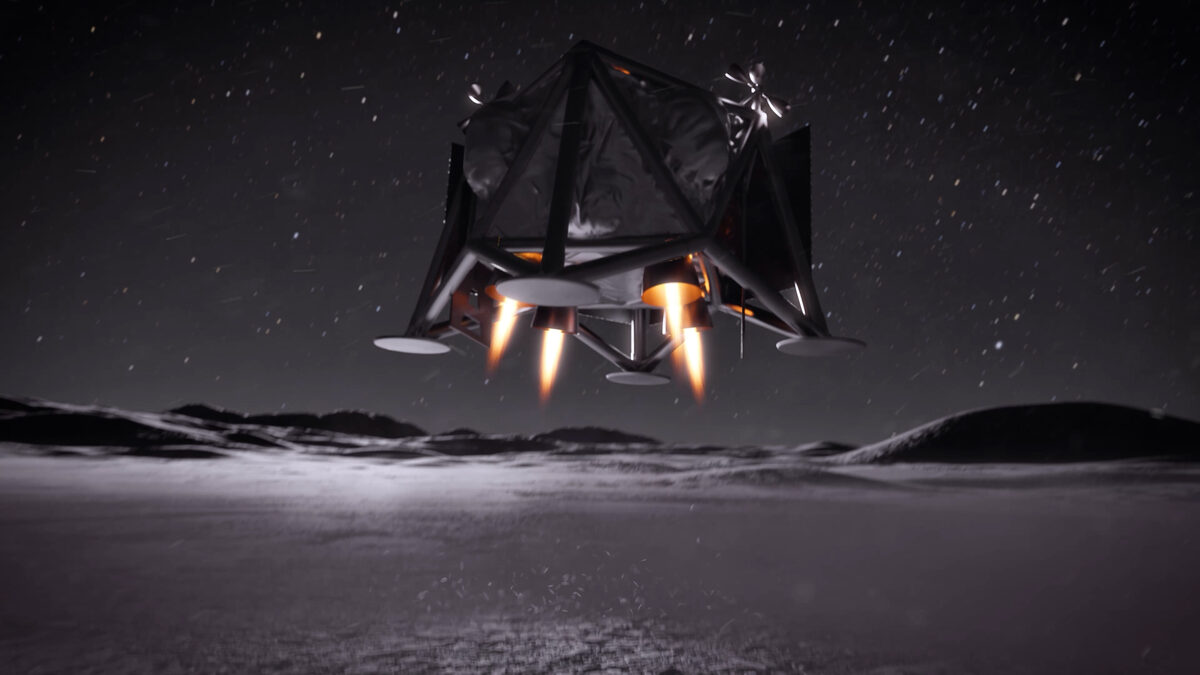
Firefly Aerospace announced on Oct. 21 that its Elytra spacecraft has passed a preliminary design review (PDR) for MoonFall, a NASA mission managed by the Jet Propulsion Laboratory. MoonFall plans to deliver four JPL-built hopping drones to the Moon's south pole. Firefly says it completed the review less than four months after receiving its contract. A PDR is still a review of designs, though. Nothing has flown. The steps that matter most are still ahead.
This explainer covers what MoonFall is, how a drone concept inspired by a Mars helicopter can work on a world with no air, what the review established, and what has to happen before anything reaches the Moon.
What is MoonFall?
MoonFall is a lunar reconnaissance mission built around four robotic flyers. JPL is building the drones and managing the mission. Firefly holds a $75 million subcontract from JPL to provide Elytra, the spacecraft that carries the drones to the Moon and releases them there. NASA is responsible for buying the launch vehicle. The mission is part of the initial phase of NASA's Moon Base initiative, according to Interesting Engineering and SatellitePro ME.
SatellitePro ME describes the profile like this. After launch, which is no earlier than 2028, Elytra spends about 45 days traveling to the Moon. It then performs a braking maneuver and releases the four drones about 50 kilometers above the lunar south pole. Interesting Engineering reports that Firefly is targeting launch readiness by late 2028. Readers should take that as the program's current goal rather than a fixed date, since Motley Fool described the launch vehicle as unidentified and SatellitePro ME says NASA will procure it separately.
On the surface, the drones are expected to operate during a single lunar day, which lasts up to 14 Earth days. They carry high-definition cameras and other instruments to survey the terrain, find candidate landing sites and look for resources. Motley Fool's June coverage said the aims include the highest-resolution map yet of the lunar surface and the detection of water-ice deposits. SatellitePro ME also reports that "survive-the-night" payloads are expected to keep operating for several months after the drones' final flights, so some operations could continue well past the first daylight period.
How does a "drone" fly without air?
This is the obvious engineering question, and the answer changes what "drone" means for this mission. SatellitePro ME says MoonFall's drones are inspired by NASA's Ingenuity Mars Helicopter. Ingenuity flew with rotors in Mars's thin atmosphere. The Moon has essentially no atmosphere, so rotors would have nothing to push against.
MoonFall keeps the idea behind Ingenuity, a small autonomous vehicle that flies short scouting trips across terrain a lander or rover could not easily reach, but the vehicles do not use rotors. Motley Fool describes them as "hopping" drones that use their rockets to launch into the "air" and then descend back to the surface. In SatellitePro ME's wording, each drone is capable of multiple powered hops.
The vehicles are not small. Motley Fool reports each drone weighs about 550 pounds and measures roughly 7 feet wide and 4 feet tall. That puts them closer to compact landers than to anything a UAS operator on Earth would call a drone.
The architecture also explains why Elytra matters. Motley Fool says Elytra deploys the drones about 30 miles above the surface and that they then descend independently, while Elytra itself stays in lunar orbit. According to SatellitePro ME, the Elytra Dark configuration can carry up to 1,000 kg of drone payload, and the spacecraft builds on technologies first demonstrated on Blue Ghost Mission 1, including core avionics, carbon-composite structures and Spectre engines. Four drones at roughly 550 pounds each comes to about 1,000 kg, near that stated ceiling. That is a simple calculation from the reported figures, not a margin Firefly has published.
What did the preliminary design review actually establish?
According to Interesting Engineering, the PDR covered Elytra's structure, thermal management, propulsion, avionics, navigation, communications and control systems, and engineers also evaluated plans for qualification and environmental testing. Engineers from Firefly, NASA and JPL took part. Ray Allensworth, Firefly's vice president of spacecraft, said in the company's announcement: "Completing PDR less than four months after contract award is a testament to the speed and rigor Firefly brings to every mission."
A PDR generally shows that a design approach meets its requirements at a preliminary level, and that the team can move on to detailed design. It does not show that hardware exists, that subsystems work together, or that the vehicle will survive launch, cruise and the braking burn. Interesting Engineering said plainly that this was a design assessment rather than a demonstration of flight-ready hardware, and that Firefly has not yet demonstrated the MoonFall drone deployment.
The schedule is the notable part. A review closed in under four months from award is consistent with Firefly reusing existing design, which fits its statement that Elytra builds on Blue Ghost Mission 1, though the sources do not say how much was reused. Firefly CEO Jason Kim spoke about the company's role in the mission when it was selected, SatellitePro ME reported.
What remains before launch?
Several major items are still open:
- Critical design review. Interesting Engineering identifies a CDR as the next milestone, a more detailed evaluation intended to establish whether the spacecraft is ready to move toward manufacturing.
- A launch vehicle. NASA is buying the rocket and, per Motley Fool, had not identified one as of June. The launch date and the late-2028 target both depend on that decision.
- The drones themselves. Elytra's review says nothing about the readiness of JPL's four hoppers. Interesting Engineering notes that the spacecraft must still complete final design review, manufacturing, assembly and testing, and the drones will need their own development and testing. Autonomous navigation and repeated rocket landings on rough polar terrain are likely to be demanding, though the sources do not assess that risk.
- Integration and release. Separating four large vehicles from a carrier in lunar orbit, with each one then managing its own descent, is a deployment problem that sits between Firefly's hardware and JPL's.
- Night survival. The reported plan to keep some payloads running for several months beyond the drones' final flights depends on hardware that can survive the lunar night. That remains to be shown.
Why It Matters
MoonFall tests a mobility idea that could change how sites on the Moon get scouted. Fixed landers see one spot. Rovers move slowly and are limited by slopes, boulders and shadowed craters. A fleet of hoppers that can relocate by rocket could map large areas of the south pole at high resolution and check possible landing zones and ice deposits before crews or heavy cargo commit to them. Interesting Engineering says the data could help planners select safer landing sites, which aligns with NASA's Moon Base planning.
For the UAS community, the mission shows the Ingenuity model being adapted for the Moon. Ingenuity showed that a small autonomous flyer can scout on another planet. MoonFall carries the same concept to a body with no atmosphere by changing the propulsion and keeping the mission profile. If it works, repositionable aerial-style reconnaissance could become a standard tool for planetary exploration, and the drone would be more than a demonstration.
The commercial structure also stands out. Motley Fool's investor commentary called Firefly's $75 million price "bargain-basement cheap," while noting that JPL's drones and the launch would add tens of millions more to total project cost. JPL is buying the delivery spacecraft as a subcontracted service rather than building it in-house. Fast milestones like this PDR help Firefly's case, but the harder test comes when Elytra and its four drones have to do the job at the Moon.
