
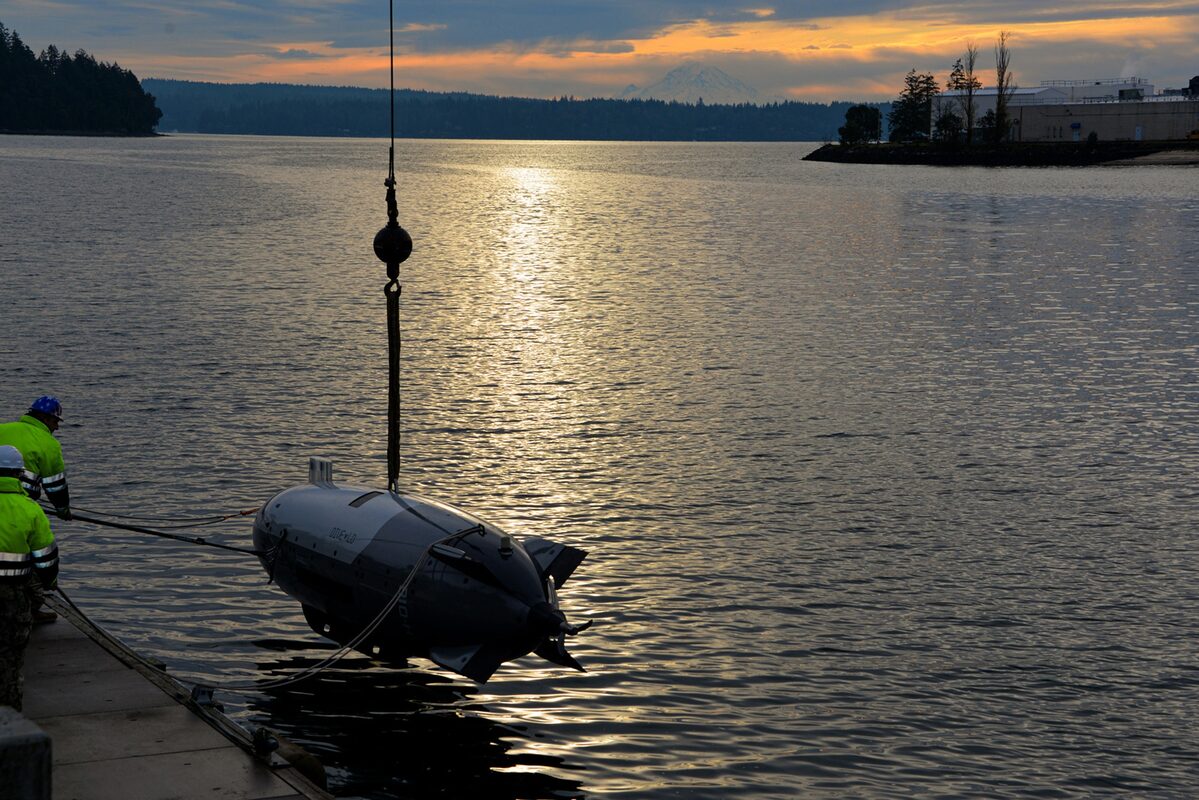
For most of its short public life, Anduril's Ghost Shark has been described mainly by its hull: a large uncrewed undersea vehicle that Australia ordered in quantity. On Oct. 19 Canberra described what goes inside it. Newly declassified details show the vehicle will carry three kinds of payload: sea mines, supply caches for special forces, and swarms of Altius aerial drones that can fly reconnaissance or carry explosives.
"Those Ghost Sharks now have teeth," Minister for Defence Industry Pat Conroy said, according to ABC News. He described "teeth with the ability to deny areas through mining" and "the ability to strike targets thousands of nautical miles away from Australia."
The announcement came as Maritime Big Play Pacific, an AUKUS Pillar II exercise near San Diego, got under way, and some of the new payloads will take part in it. Here is what has been disclosed, and what has not.
The three payloads
Sea mines: up to 12 per sortie
The most concrete figure in the release is the mine load. ABC News reports that a Ghost Shark can carry up to 12 sea mines at a time, which Defence says can be used to quickly close access to critical waterways. DroneXL describes the same figure as a per-mission load. David Goodrich of Anduril Australia framed the case in terms of cost and risk, telling ABC that the vehicle will deploy naval mines "at significantly lower cost and risk than using a surface ship or crewed asset."
That framing is the core of the pitch for uncrewed minelaying: if the work can be done by a vehicle that does not carry a crew, commanders have less to lose when they send it somewhere dangerous. Goodrich described mine laying as a clear example of the "dull, dirty and dangerous" missions he said the Ghost Shark is meant to take on, leaving sailors free for higher-value jobs.
Supply caches for special forces
The second payload is logistical. ABC News reports that Ghost Shark can drop supply caches for special forces units in hard-to-reach locations. According to DroneXL, the caches were built by the Defence Science and Technology Group, and Chief Defence Scientist Tanya Monro said they are meant to let supplies sit beneath the surface until a unit needs them. The public material does not say what goes into a cache, how many a vehicle carries, or how long one can be left in place, and DroneXL reports that Conroy would not say which forces would use them beyond telling reporters to use their imagination.
Altius swarms from under the sea
The third payload is the most unusual: Altius aerial drones launched from an undersea vehicle. According to ABC News, the swarms can fly reconnaissance or carry four kilograms of explosives to target enemy vessels. DroneXL reports that Conroy withheld the number of Altius drones in a swarm for operational reasons. Anduril also wants to bring Altius to Australia at scale, subject to government approval, DroneXL reports.
Launching an air vehicle from a submerged hull is a notable step, and the public record does not yet show it working. DroneXL's own assessment is that the mine payload looks real today, while the Altius swarm still has to be seen flying from a Ghost Shark. The Altius family has launched from tubes on other platforms, but nothing released on Oct. 19 demonstrated a launch from a submerged hull.
Mines, caches and drones are not the only options. Goodrich told reporters that the payload bays can also take heavyweight and lightweight torpedoes and what he called "cost-effective, undersea effectors," according to DroneXL. No torpedo integration was announced on Oct. 19.
Where the fleet stands
ABC News reports that "dozens and dozens" of Ghost Sharks are being delivered to the Royal Australian Navy over the next few years under a $1.7 billion contract signed last September. The total number has not been revealed. The first vehicle was delivered in January, and the type is in service this month at Maritime Big Play off Southern California.
DroneXL reports the exercise runs Oct. 5–25 near San Diego and is hosted by Naval Information Warfare Center (NIWC) Pacific. Naval News, which reproduced the minister's Oct. 19 media release, says the payload integration work covers three Australian uncrewed vehicles, not only Ghost Shark: Speartooth and BlueBottle are also included. Naval News updated its report on Oct. 20 with more event details, and notes that the release itself does not specify which capabilities the Navy intends to integrate on each vehicle; those details came from the press conference.
The first payload for Ocius's Bluebottle, an uncrewed surface vessel, is a thin-line towed-array sonar, according to DroneXL. Speartooth is the third vehicle being fitted with payloads.
Why It Matters
The detail that matters most for allied planners may be one Conroy said outright: the AUKUS export focus is payloads. "The decision around marquee projects was to invest in common payloads and sensors," he told ABC, adding, "We all have a range of our own platforms to deliver them." A hull on its own is a transport. Payloads that are integrated and tested are what turn it into a weapon system, and that is the capability Australia says it has now developed and is offering to its partners.
ABC News reports that the new capabilities are being offered to the United States and the United Kingdom under AUKUS Pillar Two technology-sharing arrangements, designed to be interoperable with whatever autonomous systems those countries choose to use. Conroy also said Australia has not given up on selling the Ghost Shark itself to both countries, according to DroneXL. DroneXL notes that in March the US Navy selected Anduril's Dive-XL, the commercial baseline Ghost Shark is built on, for its extra-large autonomous undersea vehicle program.
The May announcement of the first AUKUS Pillar II signature project, which covers payloads and enabling systems for the partners' uncrewed undersea vehicles, is the framework Naval News says this work complements. In that setting, Australia is positioning itself as a source of common payloads rather than only a buyer of hulls.
Several questions remain open: the swarm size, what the caches contain, the exact range behind "thousands of nautical miles," and whether torpedoes will follow the payloads announced so far. Australia has chosen to declassify enough to show the capability exists on paper and in displays. It has not explained how it will be used.
