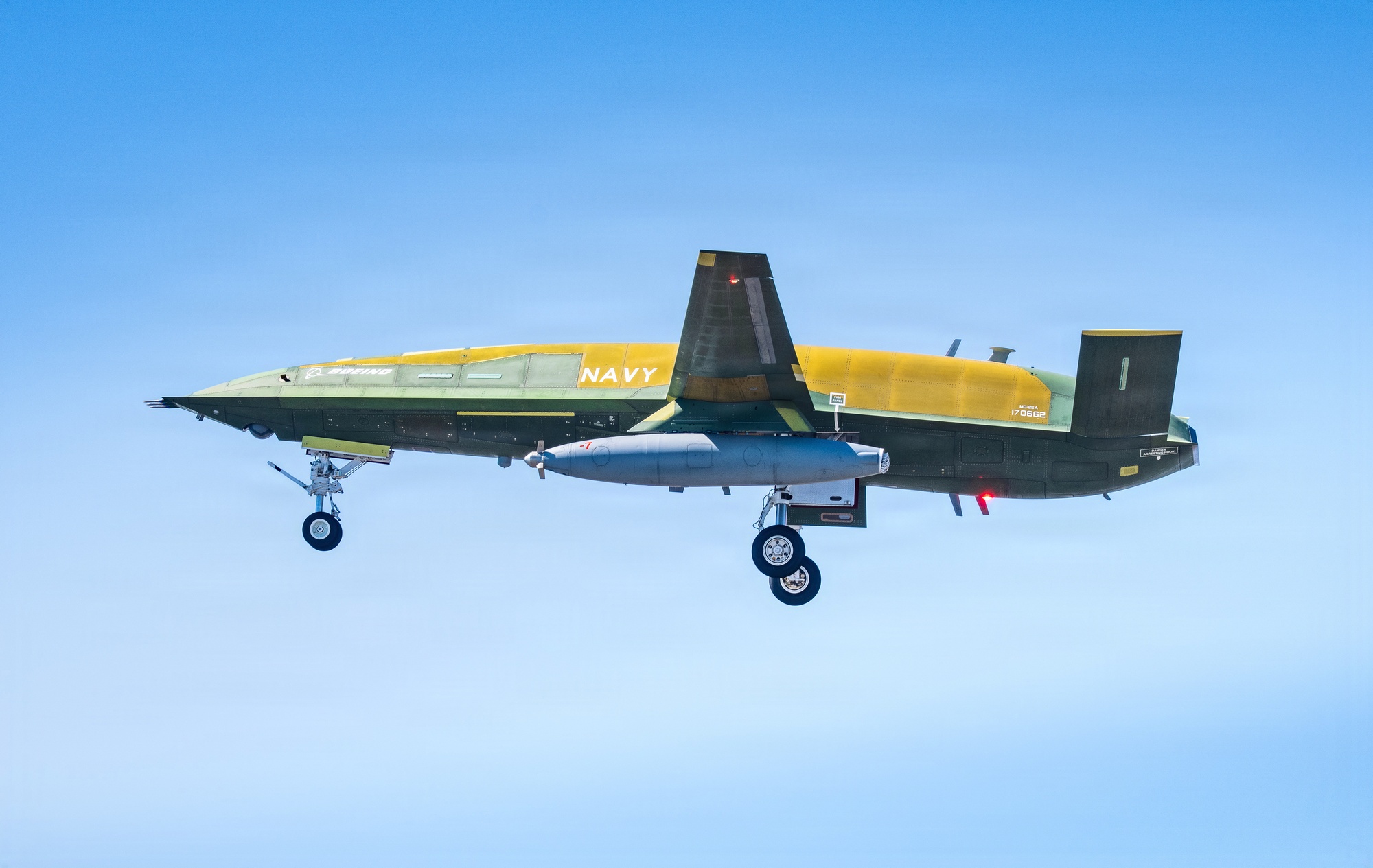
Shield AI's X-BAT is about to stop being a rendering. The company says the first of two full-scale prototypes of its jet-powered, tail-sitting vertical takeoff and landing (VTOL) strike drone will roll out by the end of October 2026, with flight testing to begin before the end of the year. The program also has new money behind it. On October 8, Shield AI announced an additional $150 million from the Office of the Under Secretary of War for Acquisition and Sustainment, routed through that office's Defense Exportability Features program via the Navy, according to The War Zone.
The schedule is now the main question. Shield AI says the government's program is set up to reach early operational capability in 2029. That leaves roughly three years to take a clean-sheet, tail-landing jet from crane-suspended hover tests to something a Navy unit can deploy. TWZ calls that path "extraordinarily ambitious."
Where the $400 million figure comes from
The new $150 million adds to an earlier $50 million Navy and Defense Innovation Unit (DIU) investment made in 2026 under the Runway Independent Maritime & Expeditionary Strike (RIMES) effort. ePlane AI reported in August that the first tranche came from the Navy Rapid Capabilities Office and DIU. Shield AI says it has committed an equivalent amount of internal funding, which brings the combined total to $400 million, as relayed by TWZ.
That figure is Shield AI's own accounting, and it mixes government and company money. Half of it is the company betting its own capital that the concept will close. The government share is $200 million across two awards.
The Air Force is not paying for any of it. ePlane AI reported that the service has chosen not to participate in funding X-BAT and is maintaining its focus on its own Collaborative Combat Aircraft (CCA) program. For now, X-BAT is a Navy-sponsored bet.
What the Navy actually asked for
DIU's solicitation listing describes the RIMES requirement in one sentence: "The DoW seeks an Unmanned Aerial System (UAS) capable of supporting Naval surface combatants through executing long range strikes with standard munition payloads while providing tactical flexibility by operating from expeditionary locations with minimal infrastructure, or from ships without large flight decks."
The wording asks for standard munition payloads, so the aircraft has to carry existing weapons rather than bespoke ones. It also asks for operation from ships without large flight decks, which points away from relying on carriers. X-BAT's pitch fits that brief closely. The tail-sitter concept, unveiled in October 2025, is designed to eliminate the need for runways, catapults or arresting wires, per ePlane AI's background reporting. Shield AI claims that three X-BATs can occupy the deck space of one legacy fighter.
The aircraft, on paper
The performance numbers below are Shield AI's claims and have not been demonstrated in flight. As TWZ relays them:
- Range: maximum of 2,000 nautical miles, with a combat radius the company has put at around 1,340 nm, possibly closer to 1,000 nm.
- Ceiling: about 50,000 feet.
- Payload: internal weapons bays roughly the size of an F-35's, plus two external hardpoints under the wings.
- Propulsion: a single General Electric F110 engine.
- Cost: ePlane AI reports a target unit cost of about $27 million. That is Shield AI's estimate, not a contract price.
Armor Harris, Shield AI's senior vice president and general manager of the aircraft division, told TWZ that the two prototypes are full-scale vehicles, with the outer mold line, the F110 engine and the full propulsion path. The first is due at the end of October.
The hard parts
The funding announcement covers the program's money. The rest of the technical story shows how much has yet to be demonstrated.
Controlling a jet that lands on its tail
A conventional jet uses airflow over control surfaces to maneuver. A tail-sitter hovering on its exhaust has almost no airflow to work with. X-BAT's propulsion path pairs the F110 with the Axisymmetric Vectoring Exhaust Nozzle (AVEN), a thrust-vectoring nozzle originally developed in the 1990s for an experimental F-16. The nozzle provides pitch and yaw control. Roll comes from bleed air routed through thrusters in the wings.
Each part has history, but TWZ notes that X-BAT still has to demonstrate the viability of its vertical takeoff and landing capability, which underpins everything else. Holding a fighter-class engine's thrust steady enough to balance an aircraft vertically is likely the central engineering problem. Commanding thrust vectoring and bleed-air reaction controls from the same flight-control system is plausibly a second one.
A cautious test sequence
Shield AI's test plan reflects that risk. TWZ describes the following sequence:
- Horizontal testing with the aircraft on its launch-and-recovery vehicle.
- Vertical testing.
- Testing while suspended from one of the biggest cranes in the world at the test site in Kansas.
- Untethered flights.
Shield AI's X-Forge 2 facility at the Newton City-County Airport in Kansas is set to be the main flight testing hub. The crane stage lets engineers test the vehicle in free flight while it hangs from the crane. It also means the "flight testing before year-end" milestone could first look like a tethered hover. The step that matters most is free flight.
The launch-and-recovery vehicle
X-BAT does not simply sit on a deck. Its system includes the air vehicle and a launch and recovery vehicle, the trailer it launches and lands from. According to TWZ, that vehicle has evolved and is now self-propelled, at least to a degree. It is a second system that has to work, including on ships, and it has to be developed, qualified and integrated alongside the aircraft. Shield AI has already tested the latch and unlatch mechanisms using an unpowered "battleship" test article.
The calendar
The milestones Shield AI has laid out, per TWZ:
- End of October 2026: first full-scale prototype is due.
- By end of 2026: flight testing begins.
- 2028: goal of flying a fully missionized X-BAT.
- 2029: series production begins. Harris says RIMES is structured with early operational capability in 2029 as the end goal.
Production is meant to take place at X-Forge 3, a facility under construction in Des Moines, Washington.
The plan leaves little slack. A missionized aircraft is meant to fly in 2028, and production and early operational capability follow in 2029. That leaves roughly a year between the first fully missionized flight and the operational goal. A single serious setback in hover control or in the launch-and-recovery vehicle could push the whole chain back.
Why It Matters
The RIMES requirement points to a real gap. The Navy wants long-range strike with standard munitions that can operate from ships without large flight decks and from expeditionary locations with minimal infrastructure. If X-BAT works as advertised, ships and units that have never operated fixed-wing jets could field one.
The Pentagon's latest $150 million shows growing institutional commitment. Even so, the $400 million headline is half company money, the Air Force is staying out, and every performance figure is still a projection. The first prototype's rollout at the end of this month will start to test whether a jet-powered tail-sitter can be controlled, launched and recovered reliably. The answer will decide whether 2029 is a plan or a slogan.