
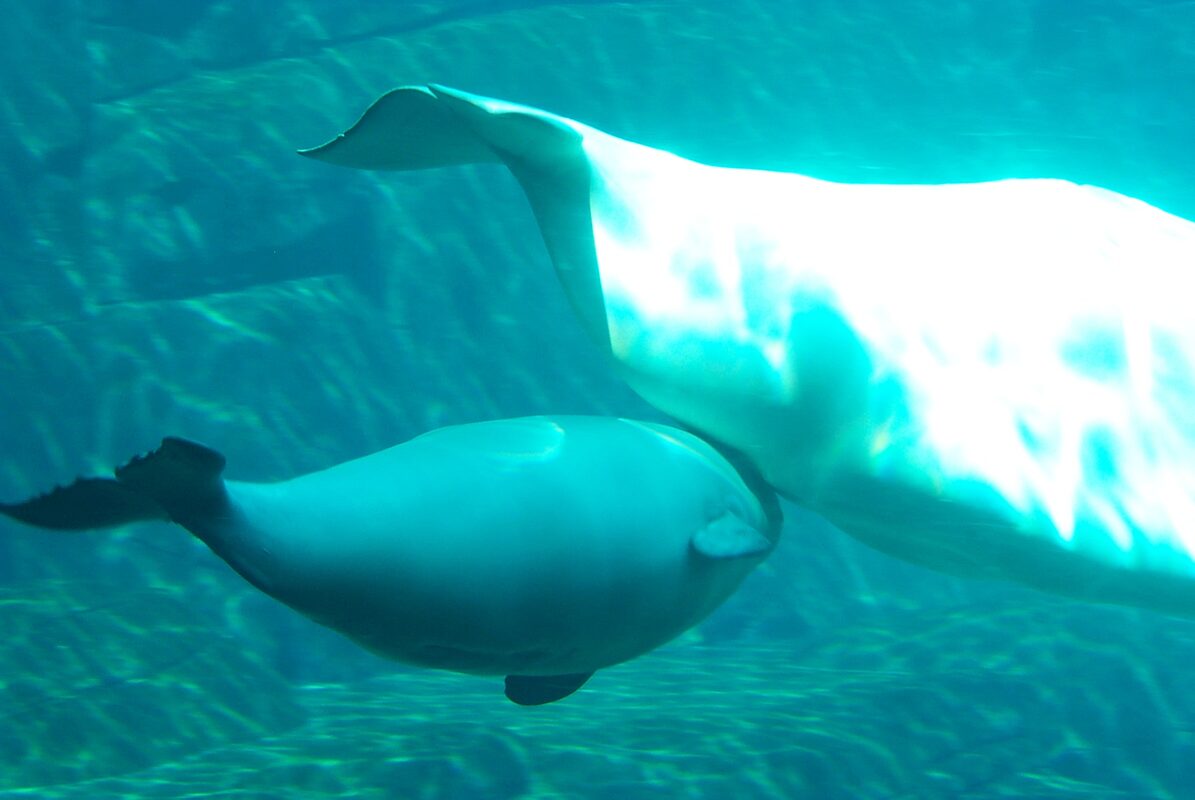
Anyone who has run an aerial wildlife survey knows the drone is the cheap part. The flights end, and someone then has to go through thousands of frames and draw a box around every animal. A new study from Florida Atlantic University (FAU) and Fisheries and Oceans Canada goes after that labeling work directly. The team trained a whale detector on a small fraction of hand-labeled imagery and let the model learn the rest from unlabeled frames.
The headline figure is 34. That is how many labeled images the semi-supervised model needed to beat a conventionally trained YOLO11s detector on Arctic beluga imagery. The overall accuracy gain is modest, though. The useful result is that the new model can find calves, which the baseline almost entirely failed to do.
The Study
The research came out of FAU's College of Engineering and Computer Science and its Harbor Branch Oceanographic Institute, working with Fisheries and Oceans Canada and the University of Manitoba. It appeared on Sept. 4 in Frontiers in Marine Science (vol. 13, doi 10.3389/fmars.2026.1913328) under the title "Using semi-supervised learning to detect beluga whales from aerial image sequences." Mohammed G. Al-Jassani is lead author and Hanqi Zhuang is senior author. FAU publicized the work on Nov. 19.
The team built a custom dataset of 7,655 high-resolution drone frames showing adult and calf belugas. The imagery was collected in 2022 and 2023 with a mix of DJI aircraft: the Phantom 4, a Mini, the Mavic 3E and a Matrice. Most of those are commercial DJI airframes, which suggests the method could suit the kind of fleet many field programs already own.
The frames were divided three ways:
- 3,417 frames in a hand-labeled pool, from which training subsets were drawn
- 3,383 frames left unlabeled, for the semi-supervised model to learn from
- 855 frames held out for testing
Across the dataset, annotators marked 27,118 whales: 20,685 adults and 6,433 calves, with as many as 31 animals in a single frame. Dense groups, partly submerged bodies and small calves pressed against larger adults make this a hard detection problem, even before you limit how much labeled data the model gets.
How Semi-Supervised Detection Works Here
A standard supervised detector such as YOLO learns only from images where every object has been boxed by hand. A semi-supervised detector learns from a small labeled set plus a larger unlabeled one, using its own predictions on the unlabeled frames as an extra training signal. The FAU team used SEMI-DETR, a semi-supervised version of the transformer-based DETR detector family.
The researchers compared it with four supervised models at seven labeling levels, from 1% to 50% of the 3,417-image pool. The low end is 34 labeled images and the high end is 1,709. The strongest supervised baseline was YOLO11s.
The Numbers
At the 1% level, with 34 labeled images, SEMI-DETR scored 19.2 mean average precision (mAP) against 16.0 for YOLO11s. The gap peaked at the 171-label level, where SEMI-DETR reached 33.6 mAP and YOLO11s 27.0, a difference of 6.6 points.
Those are real gains, but small ones. The per-class recall figures tell a bigger story:
- Calves, 34 labels: SEMI-DETR found 27.8%; YOLO11s found 1.3%
- Adults, 34 labels: SEMI-DETR found 63.6%; YOLO11s found 60.2%
- Calves, 1,709 labels: SEMI-DETR found 66.6%; YOLO11s found 43.9%
- Adults, 1,709 labels: SEMI-DETR found 84.3%; YOLO11s found 77.3%
On adults, the two models are roughly even when labels are scarce. On calves, the supervised baseline trained on 34 images was close to useless, finding about one calf in a hundred. SEMI-DETR found more than one in four. With the largest labeled set, the semi-supervised model still found about 23 percentage points more calves than YOLO11s.
FAU's announcement describes the same pattern in plainer terms: the semi-supervised model was better at telling calves from adults. That is the hard part of the problem. Calves are smaller, less frequently observed and more variable in appearance than adults, and the paper notes that they swim tight against adults and can cover only a few pixels of the frame.
What It Doesn't Do Yet
The paper is open about its limits, and several of them matter for anyone thinking of using this operationally.
Calves are still frequently missed. In the team's error analysis at the 50% labeling level, 25.3% of the 1,249 calves in the test set were missed outright. A detector that misses a quarter of calves is a big step up from one that misses nearly all of them, but it is not a replacement for a human reviewer when calf counts drive management decisions.
Detection is per frame. The paper tests detection in single frames, and it lists temporal tracking for individual re-identification as future work. As a result, turning frame-level detections into population counts would likely still need a separate deduplication step to avoid counting the same whale twice across overlapping imagery.
Not every semi-supervised method helped. The study also tested a second semi-supervised approach, Soft Teacher, and it performed worse than the supervised YOLO11s baseline at every budget tested. So the result does not show that semi-supervised learning wins in general. It shows that this particular architecture worked on this particular problem. Teams adopting the approach should benchmark it against a strong supervised baseline on their own data before trusting it.
The paper also includes a hyperparameter sensitivity analysis, and it notes that the confidence threshold may require tuning for new species or imaging conditions. The published configuration may need adjusting for other species, altitudes or sea states.
Why It Matters
For drone-based wildlife monitoring, the expensive resource has moved from flight hours to analyst hours. Small DJI airframes can record 4K video quickly, and a drone shoots video faster than any biologist can label it. A survey program's real throughput limit is how quickly frames can be labeled and reviewed, both to train detectors and to check their output.
If a usable detector can be bootstrapped from a few dozen labeled frames plus a pile of unlabeled ones, the cost of building a model for a new site, season or species could fall sharply. The authors say comparable performance needed roughly five to ten times less annotation. The calf result makes that especially relevant to marine mammal science. Calf detection bears directly on questions about reproduction and population health, and it is exactly where the supervised baseline failed under tight labeling budgets.
The lessons may carry over to other UAS work. Any program that uses drones to count small or partly hidden objects in cluttered scenes runs into a similar labeling bottleneck and a similar class imbalance between large, common targets and small, rare ones. The FAU study suggests that semi-supervised detection can help with both, provided operators accept its stated limits: per-frame detection only, a meaningful calf miss rate, and no guarantee that a different semi-supervised method will perform as well.
