
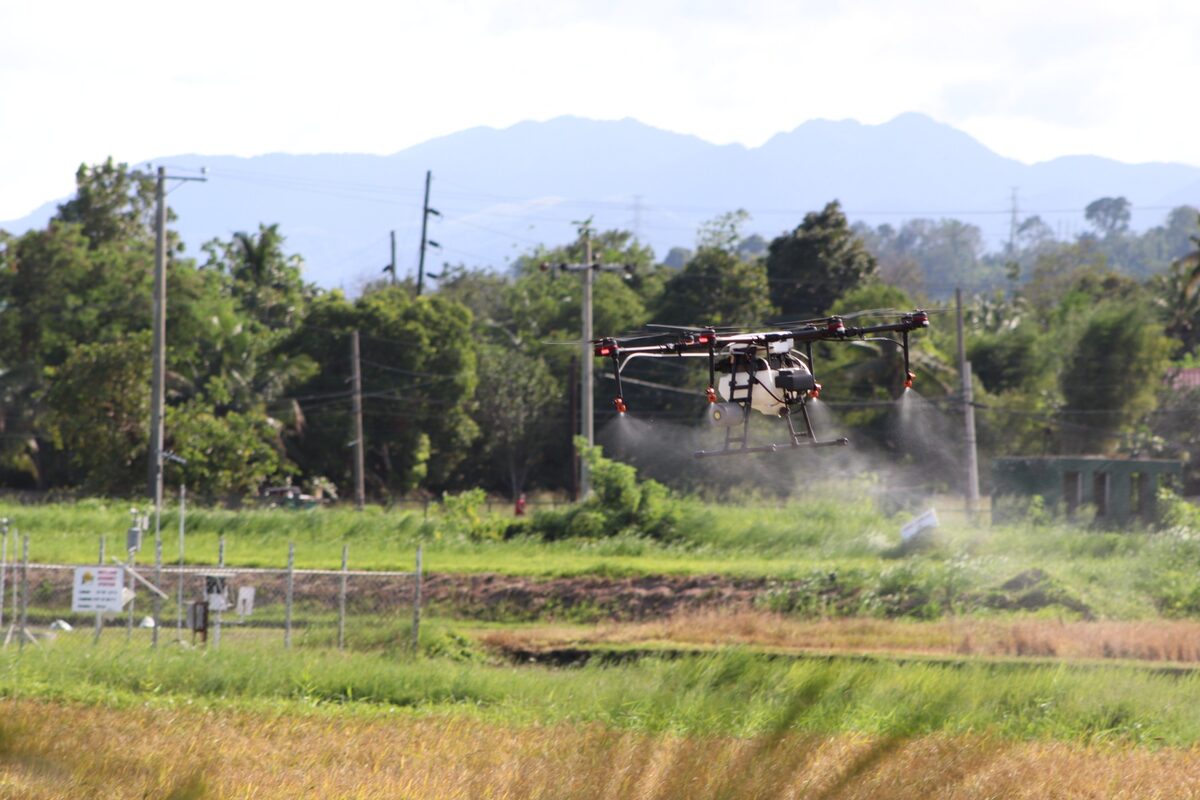
Agricultural drones sow rice by broadcasting it. The aircraft flies over a flooded or muddy paddy and scatters seed, and the seed lands wherever rotor downwash and gravity put it. A team at South China Agricultural University (SCAU) is trying to make the drone plant in rows instead. Their method is a pump that fires germinated rice into the mud in timed pulses, so each cluster of seed is driven down through the rotor wash instead of drifting in it.
The work is described in a paper in the Transactions of the Chinese Society of Agricultural Engineering (volume 42, issue 19), with Zhou Zhiyan as corresponding author. DroneXL covered it on Nov. 18. The engineering is careful. The agronomic claim attached to it, a yield gain over broadcast seeding, rests on far less data than the headline figure implies.
The Problem With Broadcasting From the Air
Zhou, Chen Jiahao, Yang Deshuai and colleagues set out the case in a separate review in the Journal of South China Agricultural University. They write that UAV direct seeding is still mainly broadcasting, and that this has two weaknesses. Seed falls unevenly, and poor air permeability in the crop makes diseases and pests more likely. Ordered seeding, which improves the row and hill alignment of seed, is in the review's words conducive to better sowing quality and to stable, increased yields.
According to DroneXL, XAG brought broadcast granule spreading to rice in 2020. Moving from scattering seed to placing it is the next step, and it is a hard one for a vehicle that hovers on a column of moving air.
How the Pump Works
The SCAU design does not drop dry seed. It pumps a slurry of sprouted rice, cellulose powder, bentonite and water, and it runs in 10 Hz pulses. The pump pressurizes the mixture and raises the seed's exit speed, which limits how far the rotor wind field pushes the seed off its line. In the field trial reported by DroneXL, the drone flew at 2 m/s, 2 m above the mud.
The pump itself was the main design problem. The researchers compared three architectures: an axial-flow pump, a helical impeller pump and a semi-open impeller pump. They ranked them with the Analytic Hierarchy Process (AHP), a weighted multi-criteria scoring method, using four criteria weighted at 16.76%, 23.11%, 48.41% and 11.72%. The semi-open impeller scored 0.985 on the composite index. The axial-flow pump scored 0.464 and the helical impeller 0.231.
The team then refined the semi-open impeller with computational fluid dynamics and a Box-Behnken response-surface experiment. The optimized pump has 4 blades, a 76 mm impeller and a 22 mm blade width. It moves 1.12 kg/s of slurry.
Seed damage is the figure that decides whether a seeding pump is usable at all. Spinning germinated rice through an impeller can break sprouts and kill seed. The optimized design damaged 0.74% of seed. The paper set a damage rate below 0.8% as an optimization objective, and DroneXL describes 0.8% as the ceiling in China's national standard for drone rice seeding. The pump passes that, though not by much.
What the Field Test Showed
Field verification ran on Aug. 9, 2025, at a site in Guangzhou's Zengcheng district. The team compared the pulsed-jet pump with a commercial Seaflo DC pump on two placement measures:
- Lateral accuracy: the standard deviation of seed-cluster centers from the target line was 2.0 cm with the pulsed-jet pump and 2.9 cm with the Seaflo pump.
- Spacing consistency: the coefficient of variation in spacing between clusters was 13.2% for the pulsed-jet pump and 18.6% for the comparison pump.
DroneXL calls these the strongest numbers in the paper. A tighter lateral spread and more regular spacing mean the drone is laying down something much closer to a planted row than a scatter, which is the whole aim of ordered seeding. According to DroneXL, the comparison pump ran on the same rig.
The Yield Number, and What It Rests On
The abstract reports a yield of 6,731.03 kg/hm2 (kilograms per hectare). DroneXL's headline describes this as an 11% yield gain over broadcast seeding. The detail behind that figure deserves attention.
The crop was harvested on Nov. 22, 2025. According to DroneXL's account of the paper, yield was measured from three 1 m2 plots per seeding method at the one test site. Pulsed-jet plots yielded 6,430 to 7,028 kg/ha. Broadcast plots yielded 5,798 to 6,337 kg/ha.
The two ranges do not overlap, which is a point in the method's favor. But three square meters per treatment is very little ground from which to project a per-hectare yield. Paddy yields change with soil, water management, edge effects and small local differences that a handful of square-meter quadrats cannot average out. All the data come from one site and one season. Treat the result as an encouraging early signal that justifies bigger trials. It is not a demonstrated agronomic gain.
Limits the Authors Acknowledge
According to DroneXL, the researchers name two weaknesses themselves. The first is high power draw at the pump's working voltage. On a battery aircraft, that energy plausibly comes out of flight time and the area covered per sortie. The second is seed depth. The pulse puts the cluster in the right place in the plane of the field, but the team cannot yet control precisely how deep the seed goes into the mud, and depth affects emergence and establishment.
Both problems matter for practical use. A seeding system that places rows accurately but has to land often to swap batteries, or that buries seed at varying depths, gives back some of what the precision gained.
Why It Matters
Broadcasting has been the default for drone rice seeding because it is simple. The SCAU work shows that a drone can do ordered seeding with a purpose-designed pump. The method uses pulsed fluid momentum to get past downwash, and its seed damage rate came in under 0.8%. The placement results, 2.0 cm lateral deviation and 13.2% spacing variation, beat an off-the-shelf pump on the same test, and they are the kind of figure that matters for row-based field management.
The economics remain unproven. A yield advantage measured on three square meters per method, at one site, in one season, cannot show that drone row-seeding pays for itself. Power consumption and depth control will also decide whether the pump works in day-long operations. For operators and equipment makers, the useful takeaway is that pulsed-jet seeding is now a credible engineering approach, and the next proof needs to be multi-site, multi-season trials on realistic plot sizes.
Sources
- Design and experiment of a pulsed-jet rice seed metering pump for UAV (Transactions of the Chinese Society of Agricultural Engineering)
- Research progress and prospect of ordered seeding technology via unmanned aerial vehicles (Journal of South China Agricultural University)
- Chinese Drone Shoots Rice Seeds Into Mud, Lifts Yield 11% in Trial (DroneXL)
