
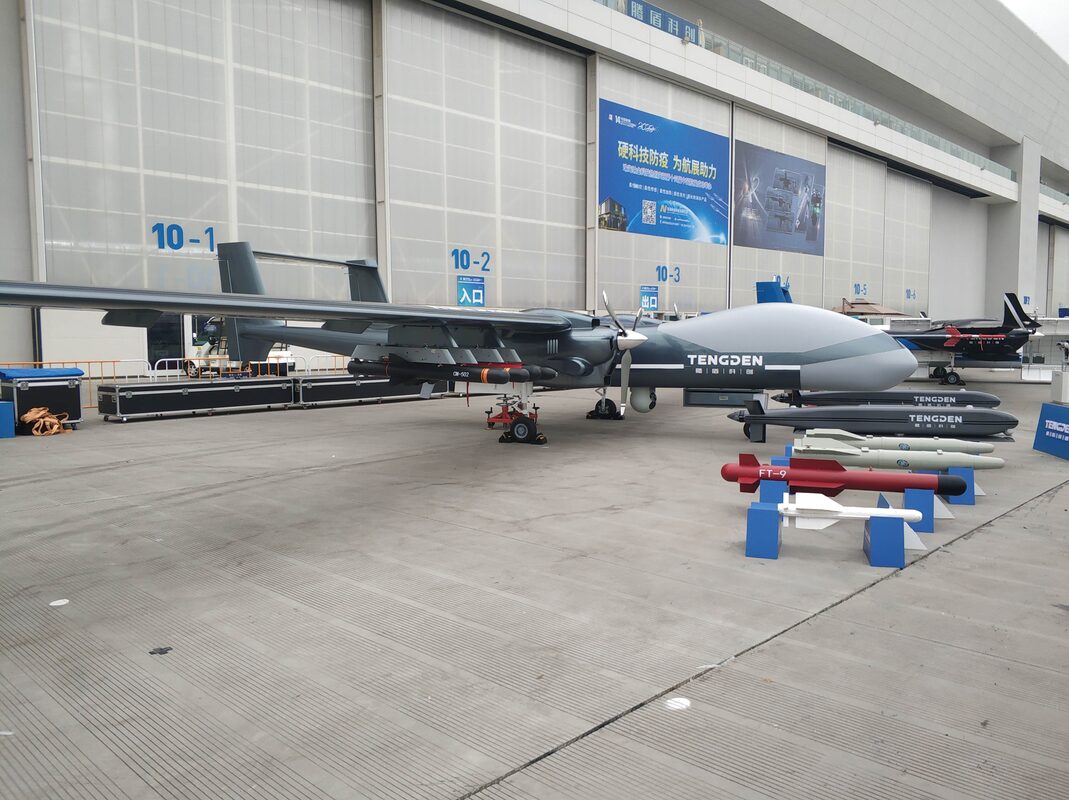
Air White Whale's W5000, which the company and Chinese state media call the world's largest uncrewed cargo aircraft, made its first flight on Saturday, Nov. 14, at Otog Front Banner Oljoq Airport in Inner Mongolia. The flight lasted about 30 minutes. It was a technical verification flight, not a demonstration with cargo aboard. It also came about 25 months after the aircraft was rolled out, and the service date the company now gives is more than a year later than the one it gave at rollout.
The flight shows that the airframe can take off, fly autonomously and land. It does not show that the business case works. The company's own numbers have moved during the program, and in one case two outlets that covered the flight disagree on a basic figure.
What happened on the flight
According to the flight account reported by DroneXL, which drew on the account published by the Changzhou municipal government, the W5000 began its takeoff roll at full thrust with 8 degrees of flap and left the runway after about 600 meters. It climbed at 5 meters per second at an indicated airspeed of 220 km/h to 1,000 meters. It then flew four turns at about 20 degrees of bank, descended to 500 meters and landed on a 3-degree approach.
Global Times agrees on the roll of roughly 600 meters and the 30-minute duration, but says the aircraft climbed to 2,000 meters. The reports do not explain the difference. DroneXL's account gives more detail, with climb rate, airspeed, bank angle and approach path, while the state-media figure is twice as high. Until the developer publishes flight-test data, the altitude is unresolved. In either case the profile is a first-flight envelope check, and nobody has claimed it was a test of performance at the edges of the envelope.
Global Times said the flight covered autonomous flight and data-link tests and described the operating concept as "autonomous flight plus ground monitoring." That distinction matters for a cargo drone. Remote piloting means a person flies the aircraft from the ground. Here the aircraft flies itself and an operator on the ground supervises. A cargo network that depends on the aircraft flying its own routes needs the second model.
The aircraft, by the numbers
The W5000 is named for its 5,000 kg payload, as The War Zone reported when the design appeared at Airshow China 2024 in Zhuhai. The published specifications:
- Payload: 5 metric tons
- Maximum takeoff weight: 10.8 metric tons (10,800 kg)
- Maximum range: 2,600 km
- Cruise speed: up to 526 km/h (2024 figures)
- Cargo volume: more than 65 cubic meters
- Dimensions: about 75 ft long with a 74.5 ft wingspan, per DroneXL
- Propulsion: twin turboprops, reportedly AEP-100 engines from Aero Engine Corporation of China
The 2,600 km figure is the maximum range. It is not the range with a full 5-ton load. DroneXL notes that the flight announcement lists payload and range as separate maximums and does not say how far the aircraft flies with 5 tons aboard, and for a freighter that number usually matters more to operators. Payload is nearly half of maximum takeoff weight, which leaves a fixed budget for fuel. A long range and a full load are unlikely to be possible on the same flight.
Global Times also said the aircraft's 220,000 components are domestically produced and that carbon-fiber composite makes up 65 percent of the airframe, according to information released by the company.
The orders: 835 letters, zero contracts
Global Times reports that the company has received 835 letters of intent for orders, with prospective customers including several domestic logistics companies. DroneXL noted two qualifications. Letters of intent are not purchase contracts, and the announcement names no customers.
Letters of intent cost little to sign and bind nobody. They show that a logistics operator is interested, not that it has committed money. No paying cargo has flown on the W5000. The figure of 835 is better read as a measure of how far the company has marketed the aircraft than as an order backlog.
The cost claim keeps rising
The most notable number in the coverage is chief executive Hu Zhendong's statement that cost per ton-kilometer could be more than 60 percent lower than for comparable piloted freighters. DroneXL traced how this claim has changed:
- 2024 reports: about 40 percent savings
- Company website: 43 percent
- Hu, after the first flight: at least 60 percent
Between 2024 and now the program flew once, for 30 minutes, with no cargo. None of the reports describe new operating data that would support a larger savings figure. Economic projections for an aircraft that has not carried a commercial load are estimates. When the estimate gets more optimistic while the schedule slips, readers should treat it with caution.
The schedule
The W5000 was rolled out on Oct. 18, 2024. At that point, according to DroneXL, deliveries were expected in the second half of 2026. Instead the second half of 2026 produced the first flight, about 25 months after rollout. State broadcaster CMG, cited by Global Times, now says commercial service will begin by the end of 2027.
The biggest unknown is airworthiness certification. DroneXL reported that the Changzhou account says certification work is moving ahead but gives no date. A five-ton uncrewed aircraft flying autonomous cargo routes needs regulatory approval before it can carry a customer's freight, and no published plan explains how the W5000 gets from one verification flight to certification in about 13 months.
The military question
Air White Whale presents the W5000 as a logistics product. The War Zone noted in 2024 that its payload is just below the 5,500 kg of the Xi'an Y-7, a crewed twin-turboprop transport still in Chinese military service. DroneXL makes the same comparison and calls the aircraft a civil program with an obvious second potential customer. An uncrewed aircraft able to carry close to a light tactical transport's load over 2,600 km could be useful for resupplying remote or contested positions, where losing an aircraft costs no crew. That is inference: none of the current reporting identifies a military customer or program.
Why It Matters
Large uncrewed freighters are moving from concept toward real aircraft, and China wants to lead in the heavy end of that market. The W5000's first flight is a real milestone. Airframe, engines, flight controls and data link all worked together in the air, and that is the point where many programs fail.
But a first flight is the start of the hard part. The facts on the record are one 30-minute flight, an altitude figure the two main accounts disagree on, a maximum range that is not the range at full payload, 835 nonbinding letters with no named customers, a cost-savings claim that grew from 40 to more than 60 percent without new evidence, a delivery target that has already slipped by more than a year, and no certification date. Defense and logistics analysts should follow the next steps: a flight test campaign with published results, a first named and binding contract, and a certification plan with dates. Until then the W5000 is a promising demonstrator, not a freighter in service.
