
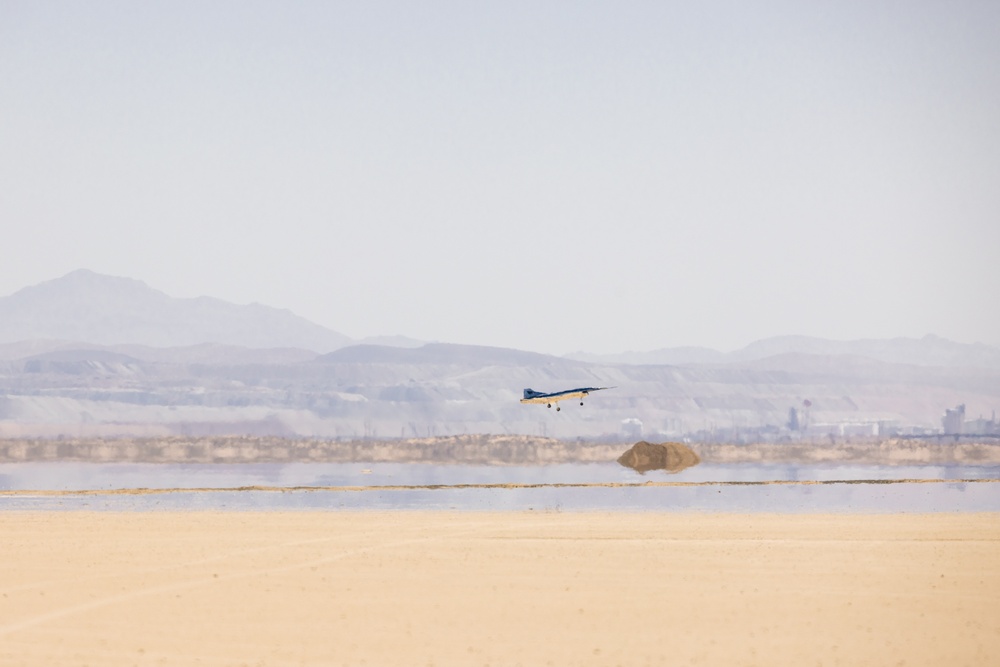
Hermeus has spent most of its existence proving it can make an uncrewed airplane go fast. The startup's announcement on Nov. 12 is about what that airplane might carry once it gets there.
Hermeus and Northrop Grumman announced a strategic teaming agreement that day, in parallel press releases from Los Angeles and Baltimore. Under the deal, Northrop will provide design, development, integration and sustainment of integrated mission systems for Hermeus's next generation of reusable, unmanned high-Mach aircraft. Hermeus's release says the collaboration creates a path to equip its aircraft with technology across sensing, communications, navigation, and command and control. Northrop's release frames the pairing as its "combat-proven mission systems" and "ready-now" electronic warfare, communication, sensing and autonomy expertise joined to Hermeus's Quarterhorse aircraft, with the stated goal of rapidly fielding autonomous high-Mach aircraft.
The two releases leave out a lot. Neither names a customer program, an operational mission, a delivery schedule or a dollar value. As The War Zone noted, neither company's release elaborates on the kind of operational missions the future drones could be tasked with.
What each company brings
The split of work follows a common pattern for a startup and a prime contractor. Hermeus brings the aircraft and what its release calls a rapid development approach, along with an in-house mission management system core. Northrop supplies the mission systems expertise that could turn a fast test vehicle into something a military customer might buy.
The piece of the announcement with the most technical substance is Hermeus's own. According to the Hermeus release, the company developed its mission management system (MMS) core in-house. Hermeus describes it as an open, modular system of systems that keeps flight-critical and mission-critical functions cleanly separated. The company says the core is built to the government's Agile Mission Suite and Autonomy Government Reference Architectures (AMS-GRA and A-GRA) and to the Open Mission Systems/Universal Command and Control Interface (OMS/UCI) standards. On that basis, Hermeus says the core allows the companies to integrate and update mission capabilities "in weeks rather than years" as requirements evolve.
Northrop's release makes a similar argument from the buyer's side. It says the Department of War needs autonomous systems developed and fielded in months, not years. The Northrop release includes a quote from Kyle Mimken, a program manager at Northrop Grumman, and the Hermeus release quotes CEO Zach Shore.
Why the open mission core matters
Splitting flight-critical from mission-critical functions is the most practical idea in the announcement. Flight-critical software, the code that keeps the aircraft stable and controllable, is generally costly and slow to change, because changes have to be requalified. Mission software and hardware change much more often: a new EW technique, a different sensor, an updated datalink, revised autonomy behavior. If the two layers are kept apart behind standard interfaces, a payload provider like Northrop could, in principle, swap or upgrade mission equipment without reopening the qualification of the flight control system. That is an inference from the architecture Hermeus describes, not something either release spells out.
Building to government-recognized open standards such as OMS/UCI should also make the aircraft easier for a military customer to accept. A mission core that uses interfaces the services already know is easier to integrate with existing command-and-control systems. Hermeus's "weeks rather than years" figure is a claim about that architecture, not a demonstrated result. Neither release describes a specific capability that has been integrated on that timeline.
Where Quarterhorse stands
The deal comes as Hermeus's flight test program advances. According to The War Zone, the company was founded in 2018, and its delta-winged Quarterhorse Mk 2.1 was the first of its demonstrators to break the sound barrier, in a test flight in May. The Mk 2.1 has also demonstrated the ability to release stores at high speed, which is directly relevant to any future payload or effects role. The company is now working on the Mk 2.2, which it hopes to push beyond Mach 2. The company's stated end goal is a design capable of hypersonic flight.
Hermeus also unveiled Ramjet-X in September, a smaller ramjet-powered platform that can be air-launched from Quarterhorse drones. Separately, the Defense Innovation Unit posted on July 30 about a successful unmanned stores-separation flight test under its HyCAT effort, which it described as only that program's fifth flight since the spring.
Together, these milestones describe a company that has been building speed, store release and test tempo. The Northrop deal adds a partner for the mission systems that would go inside future airframes.
What is still unstated
The gaps in the announcement are worth listing, because they will decide whether this partnership leads to a fielded system or stays a teaming agreement.
- Customer. Neither company names a service, program office or contract vehicle. The Northrop release refers to the Department of War's needs in general terms only.
- Mission. The capability areas named across the two releases (EW, sensing, communications, navigation, C2, autonomy) cover almost every role an uncrewed aircraft could fill. The releases do not say whether the focus is reconnaissance, electronic attack, decoy work, strike or something else.
- Aircraft. The Hermeus release refers to its "next-generation" reusable high-Mach platforms. Neither release says which Quarterhorse variant, if any, will carry the first Northrop mission systems.
- Schedule and money. No timeline for integration or flight testing is given, and no dollar value is disclosed.
Why It Matters
Speed alone does not make a useful military aircraft. A high-Mach drone becomes operationally relevant only when it carries sensors, emitters and autonomy that can do something useful at that speed, and when those payloads can keep up with changing threats. Hermeus has shown in test flights that its airframes can go supersonic and release stores. Teaming with Northrop gives the company a partner with established mission systems and electronic warfare expertise, and gives Northrop a role on a high-speed uncrewed test program.
The bigger bet is architectural. Both companies are pitching a fast path to fielding: Hermeus through an open, standards-based mission core with flight-critical and mission-critical functions separated, and Northrop through autonomous systems fielded in months, not years. If that holds up, it is a model other uncrewed programs could copy. The announcement shows the design intent. It does not yet show a program, a mission or a date, and those details will determine what this agreement is worth.
Sources
- High-Speed Aircraft Startup Hermeus Joins Forces With Northrop Grumman (The War Zone)
- Northrop Grumman to Power Hermeus' Mission, Bringing to Life a New-Class of Autonomous Military Aircraft (Northrop Grumman)
- Hermeus and Northrop Grumman Team Up to Bring Advanced Mission Systems to High-Mach Aircraft (Hermeus)
