
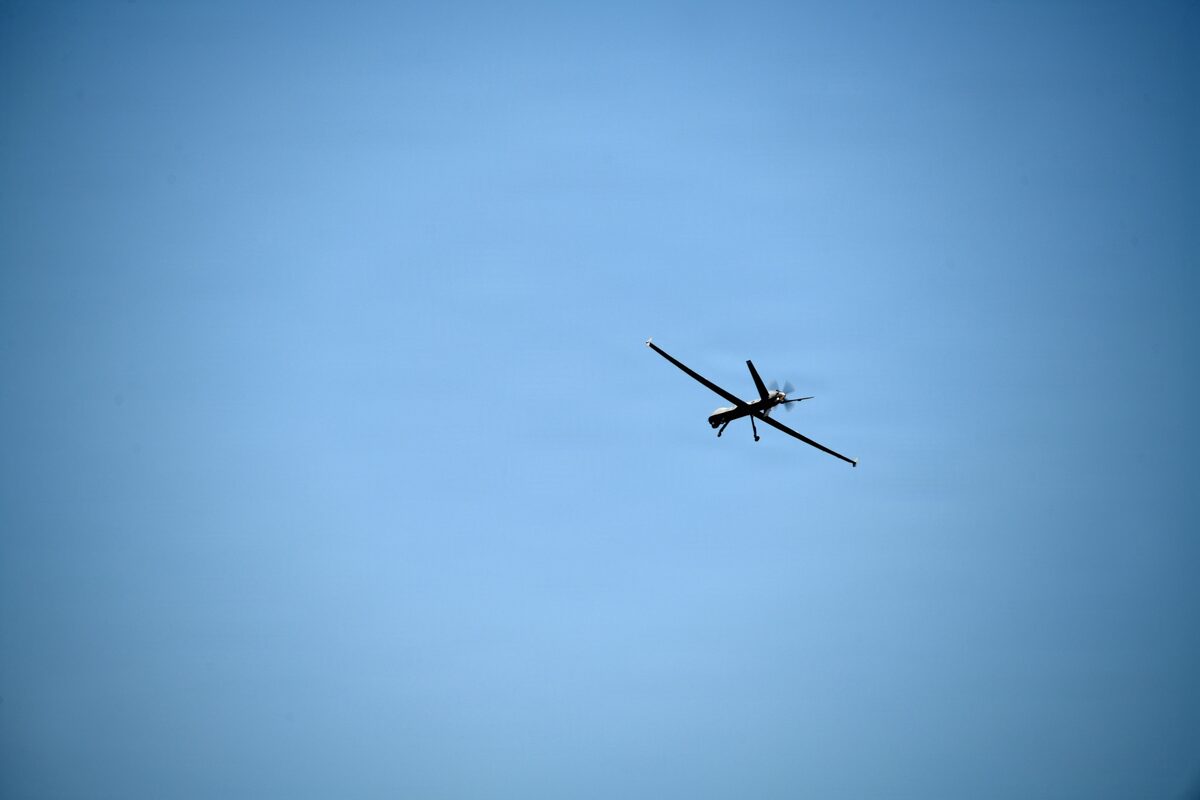
Germany's newest long-endurance drone has flown, but not yet as a drone. On Saturday, Nov. 14, the AeroForce X prototype, registered D-IAFX, took off from Strausberg airfield east of Berlin with a pilot in the cockpit. Its developer, Braunschweig-based Aerodata AG, says the flight went to plan.
According to the company release relayed by Defence Network, the sortie lasted about an hour. The crew checked controllability, stability and system performance, and Aerodata says every requirement for a first flight was met. DroneXL reported that the release it saw gave no flight time, so the one-hour figure rests on Defence Network's account.
Aerodata CEO Neset Tükenmez said the company had flown its own aircraft platform for the first time in its history, and described the AeroForce X as the first German MALE-UAS. Ole Vörsmann, who heads the company's unmanned systems division, is also quoted in the release. Those are big claims for a prototype that has flown once, with a human at the controls. No German military order for it has been announced.
What Flew, and What Didn't
Flying a prototype MALE (medium-altitude, long-endurance) aircraft with a pilot first is a common way to reduce risk, since engineers can check the basic aerodynamics and handling before handing control to an autopilot and a ground station. Aerodata has said what comes next: more crewed flights, then autopilot testing, then the first uncrewed flight. The company has not given a date for that milestone. When the prototype was unveiled in August, ingenieur.de reported that flight testing without a crew was planned to continue from 2027.
The first flight came later than planned. Ingenieur.de reported that final assembly was finished in June, that the aircraft was shown publicly on Aug. 19, and that the first flight was planned for mid-October at Strausberg. It actually happened about a month later. For a new aircraft program that is a small delay, but it shows the program is still early.
The Numbers, as Aerodata States Them
Most published performance figures for the AeroForce X come from the manufacturer. Ingenieur.de points out that, apart from the dimensions, they are largely manufacturer claims and development targets rather than flight-test results. With that in mind, here is what Aerodata says the aircraft is built to do:
- Wingspan: 26 m (about 85 ft)
- Endurance: up to 40 hours
- Payload: up to 1,300 kg (about 2,866 lb): 700 kg in the fuselage and 325 kg on each underwing hardpoint
- Range: up to 10,000 km (about 6,214 mi)
- Ceiling: about 12.2 km
- Maximum takeoff mass: just under 5 tonnes (about 11,000 lb)
Aerodata says the main mission is monitoring critical maritime infrastructure. Ingenieur.de described the kinds of payloads Aerodata lists, including radar, cameras and sonar buoys. Aerodata says the aircraft is meant to carry and deploy sonobuoys and process the data they return, which would take it beyond watching the surface. Ingenieur.de also reports that the company is targeting series production in 2029.
A Rescued Airframe
The AeroForce X did not start as an Aerodata design. The airframe began life as the i-5 at Apus Aeronautical Engineering in Strausberg. According to ingenieur.de, citing public broadcaster rbb, Apus ran into financial trouble, and Aerodata took over the project in 2025. DroneXL notes that for more than 40 years Aerodata has built flight-inspection and surveillance systems that fly in other manufacturers' aircraft, so this is its first aircraft platform of its own. That makes the program a step up for the company, from integrating systems on other manufacturers' aircraft to developing an aircraft itself.
Taking over an existing, largely developed design is likely part of why the program moved as fast as it did. Aerodata took over the project in 2025 and flew the aircraft in late 2026, which DroneXL called fast for a company that had never flown an aircraft of its own.
Measured Against the Heron TP
The obvious comparison is the Israeli-built Heron TP, which the Bundeswehr already operates. Ingenieur.de's headline makes that point: it is about the same size, but Aerodata claims the new aircraft can stay airborne much longer. Ingenieur.de and DroneXL give the Heron TP's figures as 27 hours of endurance and 1,600 kg (3,527 lb) of payload.
On paper, then, the AeroForce X would stay up 13 hours longer and carry 300 kg less. Those are design figures, not demonstrated ones. Ingenieur.de says the flight test program has to show whether the 40 hours can actually be reached. Endurance figures for long-endurance aircraft usually depend on the configuration, including payload, fuel and mission profile, so the 40-hour figure and the 1,300 kg payload figure should not be assumed to apply on the same flight. The Heron TP's 27 hours is the figure the Bundeswehr itself cites for an aircraft already in service. A fair comparison will only be possible once the AeroForce X has flown uncrewed, with sensors on board, for a sustained period.
Ingenieur.de also names the Eurodrohne as a competitor. Germany is developing that considerably larger MALE system with France, Italy and Spain, and ingenieur.de says Airbus plans its first flight for 2029. Aerodata is therefore pitching a German-built, ITAR-free platform, meaning one that is not subject to US arms export rules, against both non-European and European alternatives.
Why It Matters
Germany flies the Heron TP and is waiting for the Eurodrohne. A German-developed MALE aircraft from a mid-sized company could, in principle, interest a government that wants more control over its own surveillance capacity. Berlin, however, has made a different choice for now. As DroneXL notes, Germany ordered eight MQ-9B SeaGuardians from General Atomics in January for $1.78 billion, to watch the same North Sea and Baltic waters Aerodata is building for, and no German military order for the AeroForce X has been announced. Ingenieur.de reported in August that Aerodata was in talks with the Bundeswehr.
That leaves Aerodata's aircraft in an awkward position. The SeaGuardian purchase covers the same maritime surveillance mission Aerodata is targeting. To win business, the AeroForce X will probably have to compete on cost, on being German-built, or on being free of US export restrictions. DroneXL expects the first customer to be an export buyer who wants an MQ-9-class aircraft without asking Washington first, and notes that Aerodata signed a partnership in India in April.
None of that can happen until the aircraft flies without a pilot. The Nov. 14 flight shows that the airframe flies. It does not yet show that the autopilot, ground control system and datalinks work, and it does not show the endurance that is the aircraft's main selling point. Germany's first homegrown MALE drone is a real aircraft now. The uncrewed flight testing planned from 2027 will show whether it becomes a viable product.
