
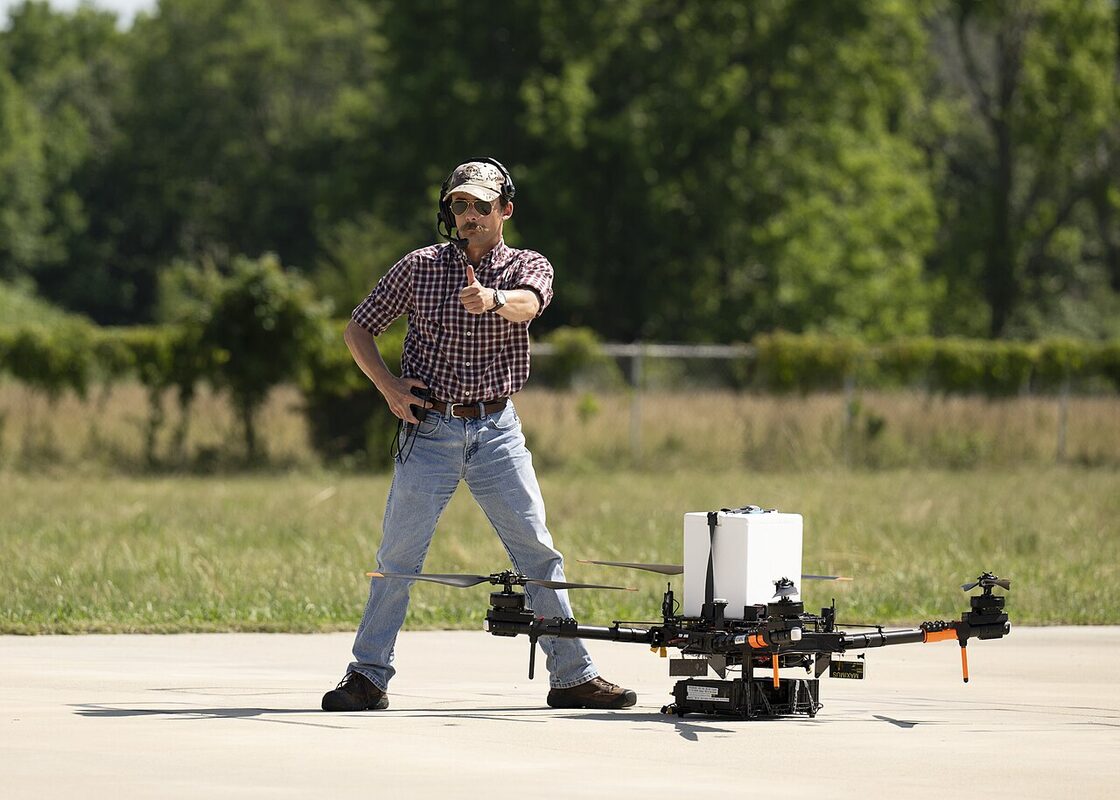
Most small-drone preflight checks still come down to a remote pilot's eyes and fingers: look at the props, wiggle the arms, spin things up and see whether anything sounds wrong. A team at the University of Cincinnati, working with a researcher from NASA's Ames Research Center, wants to hand that last step, the part where the pilot listens, to a machine.
The group has built a ground-based check that runs a drone's motors one at a time before flight, records them with microphones mounted near the motors and propellers, and lets software decide whether the powertrain sounds healthy. If it does not, computers at a ground station tell the operator the aircraft is not airworthy before it leaves the ground, according to the University of Cincinnati.
The work was presented at the Modelling, Estimation and Control Conference (MECC 2026) in Phoenix, which DroneXL reports ran Oct. 25-28. Local TV picked it up on Nov. 17. Several practical details are still unknown, and they are covered below.
What did the team actually build?
The project comes out of Professor Manish Kumar's lab at UC's Digital Futures. Doctoral student Prissha Chawla and her collaborators recorded the sounds of chipped and cracked propellers and of failing motors, then converted those recordings into data that computers at a ground station can use to flag a damaged powertrain, the university said. Chawla also pointed to grit and debris in motor bearings, which can make a motor seize.
According to Spectrum News 1, the procedure is simple. Microphones go near the motors and propellers, and each motor is run individually before flight. Running the motors one at a time plausibly makes it easier to tie an abnormal sound to a specific motor rather than to the whole aircraft, though the sources do not spell that out.
Chawla, 23, has been part of the student group working with NASA since 2024, Spectrum News 1 reported. She told the station that the sound changes with the degree of the fault, so a slight fault and a severe one do not sound the same.
Where does NASA come in?
Chawla told the university the project "started in 2024 with interest by NASA in detecting problems with motors before a drone took off." She added that the team is focusing on preflight tests NASA already runs. The NASA co-author is Chetan Kulkarni, who works in the Diagnostics and Prognostics Group in the Ames Intelligent Systems Division. NASA describes that group as performing research in fault detection, diagnostics and prognostics. Kulkarni told Spectrum News 1 that the collaboration with UC focuses on evaluating the health of drone systems before they fly missions.
The full author list, as reported by DroneXL, is Chawla, Manish Kumar, Siddharth Urankar, Luke Busse, Manuel Arias Chao of the Zurich University of Applied Sciences, and Kulkarni.
How does the software decide a motor is bad?
The paper is titled "Acoustic UAS Powertrain Monitoring: An Empirical Semi-Supervised Anomaly Detection for UAS Powertrains." DroneXL reports that the core model is a one-dimensional convolutional autoencoder trained on recordings of healthy brushless motors across nine operating maneuvers.
That design choice is the most interesting part of the work. An autoencoder learns to compress its input and then rebuild it. If it is trained only on healthy-motor audio, it gets good at rebuilding healthy sound and worse at rebuilding anything else. When a cracked prop or a degraded motor produces a sound the model never learned, the rebuilt version drifts from the original, and that gap is the anomaly signal. A UC student, Taha Momayiz, described the goal to Spectrum News 1 as teaching a model all the healthy data and how it sounds.
The semi-supervised approach gets around a practical problem in fault detection. Failure data is scarce, and there are many ways a part can fail. A system that only needs examples of normal operation does not need a recording of every possible fault before it can be deployed. DroneXL says the team did not have to collect and label a recording of every possible failure, because any sound that does not match what the model learned is flagged.
How well does it work?
According to the abstract, as reported by DroneXL, the method reaches about 97% precision and about 92% recall. DroneXL's reading, treating a fault as the positive result, is that roughly three in every 100 fault warnings are false alarms and about eight in every 100 faults are missed.
For a preflight gate, those two numbers matter in different ways. High precision means operators are not constantly grounded by false alarms, which matters because a check that cries wolf gets ignored. Recall shows how many faults get through, and in that test set about eight in 100 did. That is better than nothing, but DroneXL's own take is that it works as a second opinion for the pilot's inspection, not a replacement for it.
What is still unknown?
A fair amount. The abstract as reported does not name the aircraft used in testing or say how many microphones the setup needs. DroneXL notes that the full paper is not yet on arXiv or NASA's technical reports server, so the headline figures cannot yet be checked against the full methodology, dataset size, fault types or test conditions. Until the paper is out, the 97/92 figures should be read as abstract-level claims.
The sources also do not say how the system would cope with real field conditions such as wind, nearby equipment, other aircraft on a shared pad, or a different airframe that the model was not trained on. A model trained on one set of healthy motors may need retraining or calibration for each new platform, though that is an open question rather than a reported finding.
Why It Matters
A cracked blade or a failing motor is the kind of fault a pilot would want to catch on the pad, before the aircraft is over people, property or a mission area. Chawla framed the goal in those terms to Spectrum News 1: making sure drones do not crash on their way to a mission or on the way back.
The approach also fits the regulatory context. DroneXL notes that Part 107 requires the remote pilot to check that the aircraft is in a condition for safe operation before every flight (14 CFR 107.15), and it reports that the abstract says the results support adding real-time acoustic diagnostics to In-Time Aviation Safety Management Systems, the NASA concept for continuous safety monitoring. DroneXL also observes that a microphone is cheap and light.
The clearest operational path is automation. UC's Busse told the university the damage-detection system could be a feature of fully autonomous drone-in-a-box systems, and DroneXL reports he suggested a dock could carry the sensors and run the check on its own. For docked, remotely operated fleets with no one standing next to the aircraft, an automated acoustic run-up before each launch could take over a check that a pilot would otherwise do by hand. For now the analysis runs on a ground-station computer, and whether the method holds up across airframes and noisy environments will depend on details the full paper has yet to make public.