
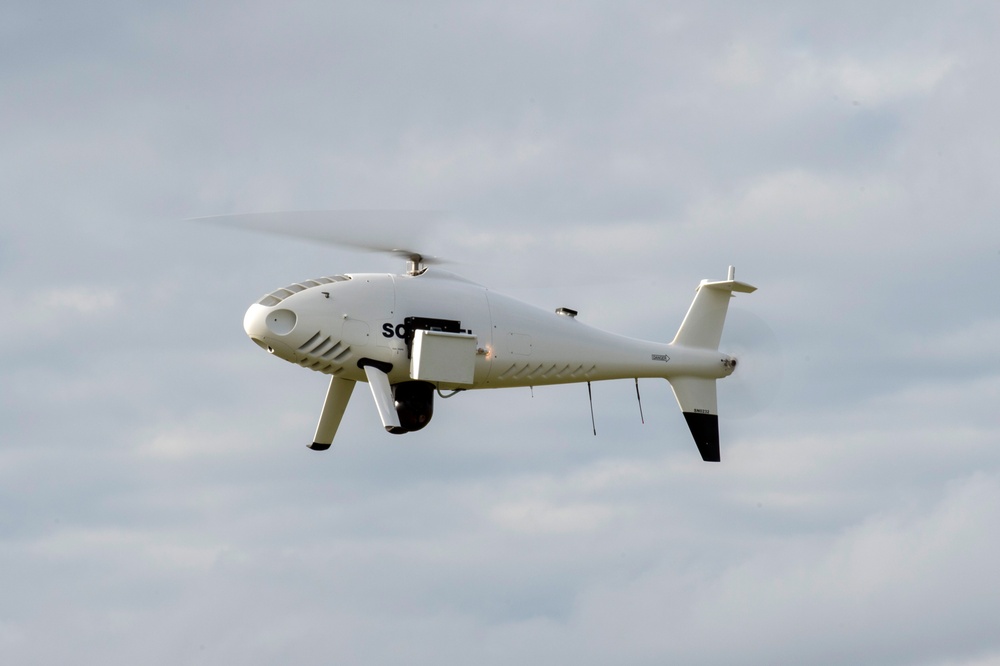
Schiebel has flown its CAMCOPTER S-100 as a drone mothership. The Vienna-based company announced on November 18 that the S-100 carried a small uncrewed aircraft aloft, released it in forward flight and then relayed the small drone's link. The proof of concept took place in Austria with OSIRIS Poland. The payload was an OSIRIS HSCD-1 camera drone, and Schiebel says the S-100 acted as "airborne carrier, deployer and communications relay" for it.
The test is narrow and the announcement says nothing about orders. According to DroneXL's reading of the release, the HSCD-1 was inert and carried no warhead. Schiebel named no customer, no contract and no delivery date. What the company did show is that its unmanned helicopter can launch a second aircraft partway through a mission and then keep it under control from altitude, which a ground launch cannot do.
What Actually Happened
Schiebel describes three steps. The S-100 carried the HSCD-1 on a side mount, according to DroneXL's photo caption. It released the small drone while flying forward, not while hovering over a launch point. Once the HSCD-1 was flying, its control link and video passed through the S-100 instead of going straight to the ground station.
The relay is arguably the more important part. A small quadcopter or fixed-wing sUAS launched from the ground is limited by its own radio horizon, and terrain, ship superstructure or the curvature of the earth can cut the link well before the battery runs low. Using a larger aircraft that is already at altitude as the relay moves the link's origin up and forward. Schiebel says the result extends the small drone's reach and endurance beyond what a ground launch allows. The second effect follows from the first: the small drone no longer spends battery flying out to the area of interest, because the S-100 has already brought it there.
The release does not give the altitude, airspeed, separation distance or relay range achieved in the test, and it does not say how long the HSCD-1 flew after release. Those numbers would show how far the concept has matured. Without them, this is best read as a demonstration that the basic sequence of carry, release and relay works, not as a measure of operational performance.
The Carrier
The S-100 is best known as a surveillance aircraft flown from warships, which helps explain why Schiebel is pitching it as a launch platform and not only as a sensor carrier. DroneXL reports a payload capacity of 75 lb (34 kg), endurance of up to 10 hours and beyond-line-of-sight operation out to 124 mi (200 km), attributing the figures to Schiebel. The outlet also notes that Canada chose the S-100 for its Halifax-class frigates in September 2025.
A payload budget of 34 kg leaves room for a small drone plus a release mechanism, and possibly more than one airframe depending on what is carried. Ten hours of endurance also changes the planning. A small drone that would normally fly for minutes from a ship's deck could wait on the helicopter until a target or contact appears, and then launch close to it.
Schiebel is not limiting the idea to the S-100. The company says the mothership concept could apply to its S-101, S-300 and S-301 airframes, and that the concept can also support high-speed interceptor drones equipped with effectors, as well as loitering munitions, in addition to reconnaissance drones like the HSCD-1. That is a much larger claim than a camera drone drop. Interceptors and loitering munitions bring weapons integration, safety certification and rules-of-engagement questions that an inert test does not address.
Who Is OSIRIS?
Schiebel's partner in the test is identified as OSIRIS Poland. The name also belongs to a counter-drone developer that drew attention earlier this year. At Xponential Europe 2026 in March, OSIRIS AI unveiled the UEB-1, a high-speed interceptor drone. Unmanned Airspace reported the following specifications:
- Top speed of up to 315 km/h (196 mph)
- Airframe of 370 x 370 x 550 mm, with a weight just above 3 kg (about 6.6 lb)
- 10,000 mAh battery
- Warhead of up to 0.5 kg (about 1.1 lb)
- AI-based predictive target tracking
RBC-Ukraine, which described the UEB-1 as a Ukraine-Poland drone, added a flight time of more than 10 minutes and a line-of-sight range of up to 18 km (about 11 mi). It also said OSIRIS AI's production lines are in Ukraine and Poland, with its research center in Kraków. Unmanned Airspace described OSIRIS as Ukrainian.
The connection between the two is easy to assume, but nothing in the record confirms it. Schiebel's release does not say whether OSIRIS Poland and OSIRIS AI are the same company, affiliates or unrelated. It also does not mention the UEB-1. Readers should treat any link between the two as unconfirmed.
The UEB-1's published numbers still show why the mothership concept matters for interceptors in particular. An interceptor with roughly 10 minutes of flight time and an 18 km line-of-sight link has little margin when launched from the ground at a target that is still far away. If a carrier with hours of endurance and a 200 km beyond-line-of-sight link brought it closer before release, both limits would matter much less. That remains a hypothetical pairing. Schiebel's statement that interceptors could be carried is a statement about the concept, not about any specific weapon.
Why It Matters
Small drones are cheap, numerous and increasingly lethal, but they share the same weaknesses: short endurance and short links. Two broad approaches have emerged to get around that. One is to make the small drone bigger and more capable, which raises its cost. The other is to carry it closer to the fight on something with more endurance. Schiebel's demonstration is a case of the second approach, using an uncrewed helicopter that navies already operate.
For a ship, a launch-and-relay capability on its existing rotary-wing UAS could turn one aircraft on deck into several sensors in the air. In a counter-drone role, it could also put interceptors closer to incoming threats than a deck or shore launcher can. Both payoffs are still prospective. The test used an inert camera drone, and Schiebel has given no customer, contract or timeline. The next things to watch are whether a navy funds further work, whether the relay range and release envelope are published, and whether a live interceptor or loitering munition is ever released from an S-100 in testing.
The demonstration is a real step, not just a rendering. The open questions are how far the concept goes beyond it, and who will pay to take it there.
Sources
- Schiebel demonstrates CAMCOPTER S-100 as drone mothership (Schiebel, November 18, 2026)
- Schiebel's Navy Helicopter Drone Drops a Smaller Drone in Mid-Flight (DroneXL, November 18, 2026)
- Xponential Europe 2026: Ukraine's OSIRIS launches its high speed AI UEB-1 interceptor (Unmanned Airspace, March 25, 2026)
- OSIRIS UEB-1 revealed: Ukraine-Poland drone clocks 315 km/h (RBC-Ukraine, March 25, 2026)
