Hardware usually decides drone competitions. Teams with better motors, lighter frames or more expensive sensors start ahead. Horizons DroneHacks 2026, held at the Stanford Robotics Center from Nov. 6 to 8, took hardware out of the contest. Every team flew the same 7-inch quadcopter with the same flight controller, depth camera and onboard computer. Software was the only thing teams could change, and the course gave them no GPS.
About 100 students from 28 universities in two countries took part, according to The Stanford Daily. From Friday afternoon to Sunday evening, they had 48 hours to program a fully autonomous drone that could maneuver through an obstacle course without GPS. The Daily describes it as Stanford's first DroneHacks and its first automated drone hackathon.
One Kit for Every Team
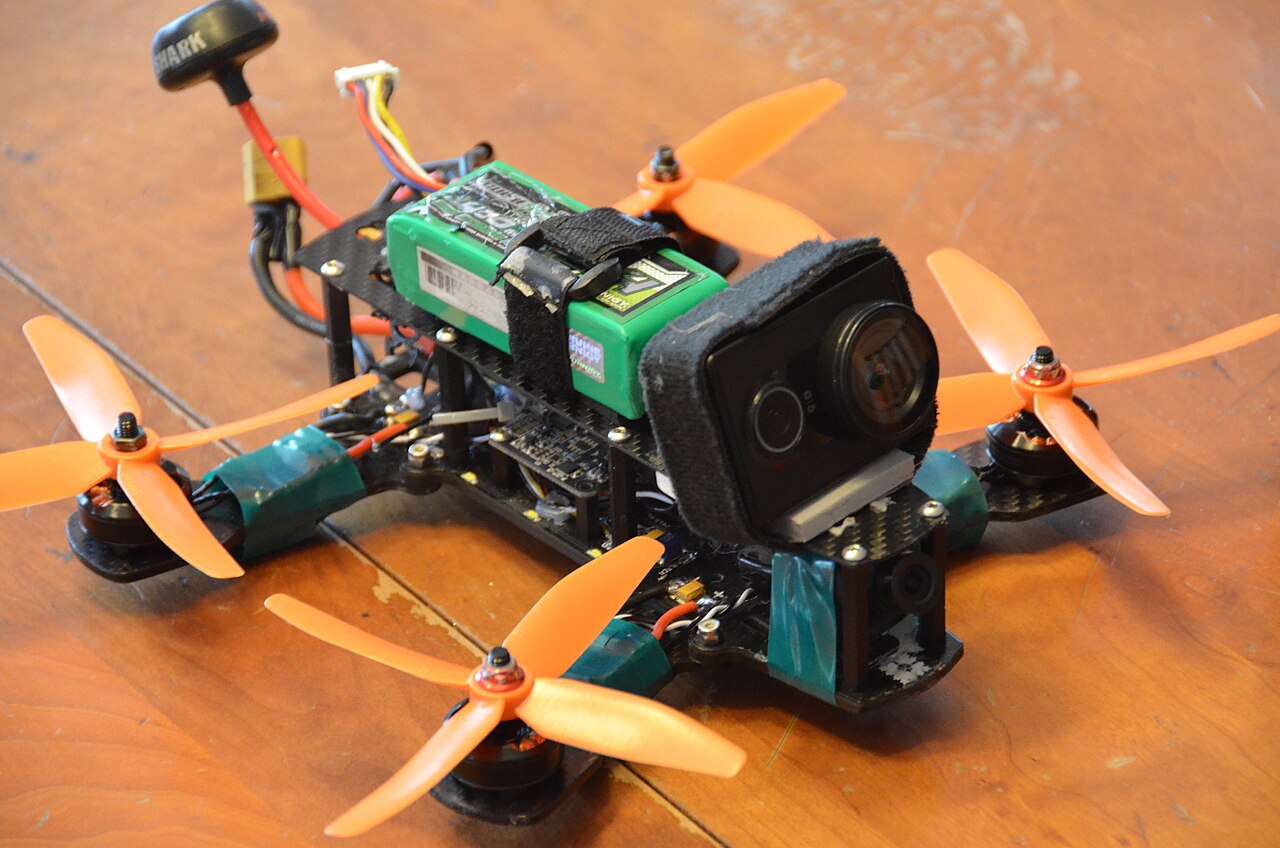
The organizers built 25 drones, all to the same design. Each was a 7-inch quadcopter with a Pixhawk 6C flight controller, a Luxonis OAK-D depth camera and an NVIDIA Orin Nano companion computer. The event page lists the same parts and notes that travel was funded for every accepted participant, subject to visa eligibility and reimbursement caps. The Daily reports that teams either flew the drones or used them for parts.
With every team on identical hardware, results came down to the software. The event page describes the task as designing, training and testing algorithms for perception, navigation, obstacle avoidance and autonomous decision-making. Teams received a downloadable simulator on Friday evening to train and calibrate their drones before they got time on the real course.
The flying area was a netted cage with plywood obstacles set on a red mat, according to a recap from the Dronecode Foundation, which sponsored the event and sent mentors. The organizers reported more than 200 test flights over the weekend, per Dronecode. Its mentors, Ramon Roche and Mike Pehel, pointed teams toward the open-source PX4 autopilot and ROS tools, so students could spend their time on the autonomy problem rather than rebuilding the stack underneath it.
Scoring, Checkpoints and a 5 a.m. Breakthrough
Judging was weighted toward actual flying. DroneXL reports that the course run counted for 60 percent of the score and the judges' assessment for 40 percent. The Stanford Daily says the judges scored technical merit and generality. The course had five checkpoints, and a drone that made it back to the start from the end earned a 25 percent bonus.
The winning team took a long time to get its drone moving through the real course. Fat Kestrel's drone did not make it halfway across until about 5 a.m. on Sunday, according to DroneXL and the Daily. The organizers had planned to close the cage at 2 a.m. but kept it open until 6:30 a.m. so teams could keep practicing. Fat Kestrel was made up of four sophomores from the University of Texas at Austin and a Stanford first-year master's student. Its last flight crossed the whole course and returned to the start. The team took first place and the $7,000 Rothberg Catalyzer Award.
Fat Kestrel won, but another team finished the course first. The Daily and DroneXL report that the first team to complete the course was Multi-Agentic B2B N2N DAS. The Daily says first place went to Fat Kestrel for the best combined technical impressiveness and course completion, so finishing first did not decide the top prize.
Prizes totaled $15,000. Besides the first-place award, the event page lists these prizes:
- Runner-up: $3,000
- Third place: $2,000
- Most Technologically Impressive: $2,000
- Fastest Run: $1,000
The Sim-to-Real Gap
Most teams ran into the same problem. Jeremy Hsieh, a Stanford student on the Multi-Agentic B2B N2N DAS team, told the Daily that there was a sim-to-real gap that "pretty much all teams, including us, very much struggled with." Code that worked in the simulator did not carry over cleanly to a real drone in the cage.
Fat Kestrel's weekend shows how that played out. Teammate Matthew Zhang spent Friday night into Saturday morning running the team's software in the simulator, according to the Daily. Through Saturday night and Sunday morning, nothing worked on the real course until the 5 a.m. flight that reached the halfway mark. After a two-hour nap, they went on to finish the course and return to the start.
Why the Event Moved to Fall
The hackathon was first planned for spring. It was delayed to fall for safety reasons, according to The Stanford Daily. Artash Nath, the event's founder and director, said the organizers wanted to be "as risk averse as possible." Dronecode's recap lists Nath as student director and Anish Bayya as associate student director of the organizing team. A netted cage is one visible result of that caution.
Who Paid, and Who Was Watching
The Rothberg Foundation was the primary sponsor, according to the Daily. DroneXL lists donors including Wing, Neros, Boeing, Skydio, Anduril, CX2, Ondas, Perennial Autonomy and Dronecode. Mentors came from Google Wing, Skydio and other companies, according to the event page. The Daily adds that Anduril showed one of its drones, fitted with a fake battery, to the students.
Organizers and sponsors described the event's purpose differently. Nath told The Stanford Daily that the event was non-recruiting and that the sponsors were there because their engineers had the technical expertise to mentor participants. Farzad Rahbar, co-founder of FlyX Technologies, told the same paper: "I'm always looking for talent." Both statements can be true. The organizers did not run it as a job fair, but the sponsors spent much of a weekend alongside about 100 students writing autonomy code under pressure. The Daily notes that several mentors and judges who planned to stay a couple of hours stayed nearly all weekend.
Why It Matters
GPS-denied flight is not just a student exercise. DroneXL points to a U.S. Special Operations Command acquisition office that told industry in May to expect no GPS in future fights, and says the sponsors have reasons to care about the problem. A drone that stops working when it loses GPS is a liability in that setting.
The hackathon's format matters too. Because every team had the same hardware, the event showed how much autonomy performance depends on software, and how far a team can get in a weekend with an off-the-shelf stack of Pixhawk, PX4, ROS, a commercial depth camera and an Orin-class computer. It also showed how hard it is to move code from a simulator onto a real drone, a gap the students themselves described.
For the commercial and defense drone companies that backed the weekend, the event gave a look at student talent working on a hard problem. Keynote speaker Noah Rothberg, a trustee of the Rothberg Foundation, told the students that "better technology could be the difference between life and death." Nath told the Daily the organizers' goal: "We want Stanford to be a drone center."