
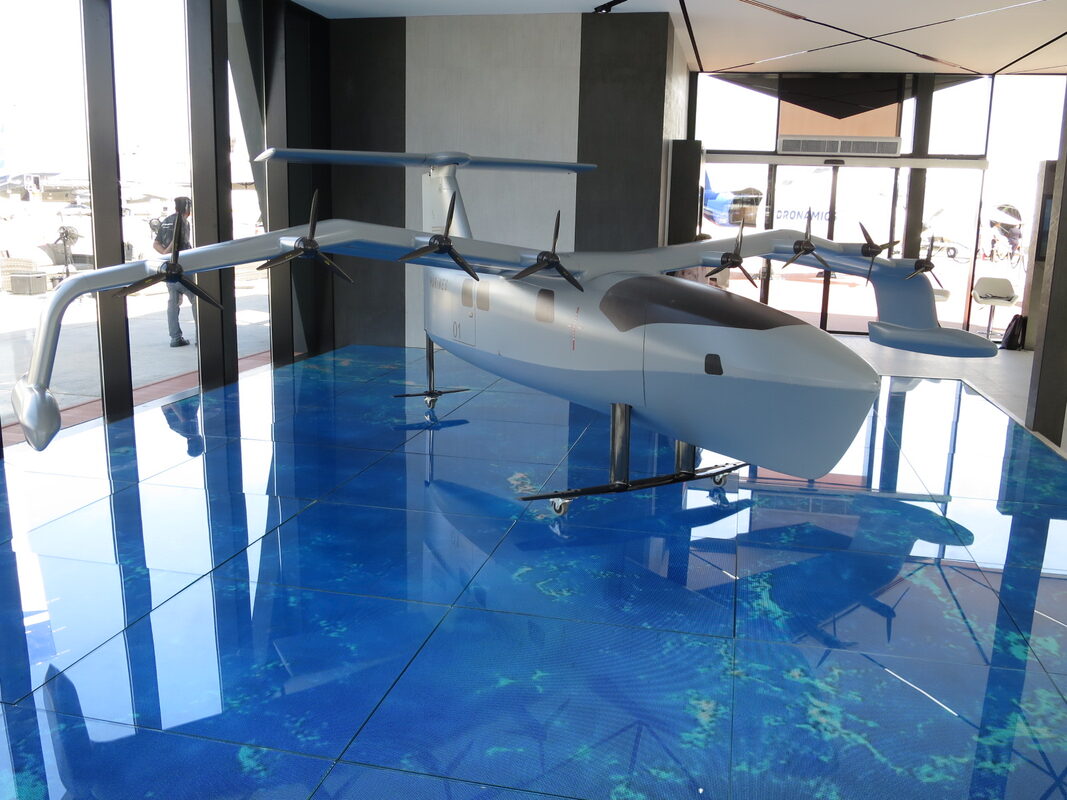
Regent's autonomous Squire seaglider has moved from demonstrations to a production contract. According to The War Zone, the company has agreed to sell an unspecified number of Squires to a US government customer. That customer will field a small fleet in the Middle East next year for what Regent CEO Billy Thalheimer calls "multi-domain perception." Regent would not name the buyer, say how many craft are involved, or give the contract's value. Army Recognition also reports that the purchasing agency, quantity, value and deployment locations were not disclosed.
Even without those details, the deal matters. It is Squire's first production contract, and it marks the craft's move from military-funded development and testing to operational production, according to Army Recognition. The company has spent the past year showing that its smaller vehicle could do more than skim fast across a harbor.
What Squire Is
Squire is small for a maritime vehicle. Army Recognition gives these figures:
- Length: 3.96 m
- Wingspan: 5.49 m
- Height: 1.68 m
- Maximum takeoff weight: under 181 kg
- Payload: 22.7 kg (about 50 lb)
- Mission bay: 35.6 x 35.6 x 30.5 cm, or 38.5 liters
Regent describes the craft as hybrid-electric. It has three operating modes. At rest and at low speed it floats on a displacement hull like a boat. As it speeds up, it rises onto a hydrofoil and can reach about 35 knots, according to Army Recognition. Above that, it flies in ground effect at up to 70 knots. Both The War Zone and Army Recognition report a planned range of more than 100 nautical miles, and Regent lists a takeoff and landing sea state of 2 feet.
How Wing-in-Ground-Effect Flight Works
A wing-in-ground-effect (WIG) craft is not quite an airplane and not quite a boat. It flies very close to the surface. The War Zone says Squire cruises at an altitude of about one wingspan above the water, which for Squire is roughly 5.5 meters. The War Zone describes the concept as taking advantage of a cushion of air compressed between the wings and the surface, which gives increased lift and reduced drag. Army Recognition similarly credits reduced induced drag with improving flight efficiency. In theory, that gives the craft high efficiency and useful speed without a runway.
Squire gets airborne with its hydrofoil stage. Army Recognition says the hydrofoils lift the hull clear of the water, which reduces wetted surface area and hydrodynamic resistance before the wings generate enough lift for flight. It adds that this arrangement addresses the difficulty conventional flying boats have accelerating through waves.
Flying low has a tactical angle too. Regent describes Squire as a drone that "flies in ground effect below radar line of sight," as quoted by The War Zone. Neither source quantifies how much harder that makes the craft to detect.
What It Will Actually Do
The War Zone reports that Regent pitches the 50-lb configurable payload for intelligence, surveillance and reconnaissance (ISR), logistics, search and rescue, and anti-submarine warfare. On its defense product page, Regent makes broader claims. It says Squire can collect EO/IR imagery for the common operating picture, carry more than 50 lb for logistics, medical supply distribution and humanitarian aid, and run automatic maritime search patterns for survivors. It also says the craft can detect enemy submarines using active and passive sonar arrays and sonobuoy mesh networks. These are the company's own statements. None of the sources says which of these missions the Middle East customer has bought. Army Recognition notes that the size of the internal compartment favors compact hydrophones, processing electronics and communications gear over the heavier arrays carried by dedicated surveillance vessels.
The contract language points to sensing more than cargo. The War Zone quotes Thalheimer saying that, combined with various sensors, Squire can do multiple on-water perception and communications missions separated by distances far greater than a USV could quickly cover, and that while flying between sites "Squire can continue sensing." The War Zone also cites Aviation Week reporting that Thalheimer said the Squires will perform an "underwater perception" mission. The War Zone calls that likely a nod to counter-mine work, which it says has become a big part of US Central Command's mission as it escorts ships through the Strait of Hormuz. That is the outlet's interpretation, not something Regent has confirmed.
A November 4 demonstration off San Clemente Island, described by Army Recognition, shows one form the sensing and relay role could take. During Maritime Big Play Pacific, Squire worked with NSI's Arowana uncrewed underwater vehicle (UUV) and served as a mobile communications gateway. Operators could change the UUV's mission without recovering it to reprogram it aboard the support vessel. Army Recognition suggests the same vehicle could relocate a communications node between separated underwater assets rather than requiring every UUV to return to a fixed control point.
A Busy Year of Trials
Army Recognition traces Squire's 2026 milestones:
- April 13: first ground-effect flight.
- July 13-24: participation in the Silent Swarm electronic warfare event at Michigan's Alpena Combat Readiness Training Center.
- BlueTIDE 2026, Newport Harbor: integration with Anduril's Lattice, with the fastest integration completed in under 40 minutes.
- November 4: the Arowana UUV gateway demonstration off San Clemente Island.
The War Zone notes that Squire runs on Regent's own control software and has been demonstrated with both TAK and Lattice. Thalheimer says this lets Squire plug into mission-management and multi-asset coordination systems. That interoperability should matter to a military buyer, since a new uncrewed vehicle is more useful when its data can flow into tools operators already use.
Where It Fits in Regent's Defense Push
Squire is the smaller of Regent's two defense products. The War Zone reports that Regent's partnership with the Marine Corps Warfighting Lab was extended in September with an additional $5 million, bringing the total to $19.25 million. That work covers the larger Viceroy WIG craft, which is designed to carry 12 passengers or 3,500 lb of cargo. With Squire now headed for production, Regent has an uncrewed product in the field-ready stage while Viceroy continues through development.
The deployment region is notable. The War Zone points out that US Central Command has established Task Force Falcon Strike, which it describes as the first multinational attack drone task force. CENTCOM declined to say whether Squire is part of that effort, and no source links the two. The War Zone also notes that the Pentagon says it has surged more than 25,000 unmanned and counter-drone systems to CENTCOM, so Squire would be arriving in a region already crowded with uncrewed systems.
Why It Matters
The War Zone notes that the WIG concept is not new, but that prior attempts to employ it at scale have had limited success, particularly for military purposes. The Soviet ekranoplans are the best-known military example, and their service was limited. Against that history, a production order, even for a small fleet with no disclosed value, is a notable step for an uncrewed seaglider headed for a combat region. Squire's case does not rest on being the fastest boat or the cheapest drone. According to Regent's CEO, it rests on covering distances far greater than a USV could quickly cover, without specialized launch and recovery equipment, while still sensing along the way. If the 2027 deployment delivers useful undersea sensing and gateway work, Squire could become a fast connector between uncrewed underwater vehicles and the operators who rely on them. If it doesn't, the questions Regent has left unanswered, including who the customer is, how many craft are involved and what they cost, will matter much more.
