
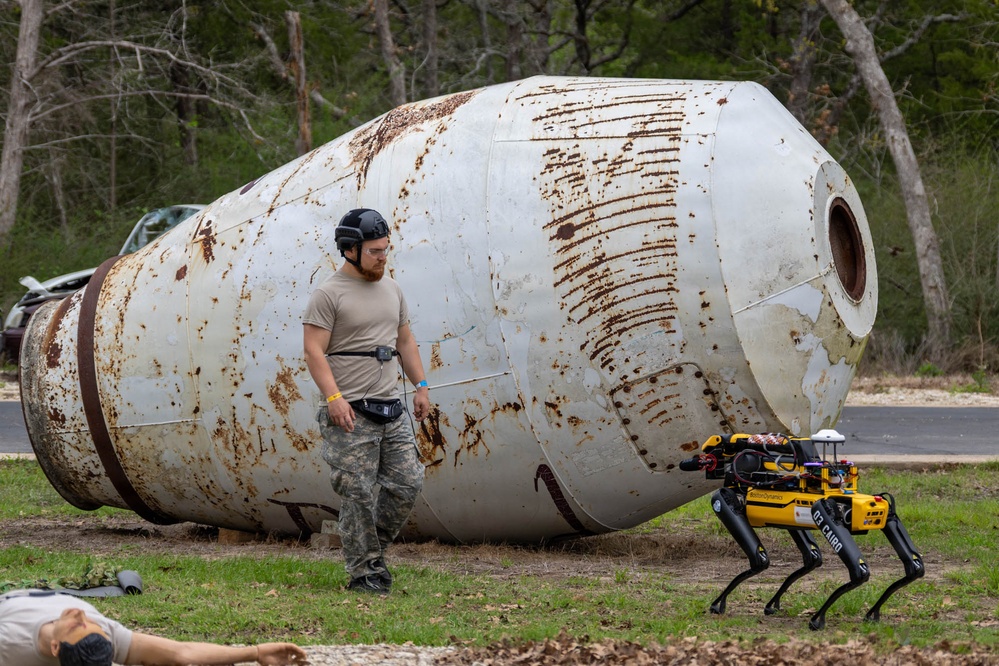
A tornado hits an open-air market. Smoke hangs over the wreckage, the light is failing, and the injured are spread across ground that responders cannot yet cross safely. The first thing on scene may not be a person. It may be a robot or a drone, sent in to find out who is hurt, how badly, and who needs help first.
That was the scenario DARPA built for the finals of its Triage Challenge. The finals ended Nov. 13, 2026 at Disaster City in College Station, Texas, closing out a competition that ran for three years. DARPA announced the winners on Nov. 16: team RoboScout won the Systems competition and its $1.5 million grand prize, and team Disruptors won the Data competition and $1 million. Local station KBTX reported that more than $3.8 million in total went to the top teams.
A week later, on Nov. 23, a C4ISRNet video segment put drones at the center of the story. It described DARPA's hope that after a mass-casualty event it can send drones to find injured victims, assess them, and begin coordinating their care.
What the Finals Tested
The final event was meant to look like a real disaster, not a clean test range. According to DARPA, competitors used autonomous systems and human-machine teams to navigate simulated catastrophic events, including a tornado striking an open-air market, along with smoke, heavy darkness and complex obstacle lanes. Each of those conditions targets a known weak point for autonomous systems. Smoke and darkness degrade cameras. Rubble and obstacles defeat simple ground navigation. A crowded, damaged market is full of clutter that a perception system has to sort through before it can pick out a person, let alone judge that person's condition.
The challenge had two main tracks, and the split shows how DARPA approaches the problem:
- Systems competition: teams fielded autonomous platforms and human-machine teams on the course. RoboScout won the $1.5 million grand prize, with DART taking the $500,000 runner-up award. DARPA also gave technical-capability prizes, with UAS-DTU placing first and Guardian Angel second; those two awards were self-funded.
- Data competition: teams worked on predicting life-saving interventions and resource allocation. Disruptors won the $1 million grand prize, with OCA-SENTINEL taking $300,000 as runner-up.
In broad terms, one track asked whether the hardware can reach casualties and gather useful information under bad conditions. The other asked whether software can use that information to predict which interventions and resources casualties need.
Human-Machine Teams, Not Replacement Medics
DARPA's main conclusion from the finals is about people as much as machines. "We've decisively proven that human-machine teams outperform every approach to the problem," DARPA Director Stephen Winchell said in the agency's announcement. He added that the work is not finished: teams were strong in different areas, such as identifying victims versus triage, lifesaving or evacuation, and he said there is a lot the community can learn from each other.
That framing matters. The challenge was not set up to show that robots can replace medics. Its results point toward autonomous systems that work alongside human responders: they go first, cover ground quickly and pass information back so that scarce people spend their time where it counts.
Competitors made a related point in practical terms. Kimberly Elenberg, primary investigator for team Chiron, told KBTX she served on active duty for 28 years and was a medic instructor. She said that if a team can detect what is in the environment ahead of time, responders can put on the appropriate protective equipment, and that helps them.
The field drew teams from abroad. KBTX reported that UAS DTU, a research team from Delhi Technological University in India, competed in the finals, and DARPA's results list UAS-DTU as the first-place technical capabilities team.
Where Drones Fit
The C4ISRNet segment, published Nov. 23, says plainly that drones are part of DARPA's plan. In the wake of a mass-casualty event, the agency hopes to send in drones to find, assess and start coordinating care for victims. The page itself has only a short description of the video, so it gives no detail on particular airframes or sensors.
The same C4ISRNet page also lists a Defense News Weekly episode, "A race for lifesaving battlefield drones," described as pairing Ukrainian innovators pioneering frontline aerial drone evacuation with DARPA's development of AI-assisted robots to find and assess injured troops and civilians. The two efforts address related but separate steps in casualty care: moving the wounded in one case, and finding and assessing them in the other.
For UAS developers, the triage concept looks like a sensing and autonomy problem more than a payload problem. A drone that can hold position over a debris field, see through smoke or darkness well enough to find a person, and send back data an algorithm can turn into a triage priority would be doing work that today depends on responders going in on foot.
From Competition to Contracts: TRIAGE-X
DARPA is not stopping at prize money. Its announcement points to an open Small Business Innovation Research (SBIR) topic, TRIAGE-X, which seeks to develop and demonstrate autonomous medical triage systems that recognize chemical toxidromes and physically deliver the corresponding antidote or life-saving intervention. The topic is open until Nov. 25, 2026, two days from this article's publication.
TRIAGE-X widens the scope in two ways. First, it moves from assessing physical injuries to recognizing a chemical exposure from the pattern of symptoms it causes. Second, it moves from assessing victims to treating them, through antidote delivery. That is a far harder problem in terms of medical authority, safety and reliability. It also fits with Elenberg's point about detecting hazards before responders go in.
The Hardening Problem
The people running the program are open about the distance between a strong competition result and equipment responders can trust. DARPA's Jeremy Pamplin told KBTX he hopes to engage the community to take the tools developed, bring them to real-world use cases and harden them. That is a familiar gap in defense technology. A system that performs on a staged course in Texas still has to hold up in weather, on bad terrain, with unreliable communications, and in front of responders who have no time to troubleshoot it.
The training community is also watching. Ray Ivie, director of TEEX Research, told KBTX that using robots and sensors for triage is directly in line with what TEEX does with its task force teams; he said Disaster City trains FEMA teams from across the country, along with fire, police and military. If these tools mature, the responders who will use them are already training at the kind of site where the finals took place.
Why It Matters
Mass-casualty triage is a math problem with too few people on one side of it. When the number of injured outstrips the number of trained responders, the first minutes go to finding and sorting victims, often in conditions that put responders at risk. The Triage Challenge was DARPA's three-year test of whether autonomous systems can shorten those minutes. Its headline finding, that human-machine teams outperform every approach, gives the drone and robotics industry a clear direction: build systems that extend responders' reach rather than replace their judgment.
For the UAS sector in particular, the C4ISRNet coverage indicates that aerial platforms are part of how DARPA imagines this working: find, assess, coordinate. TRIAGE-X, with its focus on chemical toxidromes and antidote delivery, shows where the agency is looking next, and its Nov. 25 deadline is the nearest chance for small companies to get involved. The harder step, as Pamplin suggested, is turning prize-winning prototypes into hardened tools for real-world use.
