
On Ukraine's front lines, the hardest part of saving a wounded soldier is often the first few kilometers. Drones watch the roads, and FPV attack drones go after anything that moves. Evacuation teams increasingly rely on ground robots to drag casualties out of the kill zone, and those robots are slow. Ukrainian drone maker SkyFall thinks the answer is to fly the casualty out instead. This week it handed its StarGate medical evacuation drone to a front-line unit for evaluation.
The Associated Press, which the company gave exclusive access, watched StarGate in a field demonstration on Oct. 14, 2026, at an undisclosed location. In its report, written by Samya Kullab, the AP called the aircraft Ukraine's first aerial drone built to evacuate wounded soldiers. That description is the AP's. It is not an established technical milestone. DroneXL notes that the Ukrainian outlet Militarnyi reported in May that an unnamed heavy multicopter had been tested carrying a person playing a casualty, with neither the unit nor the maker identified.
What SkyFall Built
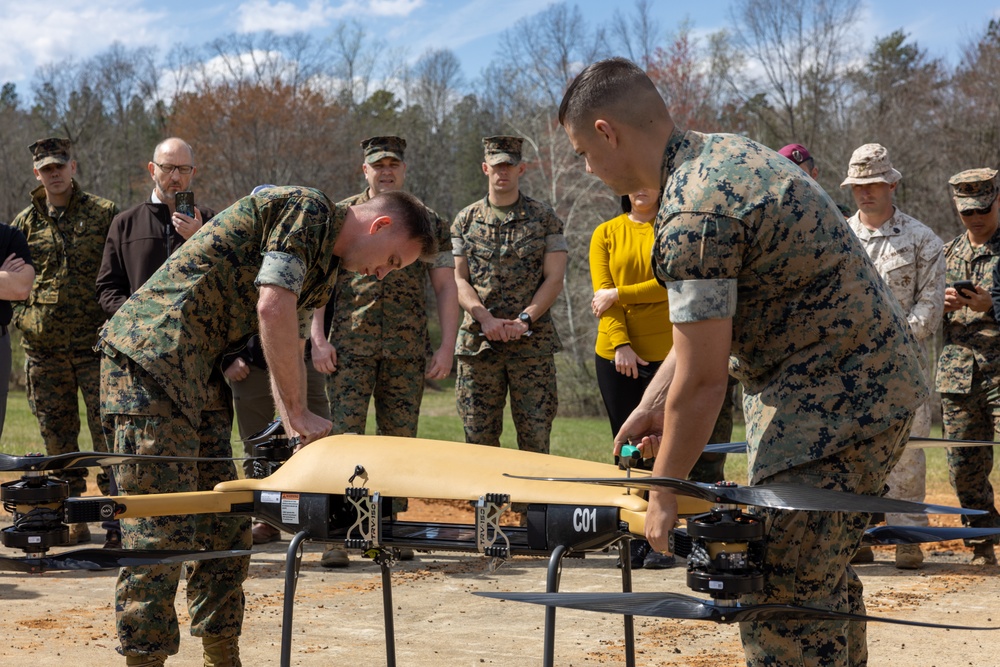
StarGate is a six-rotor multicopter with a stretcher cabin. SkyFall developed it over the past year. All of the performance figures below come from the company, and none have been independently verified:
- Payload: 330 lb (150 kg)
- Cruise speed: about 40 mph (65 km/h)
- Top speed: about 65 mph (105 km/h)
- Range: about 9 miles (15 km) one way. No round-trip figure has been given.
- Preparation time: about 10 minutes before flight
- Control links: Starlink plus SkyFall's own L-Link
- Navigation: AI-based navigation for areas where GPS is jammed. The drone flies back to a safe area if it loses communications.
- Sensors and self-defense: thermal cameras and a net launcher
- Cost: at least $50,000 per system, depending on configuration
Note that the range is one-way. A 15 km leg covers the trip from a casualty collection point to the rear, but the reporting does not say how the drone gets back out, or how often it can make the trip. Those questions are the kind the field evaluation will have to answer.
The Demonstration
The most notable moment in the AP demonstration was defensive. With jamming switched on, StarGate's net launcher snared a simulated attacking FPV drone. In this war, FPV drones are the aerial threat that dominates the front line, so an aircraft that can stop at least one incoming attack has a real advantage. Still, it was one staged engagement against one simulated attacker. That is a long way from fighting off coordinated FPV strikes in real combat.
SkyFall also says StarGate kept flying after losing one of its arms. The AP noted that the company has not provided data on how reliable the aircraft is in combat or how well it survives damage. For now, the claim about flying with a missing arm is only the company's word.
Where the Idea Came From
According to the AP, the idea came from Flint, the call sign of the commander of the 475th Separate Assault Regiment, also known as Code 9.2. That makes StarGate a familiar kind of Ukrainian drone program: a front-line commander identifies a gap, and a domestic manufacturer builds something to fill it in about a year.
KVN, a commander in Code 9.2, described the gap. Ground robots, which have taken on a growing role in evacuating casualties, can take two to three hours to reach a position, depending on distance, road conditions and the threat from above. "Covering 10 kilometers in minutes would be a drastic change," KVN told the AP.
For a wounded soldier, the difference between hours and minutes can decide whether he lives. The math works only if the drone survives the trip, and that is what the unit now has to find out.
What Happens Next
SkyFall confirmed that the unit is evaluating StarGate but declined to share any results. KVN said his unit will need at least a month of flying StarGate before it can produce a meaningful success rate. Until then, the public record is one choreographed demonstration and a spec sheet.
SkyFall is planning big regardless. The company says it aims to build up to 1,000 StarGate systems a month by the end of 2026. At a minimum of $50,000 each, that would be at least $50 million a month in hardware if the target is met. The target is ambitious because, by the company's own account, the aircraft only began front-line testing this week.
Who Is SkyFall?
SkyFall emerged after Russia's full-scale invasion in 2022 and has grown into a Ukrainian drone manufacturer. Its product line includes the Vampire heavy-lift drone, which Russian troops call "Baba Yaga," the Shrike FPV drone and the P1-SUN interceptor. StarGate appears to draw on that heavy-lift multicopter experience.
That track record cuts both ways. DroneXL notes that "Electric," a drone expert with the 93rd Brigade, put the Vampire's working life at about 10 flights in May. If StarGate shares any of that wear profile, it would matter for an aircraft meant to carry people. A $50,000 medevac platform that wears out after a handful of sorties is a very different deal from one that lasts for months.
Not the Only Heavy-Lift Medevac Concept
Ukraine is not the only country testing drones for casualty evacuation. DroneXL points to the Flowcopter FC-100, which U.S. soldiers from the 2nd Cavalry Regiment tested with a full-weight dummy during Sabre Strike 2026 in Poland in May. That test was an exercise, while StarGate is going to a unit in combat, against an enemy that jams and hunts drones.
Why It Matters
Evacuating casualties has become one of the defining problems of the drone war. The AP describes a kill zone under constant drone and artillery threat that in some sectors stretches 10 to 15 kilometers or farther, where wounded troops can be stranded for weeks or months. Unmanned ground vehicles have taken on a growing role in evacuation, but they struggle with mud, craters and shattered roads, and rivers, mines and drones can stop them altogether. A drone that could reliably fly a wounded soldier 10 kilometers in minutes, while jammed, would change how quickly casualties reach care.
Almost everything that would make that possible is still unproven. Every performance number comes from the manufacturer. The jamming and FPV-defense results come from a single demonstration the company arranged. There is no combat reliability data, and the company has declined to disclose evaluation results. UNITED24 Media and Ukrainska Pravda both covered StarGate, but both relied on the same AP demonstration, so their reports do not independently confirm any of the claims. The useful number will be the success rate Code 9.2 produces after a month or more of real missions, if SkyFall or the unit chooses to publish it.
Sources
- 'StarGate,' Ukraine's first aerial drone to evacuate wounded soldiers, ready for battlefield testing (AP via Anchorage Daily News)
- SkyFall Sends Its $50,000 StarGate Medevac Drone to the Front Line (DroneXL)
- Ukraine's StarGate Drone Could Evacuate Wounded Troops From Front-Line Kill Zones (UNITED24 Media)
- AP: Ukraine tests SkyFall StarGate drone to evacuate wounded soldiers (Ukrainska Pravda)
