
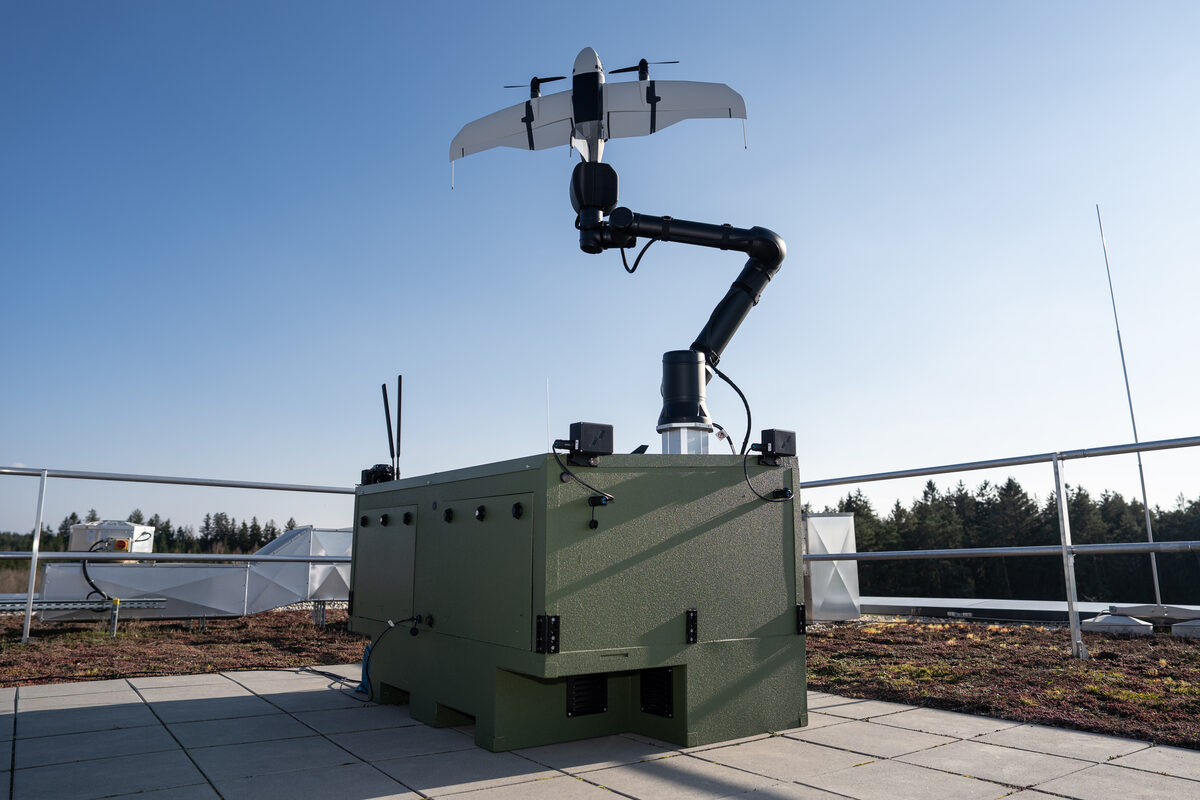
An experimental battery-electric drone from German manufacturer Quantum Systems reached 777 km/h on Oct. 19, the company says. That is 419.5 knots, or about 483 mph. The aircraft is called the Apex Recordhunter, and it was built by N3XT, Quantum's experimental research division. In June the same prototype reached 699 km/h, so the new run is 78 km/h faster. The company presents the aircraft as a testbed for high-speed interceptor drones meant to catch the jet-powered versions of Russia's Geran attack drone, which fly at 500 km/h or more.
There is one important limit on the claim, and Quantum acknowledges it: the 777 km/h figure is not an official record. Here is what the company has shown, what it has not, and why the speed matters.
What was actually flown
New Atlas reports that the figure was announced in a social media post by Quantum executive Martin Karkour. The Spanish defense outlet Ejercitos also says Karkour confirmed the figure. The two outlets give him different titles: Ejercitos calls him Chief Commercial Officer and New Atlas calls him CRO. The discrepancy has no bearing on the result.
Unmanned Airspace passes on a more detailed account from the Ukrainian outlet Militarnyi. According to that account, the drone went from 0 to 777 km/h in 27 seconds, reached peak speed for only a fraction of a second, and then the pilot slowed it down and landed. Ejercitos converts the peak to about 216 meters per second.
The short hold at top speed matters. This was a sprint: one burst of acceleration followed by an immediate slowdown, not a sustained high-speed cruise. In its relayed account, Militarnyi says the main engineering challenge was keeping the aircraft stable, because even minor deviations from the intended flight path create additional drag and consume energy.
Why it isn't a record yet
New Atlas explains that under rules from the FAI (the international body that certifies aviation records), a speed record needs two consecutive flights in opposite directions over a measured course, completed within a set time limit, to cancel out the effects of wind. Quantum has flown only one direction so far, and the company acknowledges that the result cannot be officially confirmed until the return run is done. Ejercitos likewise says a run in the opposite direction is still required.
Times of Defence compares the unverified 777 km/h with what it describes as the standing official record for electric aircraft, about 658 km/h. If a two-way run confirms anything close to the single-run speed, the Recordhunter would clear that mark by a wide margin. That outcome is still hypothetical.
What the airframe is, and what the reports disagree on
Public details about the aircraft are limited, and the outlets covering it do not agree. Ejercitos describes a fixed-wing design shaped to reduce drag. It says N3XT spent about a year developing it and that the high-discharge battery-electric propulsion comes from V4Smart, which it identifies as a Porsche Group company. Times of Defence calls the airframe a quad-rotor hybrid instead. The sources reviewed for this article do not settle the question.
According to the Militarnyi account, the developers combined three things in a compact airframe: a revised aerodynamic design, a powerful electric motor, and a cooling system. New Atlas adds that the flight collected aerothermal data (how heat builds up at high speed) and electrical data. That fits a program focused on the hard part of electric speed: pushing very high power through batteries, motors and controllers for a short time without overheating them.
The target: jet-powered Gerans
The reason for the program is the changing Russian drone threat. New Atlas puts the cruise speed of Russia's jet-propelled Shahed/Geran variants at roughly 270 knots (about 500 km/h), and says the Recordhunter's speed exceeded it. Times of Defence gives a range of 500 to 600 km/h.
That speed gap affects interceptor design. If a pursuing drone is only a little faster than its target, it has little room to catch a jet drone from behind or to recover after a missed first pass. Ejercitos says the Recordhunter program is aimed at developing electric propulsion for future interceptors against the jet-engine Geran versions. Unmanned Airspace, citing Militarnyi, says the findings are already being applied to the development of new counter-drone systems.
New Atlas also notes that an interceptor with this kind of performance could destroy jet drones either by kinetic impact or with a proximity-fuzed warhead (one that detonates when it gets close to the target), providing a much cheaper alternative to solid-rocket missiles.
Where this fits in Quantum's interceptor business
Quantum is not presenting the Recordhunter as a product, and none of the sources describes it as one. Times of Defence links the flight data to interceptor work under Quantum WIY Industries, which it describes as a joint venture with Kyiv-based WIY Drones. It also links the data to an interceptor program called "Strila." Times of Defence alone says 15,000 Strila units were ordered for Ukraine's National Guard. The other outlets reviewed for this article do not report that number.
The wider political context comes from Unmanned Airspace. It reports that earlier in October, German Chancellor Friedrich Merz announced German financing for several tens of thousands of Quantum Systems interceptor drones for Ukraine, as part of Germany's military aid package for the winter of 2026/2027, with the systems to be manufactured in Ukraine. That ties Quantum closely to Western-funded production of counter-drone interceptors for the war.
Why It Matters
Battery-electric aircraft are usually associated with endurance and low noise, not speed. The Recordhunter run, if a two-way flight confirms it, would show that a battery-powered airframe can briefly reach speeds well above those of the jet-powered drones Russia now uses against Ukraine. Combined with Quantum's interceptor joint venture and large German-funded production plans, that is why the flight reads as interceptor research and not a speed stunt.
The flight also leaves important questions open. A peak held for a fraction of a second, reached in a 27-second sprint, says little about how long an interceptor could keep up that speed, how far it could fly, or whether it could guide itself onto a maneuvering target. The record is unofficial until the return run is flown, and published accounts still disagree on whether the aircraft is a fixed-wing design or a quad-rotor hybrid. For now, the solid facts are that Quantum has a fast electric demonstrator, a clear target in the jet-powered Geran, and an interceptor production effort that could use what the demonstrator teaches. Whether that turns into fielded interceptors that are both fast enough and cheap enough is still to be shown.
Sources
- Apex Recordhunter electric drone sets unofficial speed record (New Atlas)
- Germany's Quantum Systems 'achieves 777 km/h speed for new interceptor drone' (Unmanned Airspace)
- Quantum Systems has announced that its Apex Recordhunter interceptor drone has reached a speed of 777 kilometres per hour (Ejercitos)
- Quantum Systems Apex Recordhunter Demonstrator Reaches 777 km/h in High-Speed Electric Flight Test (Times of Defence)
