
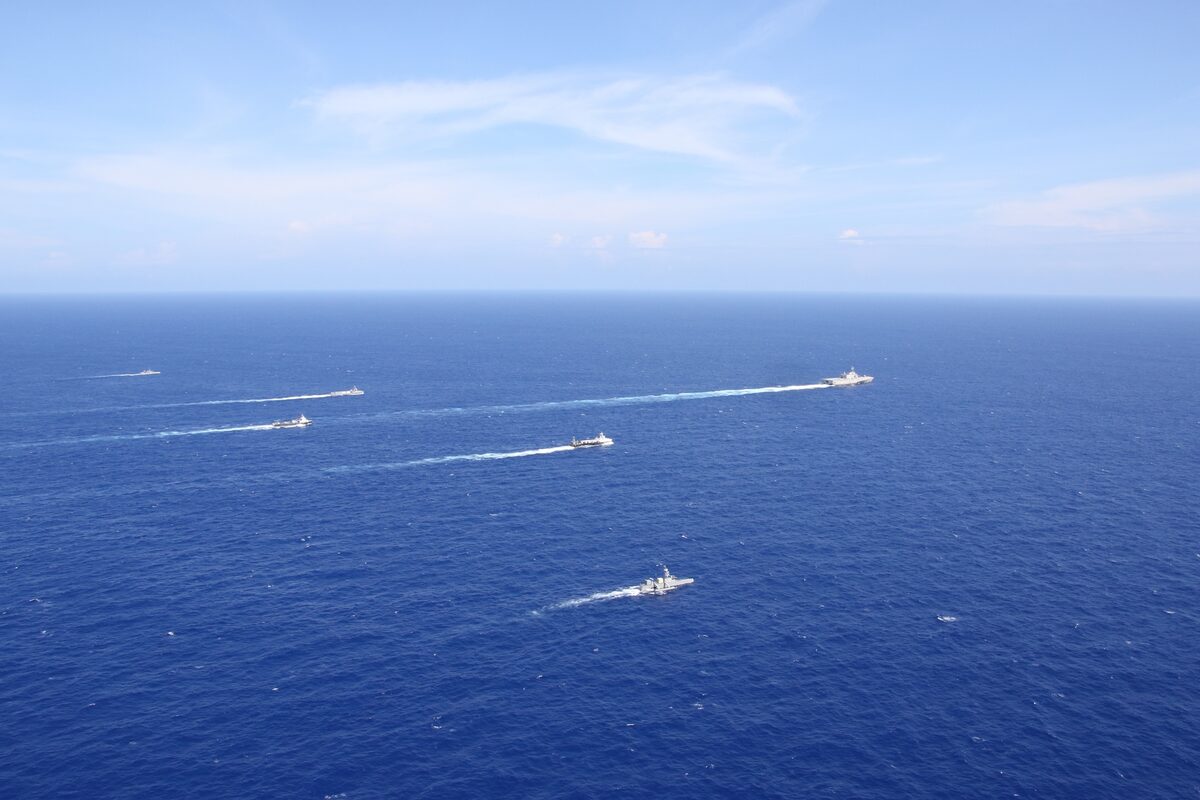
A twelve-foot hull with a solar array sat in open water roughly 73 to 75 miles northwest of Luzon on the evening of June 15, 2026, Pacific time — already June 16 in the Philippines' time zone — and quietly did what billion-dollar navies pay for. Using onboard radar, it picked up a Chinese People's Liberation Army Navy Type 052D guided-missile destroyer at a range of about 10 nautical miles, then closed the gap to a few hundred meters and started recording. The Chinese warship altered course. No weapons were fired. Nobody on either side was in any apparent danger. But the encounter, made public for the first time on July 29 and 30, 2026, and independently verified by Reuters, is the clearest data point yet that cheap, uncrewed surface vessels are becoming a real presence in the waters China treats as its own backyard.
The vessel involved is the Lightfish, built by California-based Seasats, a six-year-old autonomous surface vessel company. It weighs 305 pounds, runs on a solar-hybrid power system, can stay at sea for up to six months at a stretch, and has a range in excess of 8,000 nautical miles. It costs approximately $240,000 — a rounding error next to the roughly $1 billion price tag typically attached to a Type 052D destroyer, one of the PLA Navy's more capable multi-mission surface combatants.
"The Ukrainians have definitively proven the threat that small USVs pose to surface ships," Seasats CEO Mike Flanigan said, invoking the naval drone campaign that has repeatedly damaged and sunk Russian Black Sea Fleet vessels using far cheaper platforms than the ships they targeted. Flanigan's point wasn't subtle: if a small, inexpensive surface drone can get within a few hundred meters of a destroyer undetected — or detected too late to matter — the same platform could, in a different mission profile, be carrying something more than a camera.
What Actually Happened
According to reporting from The War Zone, the Lightfish detected the Type 052D via radar at approximately 10 nautical miles and closed to within a few hundred meters of the vessel in the Luzon Strait — the body of water separating Taiwan from the northern Philippines and one of the most closely watched naval chokepoints in the Indo-Pacific. The destroyer changed course in response to the drone's presence. Reuters verification, reported by the Taipei Times, confirmed the identity of the ship as a Type 052D by matching its deck layout, superstructure, crane, and mast configuration against archive imagery. Reuters also verified the location — approximately 105 kilometers northwest of Luzon — using telemetry data pulled directly from the Seasats drone, and confirmed the date of the encounter through the original file's metadata.
This was not the Lightfish's first brush with the PLA Navy. The War Zone reported that a Lightfish drone had a separate encounter in May 2026 with a Chinese Type 056 corvette in the Taiwan Strait, suggesting the June encounter was not an isolated fluke but part of a pattern of these vessels operating in and around contested Chinese naval activity.
Seasats, for its part, told Philippine outlet Interaksyon that it believes this is the first footage of its kind recorded by a private U.S. firm showing a PLA Navy ship operating inside the Philippines' exclusive economic zone. That framing matters: the encounter took place in waters the Philippines claims as its own EEZ, not in international waters far from any coastline, and not inside a Chinese-claimed exclusion zone either — placing it squarely inside an already contentious jurisdictional gray area between Manila and Beijing.
Not a One-Off — The Military Is Doing the Same Thing
The Lightfish encounter didn't happen in a vacuum. About a week earlier, the U.S. Army was running its own uncrewed surface vessel operations elsewhere in the Philippines. According to an official Army.mil release, the 25th Infantry Division's 125th Intelligence and Electronic Warfare Battalion operated USVs in Casiguran Sound, on the eastern coast of Luzon, during Exercise Salaknib 26 — using the drones to screen a U.S. logistics vessel from a standoff distance of roughly six miles.
Two very different actors — a private startup with a $240,000 boat and a U.S. Army battalion with a formal ISR mission — arrived at the same conclusion in Philippine waters within the same general window of time: small, cheap, uncrewed surface vessels are useful for watching what's happening on the water without putting a crewed hull, or a sailor, anywhere near the object of interest.
Why It Matters
The strategic logic here isn't complicated, but it's uncomfortable. A destroyer costs on the order of a billion dollars, carries a crew in the hundreds, and represents a significant national investment in deterrence and power projection. A Lightfish costs about as much as a house in a mid-sized American city, requires no crew at all, and can loiter for months. If a vessel like this can approach a warship to within a few hundred meters — close enough to be a maritime version of the small explosive drone boats that have damaged much larger Russian ships in the Black Sea — then the economics of naval deterrence in contested waters start to shift. A fleet doesn't need to sink a destroyer to change its behavior; it just needs to convince the destroyer's crew, and the officers planning its patrols, that any object it can't immediately identify might not be harmless.
That uncertainty is precisely what raises the rules-of-engagement problem The War Zone's reporting flags. A commercial ISR drone recording video and a loitering munition can look identical on radar and to the naked eye until it's too late to matter. As cheap, expendable sea drones proliferate — flown by militaries, by contractors, and now by private companies with no formal government tasking — naval commanders in places like the Luzon Strait and the Taiwan Strait will increasingly have to make split-second judgment calls about vessels that give them very little to go on. The Type 052D's decision to simply alter course on June 15 was the low-risk option. It will not always be the obvious one, especially as more of these platforms, cheaper and more capable each year, start showing up in the same disputed water.
Sources
- Chinese Destroyer's Encounter With U.S. Drone Boat Highlights Future Rules Of Engagement Issues — The War Zone
- Army demonstrates security capabilities with autonomous maritime systems at Salaknib 26 — Army.mil
- Sea drone films PLA warship in Philippine waters — Taipei Times
- Commercial sea drone captures footage of Chinese warship in Philippine waters — Interaksyon
