
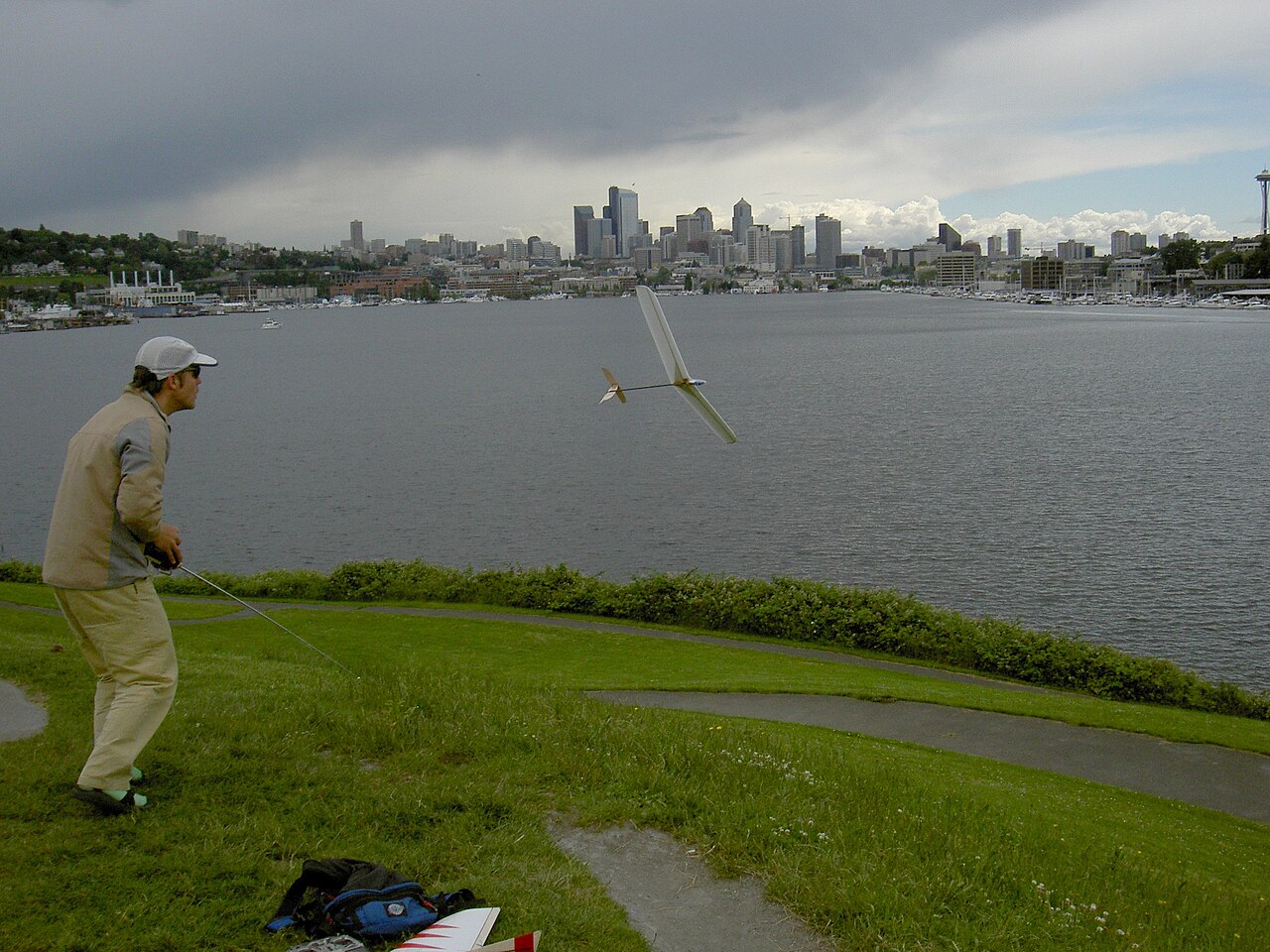
On Oct. 16, a radio-controlled glider with no motor, no propeller and no fuel crossed a radar gun at 474 mph (763 km/h) on Parker Mountain near Acton, California. At the end of that flight, Manor flew it into the hillside. The aircraft was Joe Manor's Endgame 130, a 130-inch (3.3 m) wingspan glider. According to DroneXL, the flight was not a record attempt. It was a shakedown flight for the first airframe pulled from a new set of molds.
Manor's video of the flight went up on Oct. 17 and had passed 60,000 views by the time DroneXL covered it. The speed alone is worth noting, because 474 mph is faster than the fastest jet-powered RC model on record. DroneXL lists that as Niels Herbrich's Inferno at 465 mph. A glider with no thrust source outran a turbine-powered model, and the reason is atmospheric physics more than airframe design.
How a Glider Gets Faster Than a Jet
The technique is called dynamic soaring. In a 2021 explainer for the Royal Aeronautical Society, Bill Read FRAeS describes the key feature: a shear layer on the lee side of a ridge. When strong wind blows over a ridgeline, the air on the windward side and above the crest moves fast. The air tucked behind the ridge on the downwind side is much calmer or even recirculating. Between the two is a thin boundary where wind speed changes sharply over a short distance.
A dynamic-soaring pilot flies a continuous loop that crosses that boundary twice on every lap. DroneDJ's Scott Simmie, in a 2021 report, put it simply: the aircraft flies an ellipse between two air masses that are moving relative to each other.
Each time the glider crosses from one air mass into the other, its airspeed jumps, because the air it now flies through is moving differently from the air it just left. On one side of the loop the glider turns into the faster flow. On the other side it turns back down into the slower air. If the turns are timed and banked correctly, each crossing adds a little kinetic energy, and that gain is larger than what drag takes away over the rest of the lap. Lap after lap the energy builds, and the glider goes faster.
There is no engine to limit, so the ceiling is set by drag and by structure. In the Royal Aeronautical Society account, an aircraft with no wind resistance would accelerate indefinitely, while real speed is capped by drag, and early model gliders often broke apart from wing bending and flutter. The Royal Aeronautical Society piece notes that MIT aerodynamicist Mark Drela simulated the process for a Kinetic 130 glider. The technique has been studied in simulation as well as flown on the hillside.
Albatrosses Did It First
Read's explainer makes the same comparison DroneXL does: the albatross. In that account, Lisenby explains that the black-footed albatross uses wind over the sea and eddies between waves, flying hundreds of miles close to the ocean surface without flapping its wings.
The RC version has a specific origin. According to the Royal Aeronautical Society, Joe Wurts found the effect with a foam glider at Parker Mountain in the 1990s. It is the same hill where the Endgame 130 flew this month. Parker Mountain has been the proving ground for the discipline ever since, and California's ridges have stayed central to it. Simmie's 2021 piece notes that there is a particular spot in California where conditions suit high-speed flights.
Why the Numbers Come From Radar Guns
DroneXL describes every dynamic-soaring speed figure as unofficial. The reason is the measuring tool. You might expect GPS loggers to be the obvious choice, but both DroneXL and the Royal Aeronautical Society report that GPS loses its satellite lock at around 4 g. DroneXL reports that Spencer Lisenby measured 120 g on one of his gliders, the limit of the sensor he carried.
So the community uses handheld radar guns aimed at the glider from the ground; the Royal Aeronautical Society quotes Lisenby calling radar the standard measurement. DroneXL adds that pilots usually take the reading on the slower upwind leg of the loop, and that Lisenby said measuring his 564 mph run on the down leg would have shown a ground speed over 600 mph. Figures in this class are best read as unofficial radar-gun readings rather than certified records.
Where the Record Stands
The modern benchmark comes from Spencer Lisenby. On Jan. 19, 2021 he reached 548 mph with an unpowered RC glider using dynamic soaring. The Royal Aeronautical Society covered that flight, and DroneDJ reported it at the time as a new world record for dynamic soaring, up from 545 mph set in 2018. DroneXL reports that Lisenby later set 564 mph at Bird Spring Pass in February 2023.
DroneXL also says Bruce Tebo holds the record at 567 mph, flown at Bird Spring Pass in April 2026, and that Manor was at the same session, where his Endgame was listed at 534 mph. DroneXL is the only source among those cited here for the 2026 and 2023 figures, and it notes that they are unofficial radar-gun readings.
Against those numbers, the Endgame 130's 474 mph is about 90 mph short of the reported 567 mph mark. But this was not a record run. It was a shakedown flight of the first airframe from a new set of molds, the kind of flight meant to show whether the structure and handling are sound before anyone pushes the limit. Reaching faster-than-jet speeds on a shakedown says something good about the design. The crash says something about how little margin there is at these speeds when the aircraft is working a shear layer only meters above a hillside.
The Hobby-to-Industry Pipeline
Dynamic soaring is not only a pursuit for hobbyists with radar guns. DroneXL notes that a startup called Alteon raised $2.5 million in September to build a year-long drone around dynamic soaring. The aim there is endurance, not speed: using the same energy-from-shear principle to keep an aircraft aloft far longer than batteries or fuel could.
The two goals point in opposite directions but rest on the same physics. A speed pilot takes energy from the wind gradient and turns it into velocity. An endurance designer takes the same energy and uses it to make up for drag losses forever, the way an albatross does over the ocean.
Why It Matters
For the UAS community, the Endgame 130 flight is a reminder that the atmosphere is a power source that can be tapped, and that RC pilots have learned to tap it. RC pilots have spent about three decades turning dynamic soaring from an accidental finding on a California ridge into a way to pass 500 mph. Endurance-focused companies such as Alteon are now trying to apply the same principle to a drone meant to stay aloft for a year.
The flight also shows a measurement problem anyone working on high-g autonomous flight will recognize. Standard GPS navigation stops working at loads these airframes reach routinely. Any autonomous dynamic-soaring aircraft will need guidance and state estimation that hold up under those conditions. Today's record class relies on a person with a radar gun and a pilot's reflexes. Making that loop autonomous and survivable is the engineering gap between a viral hillside video and a working long-endurance drone.
Finally, the Endgame 130 and its crash show how unforgiving the environment is. The energy that makes these speeds possible is concentrated in a thin layer of air right next to terrain. Exploiting it means flying very close to the ground at high speed, and on Oct. 16 that cost Manor his first airframe from the new molds.
