
Zipline announced on Nov. 5 that it has raised $1.5 billion at a $21.5 billion post-money valuation. The money comes with a large commitment from its biggest retail partner. Under a new national multi-year agreement, Walmart and Zipline will launch 300 additional drone delivery sites. TechCrunch reports that the two companies run 21 active drone delivery sites together today.
The jump from 21 sites to more than 300 is the part of the announcement that matters most. The release does not say where the new sites will be, which states they will be in, or when the first one opens. That leaves the most important operational detail open, even as the investment figures set records for a company that started out delivering blood in Rwanda.
The Round
Paradigm, WCM Investment Management and Layer Global led the round. Valor Equity Partners, Fidelity Management & Research Company, Uber, Tiger Global, J.P. Morgan, ARK Invest and Salesforce Ventures also took part. Zipline says the money will pay for expanding its U.S. manufacturing facilities and for hiring.
The valuation has climbed fast. DroneXL notes that $21.5 billion is about 2.8 times the $7.6 billion valuation Zipline carried in January. It is also above the $20 billion figure Bloomberg reported in September, per DroneXL. By DroneXL's count, Zipline has now raised about $2.3 billion in 2026 alone: more than $600 million on Jan. 20, a $200 million extension in March, and the $1.5 billion just announced. DroneXL says that compares with roughly $2 billion raised in total before this round.
Uber is both an investor and a delivery partner. According to Zipline, Uber is targeting one million deliveries a day with Zipline by 2029. DroneXL adds that those deliveries would run through Uber Eats. The release does not explain how that target would be met.
The Walmart Math
Walmart's relationship with Zipline goes back to 2021, according to TechCrunch. The retailer also works with Wing. DroneXL reports that when Walmart announced its millionth drone delivery in May, the program covered 66 stores in four states across both providers. Wing has a separate contract for more than 270 locations by 2027.
Taken together, Walmart now has agreements covering roughly 570 drone sites between its two vendors: 300 with Zipline and more than 270 with Wing. In May, the whole program covered 66 stores. Building out that many sites means more aircraft, more launch infrastructure, more trained staff and more FAA operating authority. DroneXL notes that under the rules that exist today, each of those sites needs FAA sign-off, and that the FAA's Part 108 rule, which would make beyond-visual-line-of-sight flight routine, was still pending at the White House regulatory office on Nov. 5.
Zipline's current authority shows the gap. DroneXL reports that the company's FAA authorization in Dallas-Fort Worth allows up to 75 sites. Denton became its 20th DFW site in March, and Zipline also flies from a hub in Pea Ridge, Arkansas, near Walmart's headquarters. Zipline has room to grow in that one metro area, but a 300-site national rollout will likely require new approvals in markets where the company does not fly today. The announcement does not say how far along those approvals are.
What Zipline Says the Network Is Doing
Zipline backed the raise with operating figures, all drawn from its own data:
- Volume: More than one million deliveries in Dallas-Fort Worth so far this year.
- Speed: In October, the median order arrived 19 minutes after checkout, compared with 30 minutes or more for traditional delivery. Bakery orders had a median of 10 minutes.
- Restaurant economics: In a cohort of its longest-tenured restaurant partners, Zipline's share of delivery revenue rose from 10.8% to 34.9% between March and October. The company says the cohort's delivery gross merchandise value rose 26%, with 80% of that increase coming from Zipline orders.
- Fleet experience: 150 million commercial autonomous miles flown, which Zipline says were flown without a safety incident. DroneXL notes the total is up from 135 million reported in July.
The restaurant numbers come from the company. DroneXL points out that the cohort is Zipline's own selection and that the release does not say how many restaurants are in it. Zipline says its orders were incremental and did not reduce demand from other platforms, but without the cohort's size or makeup, outsiders cannot check that claim.
The Hardware Behind It
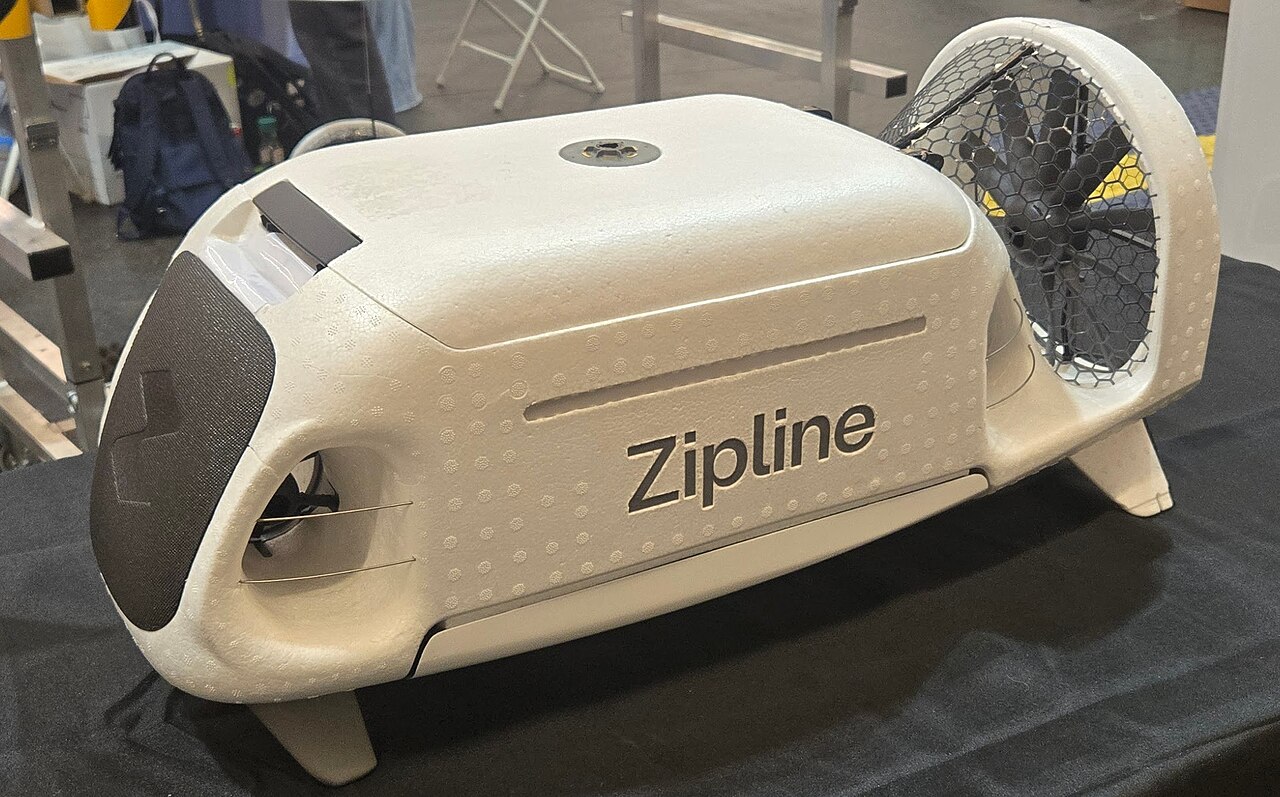
Zipline flies two systems. TechCrunch describes Platform 2, the home delivery system, as designed to carry up to eight pounds within a 10-mile radius. Platform 1, the larger aircraft, is used for long-range deliveries for enterprise, business and government customers and can cover 120 miles round trip. Zipline received its Part 135 air carrier certification from the FAA in 2022, which TechCrunch calls a critical regulatory hurdle that authorized long-range commercial drone deliveries.
Zipline was founded in 2014 and got its start in Africa, delivering blood in Rwanda. Its first U.S. operations began in 2020, ferrying medical equipment and supplies to Novant Health in North Carolina. TechCrunch reports that it now delivers food, retail, agricultural and health products in five African countries, several U.S. cities and Japan.
Why It Matters
For most of the past decade, US drone delivery lived in pilot programs: a few stores, a few suburbs, and press events. The Walmart agreements now on the books, together with Uber's stated 2029 goal, point to an industry planning for national-scale operations. Investors seem to agree. The $21.5 billion valuation is about 2.8 times the one Zipline carried in January.
The missing pieces are the ones that will decide whether those plans work. Zipline has not named markets or a launch date for the first of the 300 sites. Its largest proven operation, in DFW, is covered by an FAA authorization that allows up to 75 sites in that one area. Walmart now has two vendors building toward several hundred locations each. That will test how quickly the FAA can approve operations at this scale, and whether the delivery times and restaurant gains Zipline reports in Texas hold up in other markets.
Watch for the first site announcements under the new agreement and for new FAA authorizations outside Dallas-Fort Worth. Those will show whether 300 sites is a firm build plan or a long-range goal.
