
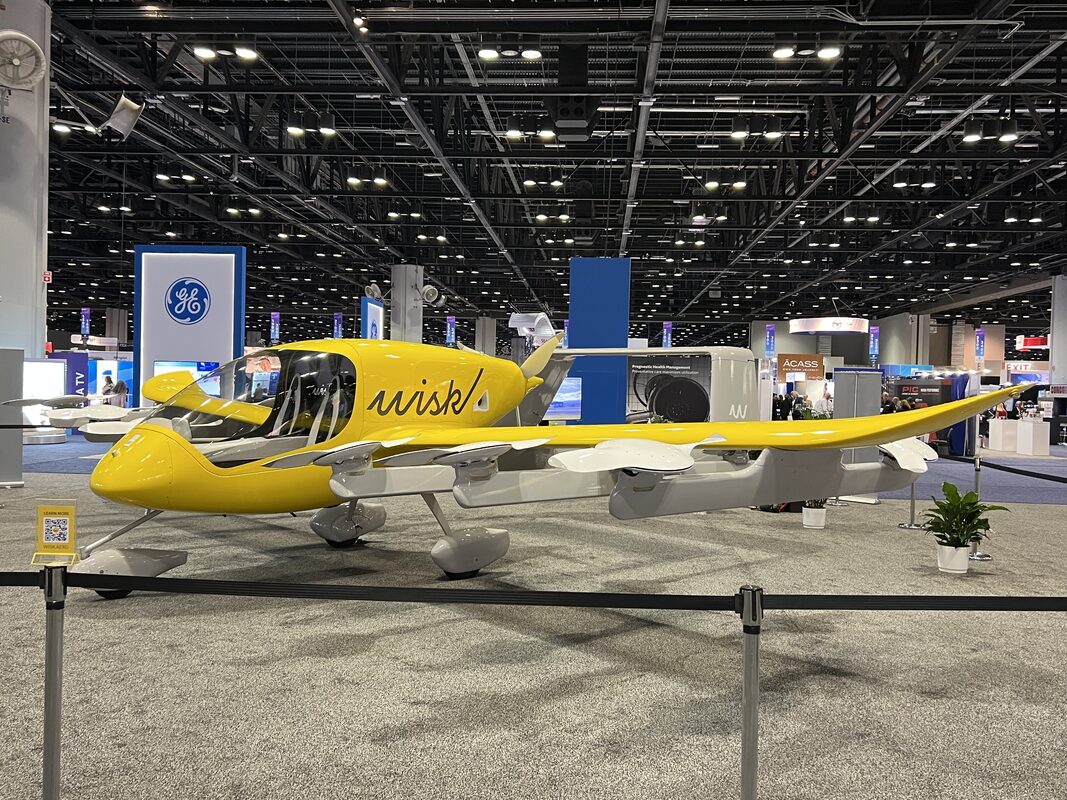
Wisk Aero now has a working vertiport at Hollister Municipal Airport in California. The company held a ribbon cutting on Oct. 29 with local, state and federal officials, and on Oct. 30 it announced that the 100-by-100-foot pad is fully operational. Wisk describes it as one of the nation's first public on-airport vertiports built for both piloted and autonomous operations.
The timing is awkward. Wisk says it built the pad to existing FAA vertiport standards, which DroneXL identifies as Engineering Brief 105A. One week before the ribbon cutting, on Oct. 22, the FAA posted draft Advisory Circular 150/5390-4. If the draft is finalized, it cancels EB 105A. The pad, which Wisk calls purpose-built for validating precision landing and its autonomy stack, has opened while the rules for designing it are being rewritten.
What Wisk Built
According to Wisk's release, the Hollister site uses elevated steel structures, integrated solar panels, power banks and taxiway connectors. The company calls the design deployable and says it can be adapted for future flight-test sites. The pad also has transceivers that support precision-navigation testing in reduced or zero visibility, and Wisk says they work across all VTOL platforms, not only its own.
Wisk frames the site as a dedicated testbed for terminal-area procedures, precision landing, and validation of approach and departure profiles. "It gives us the exact physical setup needed to validate precision landing technologies and our complete autonomy stack," CEO Sebastien Vigneron said in the release. Jeff Crechriou, the airport's executive director, was also quoted in the announcement.
The project moved fast. DroneXL reported that the pad became fully operational nine weeks after Wisk announced construction had started. Wisk credited Caltrans, the City of Hollister, the FAA Airports District Office and the FAA Office of Airports, among others. The site anchors the California Advanced Air Mobility Corridors Initiative, which the Monterey Bay Economic Partnership leads.
The Aircraft on the Pad, and the One Not Yet Flying to It
DroneXL reported that N607WA, Wisk's second Generation 6 aircraft, sat on the pad during the ceremony. N607WA has been in flight test since its first flight on May 4. But as DroneXL noted, neither Wisk's announcement nor its LinkedIn post about the opening says a Gen 6 has flown to the vertiport. Having the aircraft on the pad was a display, not an operation.
The first traffic will be surrogate helicopters. According to DroneXL, a July filing by Hollister describes the first traffic as Wisk's existing surrogate helicopter operations moving to the new site. This is a common way to develop autonomy: a conventional rotorcraft carries the sensors, flight-control software or landing-guidance equipment, and engineers collect approach and landing data at the real facility before the target aircraft is ready to fly the same profiles. Wisk's release says the site is prepared to host both surrogate helicopters and Gen 6 aircraft, but it gives no date for Gen 6 operations there.
Where the Data Goes
Wisk says the data from Hollister will feed the FAA's eVTOL Integration Pilot Program (eIPP). According to DroneXL, the company takes part in eIPP through the Texas Department of Transportation's project, one of eight the FAA selected in March. A California pad producing data for a federal program that Wisk entered through a Texas project suggests that participants can produce evidence wherever they have the infrastructure.
For the FAA, a pad on an active public airport, with precision-landing equipment that any VTOL aircraft can use, is a useful place to collect that evidence. Terminal-area procedures for autonomous aircraft, including approaches to a small pad in poor visibility, are the kind of operation the site was built to test.
The Standard Under the Pad Is Changing
The FAA's draft AC 150/5390-4, Vertical Flight Aircraft Infrastructure Design, is issued by the agency's AAS-100 office. It provides standards for the planning, design and construction of takeoff and landing facilities for vertical flight aircraft. It merges two documents. The draft cancels AC 150/5390-2D, the heliport design circular dated Jan. 5, 2023, and EB 105A, the vertiport design brief dated Dec. 27, 2024. Heliports and vertiports would then share one design reference.
DroneXL's reading of the draft finds several significant changes:
- No aircraft limits. The draft drops the aircraft limits found in EB 105A.
- Sizing tied to the rotor. The touchdown area is sized at the aircraft's rotor diameter plus 10 feet, so it scales with the aircraft that will use it.
- Powered-lift approach surfaces. Approach surfaces for powered-lift aircraft are set at 15:1 or shallower.
- Timeline. Public comments close Jan. 11, 2027, and DroneXL reports the FAA expects final standards in summer 2027.
The draft is advisory. The FAA says the AC is not legally binding and conformity is voluntary. It is, however, an acceptable means of satisfying Part 139 airport certification requirements and federal grant assurance obligations where those apply. For an airport that takes federal money, that wording matters: in practice, the AC is how the airport shows it is doing things correctly.
Does the Hollister Pad Fit the New Rules?
Neither Wisk nor the FAA has said, in the sources reviewed, whether the Hollister pad conforms to the draft. The new touchdown-area rule depends on rotor diameter, and none of the sources give dimensions for the Gen 6 or the surrogate helicopters. So nobody outside Wisk can say from these sources whether a 100-by-100-foot pad has enough margin under the proposed formula. The approach-surface criteria raise a similar question. They are drawn from the pad outward over the airport environment, and the sources contain no obstacle or surface analysis for Hollister.
The deployable design may be a useful hedge for Wisk. If the final AC requires different geometry, a modular steel structure is likely easier to change than a concrete pad. The draft is also open for comment, and Wisk will soon be running its own approaches at a working on-airport vertiport. That puts the company in a good position to submit comments based on operational data rather than models. DroneXL has made a similar call for Wisk to share its measurements with the FAA before the Jan. 11 deadline.
Why It Matters
Vertiport infrastructure has trailed the aircraft. Hollister is a working facility on a public airport, built to test terminal operations in reduced visibility, and Wisk says it will feed data into the FAA's eVTOL Integration Pilot Program. That makes it one of the clearer signs that the infrastructure is starting to catch up.
It also shows the cost of building early. Wisk built to existing FAA vertiport standards, which DroneXL identifies as EB 105A. Within a week of the ribbon cutting, the FAA had posted a draft that would replace it with a combined heliport-vertiport circular that sizes pads by rotor diameter and sets new approach geometry for powered lift. Other airports and developers planning vertiports now face a choice. They can build to guidance that would be cancelled, build to a draft that may change before final standards arrive, or wait.
The operational claims also need some caution. The pad is open, the transceivers are installed and the program is underway. But surrogate helicopters will fly the first approaches, and no Gen 6 flight to the pad has been announced. Whether Hollister proves out Wisk's "complete autonomy stack" depends on when the aircraft it was built for starts landing there.
