
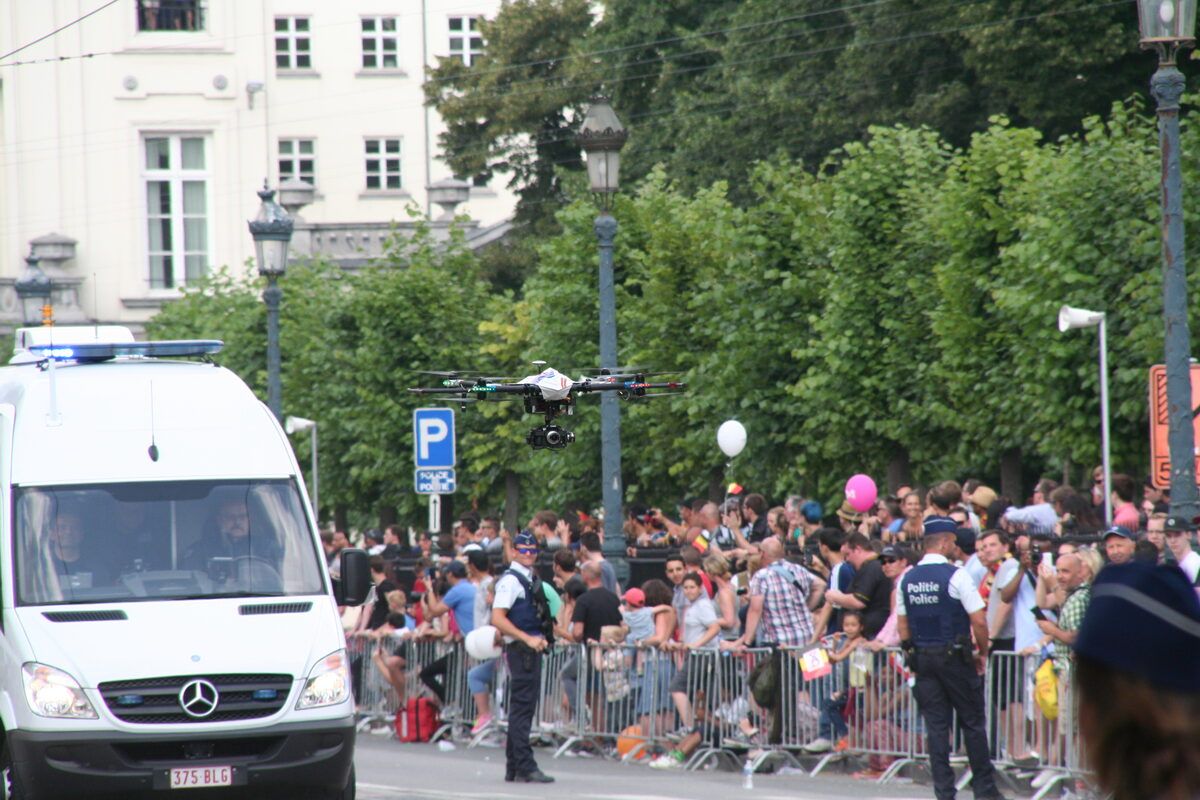
On Tuesday, Nov. 10, the West Valley City Council in Utah votes on a police drone program. For the first year it costs the city nothing. After that it becomes a five-year bill of close to $875,000, and that bill starts on its own. Under a Motorola Solutions quote dated Sept. 15, the West Valley City Police Department would get three BRINC drones on a six-year subscription. Year one is free. Years two through six cost $174,997 each, or $874,985 in total, according to DroneXL, which reviewed the council documents.
The key detail is that the paid years begin automatically unless the city gives notice. A council that votes yes this week is effectively approving the later spending too, unless a future council takes the trouble to back out.
What the city would get
The proposal covers three kinds of aircraft. FOX 13 Salt Lake City describes them as one drone dispatched straight to calls, one carried by trained officers, and a smaller drone for indoor work in SWAT-type situations. According to DroneXL, the three aircraft on the quote are a station-based BRINC Guardian, a BRINC Responder and a Lemur 2, BRINC's indoor drone.
The docked aircraft is the core of a drone-as-first-responder (DFR) program. It launches from a fixed station when a call comes in and is meant to reach the scene before patrol cars. The Responder is a tactical drone that officers launch themselves. The Lemur 2 is built for flying inside buildings, and that use has drawn the most pointed questions so far.
How the money works
DroneXL's reading of the deal documents lays out the structure:
- Year one: no charge. The aircraft remain BRINC property during the trial.
- Years two through six: $174,997 a year, $874,985 in total. Title to the aircraft passes to the city once the first paid year starts.
- Automatic conversion: paid years begin unless the city gives notice.
- Exits: the quote allows termination for convenience during the first year. A contract addendum lets the city cancel without penalty up to 30 days before the first paid year. A non-appropriation clause allows termination on 30 days' written notice if the council does not fund the program.
- Vehicle: Motorola is selling the package through a Sourcewell cooperative purchasing contract, which the city's issue paper says Motorola won through competitive bidding.
- Deadline: the quote expires Nov. 14, four days after the vote.
The exits are real, and the city can leave without paying. But every one of them requires the city to act. If nobody acts, the city stays in. Chief Colleen Jacobs said continuing costs would be about $175,000, with subscriptions renewed over five years, FOX 13 reported. That matches the quote.
The deal has a precedent. DroneXL reports that League City, Texas, approved a similar free-first-year structure in July, worth up to $1,759,980 over six years.
The exclusivity clause
The addendum also makes BRINC the city's sole DFR provider for the 12-month trial. DroneXL reports that West Valley may not deploy or buy any autonomous docked drone or DFR product from another company until the paid years begin, and that Motorola can end the deal immediately if it does. That means the department's first year of drone-response experience would come entirely from one vendor's hardware. By the time the city has to decide whether to pay, it will not have tested any alternative.
The commercial relationships matter here. Motorola Solutions, the company selling the subscription, led BRINC's $125 million funding round in July, DroneXL notes. The free year is offered by a seller that is also an investor in the drone maker.
The FAA paperwork is already done
The city already has its federal authorization. The FAA issued Certificate of Waiver 91.113-2026-00385 to the West Valley City Police Department, at 3577 S. Market St. It is effective April 1, 2026, through April 30, 2030, and the FAA can cancel it at any time. The waiver covers small unmanned aircraft systems operating within and beyond visual line of sight (BVLOS) at or below 200 feet above ground level, or as described in its special provisions. It was issued for Public Aircraft Operations under 49 USC 40102(a)(41) and 40125, and signed by Derek Hufty of the FAA's Emerging Technologies Division, AFS-700.
The waiver sets aside a long list of operating rules, including the right-of-way provisions of 14 CFR 91.113(b), the minimum-altitude rules in 91.119(b) and (c), several airspace-specific requirements in 91.126 through 91.131, and the weather minimums in 91.155. Its special provisions set the conditions for doing so:
- BVLOS flights may be flown without a visual observer (item 11).
- Aircraft must carry anti-collision lighting visible for 3 statute miles for civil twilight and night operations (item 13).
- BVLOS operations require the ability to detect aircraft broadcasting ADS-B Out on 978 MHz and 1090 MHz (items 34 and 35).
- Accidents must be reported to the NTSB (item 36).
The waiver is also explicit that it does not waive any state law or local ordinance. The FAA has found that the operation can be conducted safely under the waiver's provisions. Whether the flights should happen, and under what limits, is still for the city to decide.
"Response drones," and the objections
Police have made a clear distinction. "These are not surveillance drones, but response drones," West Valley City Police said at a city meeting, FOX 13 reported. Chief Jacobs gave the council the same message on Oct. 27, DroneXL reports. FOX 13 reported that she said the camera on a dispatched drone faces upward while the aircraft is traveling and descends only once it reaches the scene.
Not everyone is reassured. David Ferguson, executive director of the Utah Association of Criminal Defense Lawyers, raised concerns about indoor flights and about how someone in crisis might react to a drone, FOX 13 reported. Police replied that indoor use would be limited to situations where officers are legally allowed to enter, such as with a warrant, consent or an emergency. One city official also raised surveillance and privacy concerns at the meeting.
Those limits are statements from the department. DroneXL found that the camera rule and a data-retention period do not appear in the Resolution 26-141 documents posted with the Nov. 10 agenda, and the FAA waiver says nothing about privacy at all.
Why It Matters
West Valley City is a small, clear example of how DFR programs are now being sold. The hardware is free at first, the federal waiver is already in place, the purchase runs through a cooperative contract, and the costs arrive later and automatically. The pitch is simple: try it at no cost. The financial commitment sits in clauses that require the city to opt out rather than opt in.
Several features of this deal deserve scrutiny wherever it is copied. The vendor is exclusive during the evaluation year. The seller has a stake in the drone maker through its funding round. The quote expires days after the vote. And the city's main safeguards, cancellation 30 days before the first paid year and non-appropriation, depend on someone at City Hall remembering a date roughly a year from now. Indoor drone flights also raise civil-liberties questions that the FAA waiver does not address and that the council documents DroneXL reviewed do not settle.
If the council approves the deal, the useful questions for the next 12 months are whether the department publishes flight logs and use policies, whether the warrant-consent-emergency limit for indoor flights is written into policy, and whether the council holds a separate, recorded vote before the first $174,997 payment comes due instead of letting the contract renew without one.
