
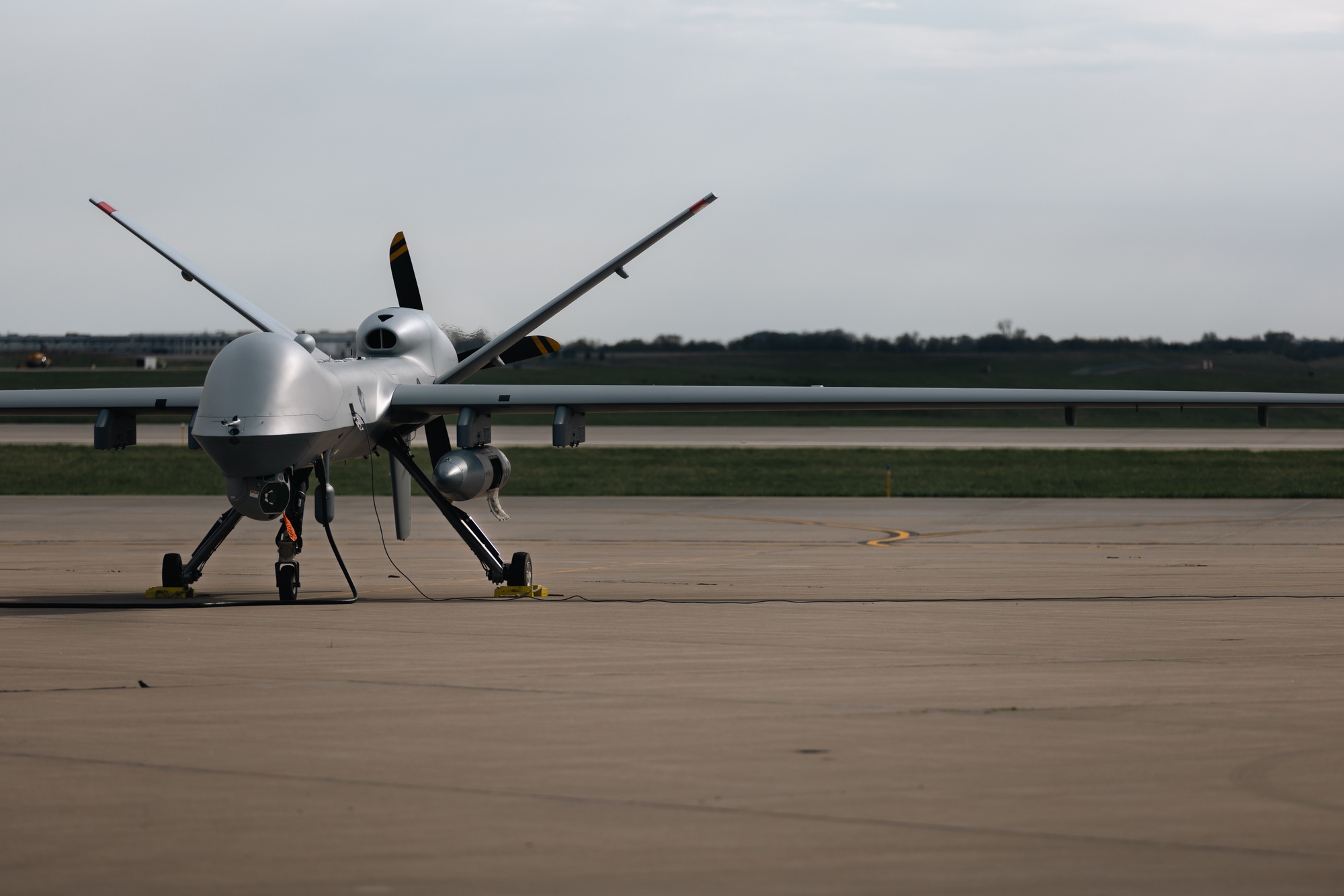
On 16 September 2026, the audience for a set of live beyond-visual-line-of-sight (BVLOS) flights in Grand Forks was state aviation officials. The Northern Plains UAS Test Site (NPUASTS) flew medical-supply and agricultural demonstrations at Gorman Field during the National Association of State Aviation Officials (NASAO) Annual Convention, and every flight ran on Vantis, the statewide network that North Dakota's Department of Commerce calls the nation's first.
The participants were NPUASTS, CVS Health, SkyfireAI, Kelly Hills Unmanned and Thales. The test site's own release, datelined Grand Forks and dated 16 September, previewed the flights in the future tense. DroneLife's account the next day reported that they took place.
What Flew
Two application areas were on the program: drones delivering medical supplies, and autonomous aircraft in agriculture.
On the medical side, CVS Air Response, a CVS Health program developing UAS applications for medical logistics, was a key component of the demonstration. The flights incorporated CVS's mobile pharmacy concept and showed how BVLOS aircraft could move medical supplies while operating on Vantis. Neither the release nor the DroneLife report gives figures on flight counts, distances or aircraft types, so what the flights demonstrated in operational terms is not public. They were demonstrations, not a commercial service launch, and nothing in the source material says otherwise.
Kelly Hills Unmanned and Thales are both listed among the participants, and according to DroneLife the two companies previously partnered on a TopSky agricultural drone network in Kansas. The sources do not say which aircraft flew in which demonstration, so the roles of Kelly Hills Unmanned, Thales and SkyfireAI on the day are not broken out.
The release quotes Trevor Woods, NPUASTS executive director, Josh Wright, a CVS Health manager, and Rob Geckle, CEO of Thales North America. DroneLife carries quotes from the same three.
The Real Pitch: The Network, Not the Aircraft
The demos were the visible part. The argument underneath them is about how BVLOS gets supported and operated. NPUASTS administers Vantis, and its program page describes it as physical and virtual infrastructure and services, plus a regulatory framework, meant to provide turnkey support to drone operators. The page describes several shared components:
- Shared detect-and-avoid. Vantis provides shared infrastructure for BVLOS UAS, including detect-and-avoid radar and sensors and system testing, integrated into larger airspace.
- Federal radar data. Vantis integrates unfiltered FAA radar data through what it calls the Vantis Federal Radar Data Enclave.
- A command center. The Mission Network & Operations Center (MNOC) is described as the command center for the entire system, where data correlation and validation, real-time aircraft monitoring and flight operations are tracked.
- Process, not just hardware. The program page says Vantis provides processes and protocols, such as change-management procedures and safety risk management.
- Onboarding and connectivity. The demo release stresses "aircraft onboarding, connectivity and operational integration," and says the statewide infrastructure can support multiple types of advanced UAS aircraft and use cases.
The program page also says Vantis uses only National Defense Authorization Act (NDAA) compliant UAS, a constraint that shapes which aircraft can join. It calls Vantis the first system of its scale in the United States. That is the operator's claim about itself. The North Dakota Department of Commerce uses a similar description, calling Vantis "the nation's first statewide uncrewed aerial systems (UAS) network" that allows BVLOS flight in industries like agriculture, energy and transportation.
The framing helps explain why NASAO was the venue. Woods said the demonstration gave state aviation officials "an opportunity to see what BVLOS operations can look like when the aircraft, infrastructure, technology and operational expertise come together," and it is reasonable to read the flights as a pitch to those officials that a shared network like this is something a state could support. Working flights on a real network, spanning medical logistics and agriculture, make that case more concretely than a presentation would. That reading is an inference; the sources do not state a goal beyond showing the officials what the network can do.
From Test Program to State-Owned Entity
Vantis is also on its way to becoming a business. According to the Department of Commerce, the North Dakota Development Fund has approved the creation of a state-owned entity to commercialize the network, with the aim of generating revenue for the state, attracting new business partnerships and developing digital aviation services. The Commerce page is undated, so it establishes that the decision was made but not when. The sources also do not say how the entity will be structured, what it will charge, or when it will start operating.
The shift changes how the demos read. A test site running flights for researchers is one thing. A state-owned commercial network seeking operators and partners is another. The NASAO demonstrations fit the second description: they show a CVS Health program and companies from the agricultural side using the same infrastructure.
Where the Federal Government Fits
Vantis is not separate from federal aviation authorities. The program page says Vantis' working relationship with FAA offices reduces obstacles and red tape for regulatory approval, and that it informs and drives future federal regulation and policy for UAS operations. Its Federal Radar Data Enclave brings unfiltered FAA radar data into the network. Thales, in its release quote, frames its role as helping to "accelerate the integration of unmanned aircraft into the national airspace."
The sources reviewed here do not describe what regulatory status individual Vantis flights carry, or how the network's framework interacts with FAA approvals beyond the radar data arrangement and the collaboration the program page describes. That gap matters, and it is one of the first things to ask as the commercial entity takes shape.
Why NPUASTS Is the Host
NPUASTS is one of nine FAA-designated UAS test sites. The FAA's test site page says the FAA Modernization and Reform Act of 2012 directed the FAA to start a five-year program to establish six sites, which became operational in 2014, and that a seventh was added in 2016. The 2024 FAA Reauthorization continued the program, and, in the FAA's words, "In 2026, the FAA added two additional test sites," bringing the total to nine. The FAA's list of the nine includes the Northern Plains UAS Test Site, ND.
The program's main objective, per the FAA, is to verify the safety of public and civil UAS operations and related navigation procedures before they are integrated into the national airspace system. The test sites' research and demonstration focus areas include detect and avoid, BVLOS operations and UAS Traffic Management (UTM), and the FAA notes that the sites have also done package-delivery research. Vantis's BVLOS and detect-and-avoid components line up with those areas, which is consistent with a state test site, rather than a private operator, running the network and the demo.
Why It Matters
BVLOS is the capability at the center of both applications on show, from medical delivery to agricultural work. North Dakota is presenting the enabling pieces (radar, connectivity, onboarding and a network operations center) as shared infrastructure that many operators can use, rather than something each must assemble on its own.
If that argument lands with state aviation officials, it could change how other states think about hosting BVLOS. It also raises questions the demos do not answer. Who bears the liability when a shared network is part of the safety case? How does a state-owned commercial entity remain neutral among the operators using it? And how will the network adapt as federal BVLOS policy develops?
For now, the concrete facts are modest. Live flights took place. The participants are named. The network exists, and the state has approved the creation of a state-owned entity to commercialize it. The metrics that would show whether it works, such as flight volumes, distances and aircraft, have not been released.
Sources
- Northern Plains UAS Test Site Flies Medical and Agricultural BVLOS Demos on Vantis at NASAO (DroneLife, 17 Sept 2026)
- Northern Plains UAS Test Site to Showcase Future of BVLOS Medical, Agricultural UAS Operations on Vantis at NASAO Conference (NPUASTS)
- Vantis: North Dakota's Groundbreaking UAS Network (North Dakota Department of Commerce)
- Vantis (Northern Plains UAS Test Site program page)
- UAS Test Site Program (Federal Aviation Administration)
