
For most of the past decade, the utility drone program has been a familiar pitch deck: a handful of quadrotors, a certificated pilot or two, and a slide deck full of "future" use cases that always seemed to live one waiver away from reality. According to a June 26, 2026 report from DroneXL, Dominion Energy has quietly turned that pitch into an operating fleet. The utility is now running 50 drones across its grid, coordinated from a dedicated Drone Remote Operations Center and flown beyond visual line of sight over commercial cellular networks. It is one of the clearest signals yet that enterprise BVLOS has moved from the pilot phase into routine infrastructure work.
The numbers DroneXL reports are worth sitting with. Of the 50 aircraft, 23 are "drone-in-a-box" units — autonomous platforms that live in weatherproof docking stations stationed at substations and other facilities, launching, flying a mission, and returning to recharge without a human ever touching the airframe. Behind them sit 10 FAA-certified pilots who have logged more than 5,000 flight hours and covered upward of 10,000 miles of transmission and distribution lines and facilities. That is not a proof of concept. That is a logistics operation.
What "drone-in-a-box" actually buys a utility
The appeal of the docked-drone architecture is that it collapses the two most expensive parts of an inspection — getting a qualified pilot to a remote site, and getting eyes on an asset quickly after something goes wrong. A box bolted to a substation fence can launch on a schedule, or on demand, and be over a fault within minutes rather than the hours it takes to dispatch a crew. The trade-off, historically, has been regulatory: flying a drone where no one can see it requires beyond-visual-line-of-sight authorization, and stitching together dozens of those flights across a service territory requires a command-and-control link that does not depend on a pilot standing in a field with a controller.
Dominion's answer to the second problem is cellular. The fleet operates under a cellular-enabled BVLOS authorization, meaning the command-and-control link rides commercial mobile networks rather than a dedicated line-of-sight radio. That is the technical hinge of the whole program. Cellular C2 is what lets a single Drone Remote Operations Center, or D-ROC, supervise aircraft scattered across the grid instead of tethering each one to a nearby operator. It is also what turns 23 boxes into a coordinated fleet rather than 23 isolated science experiments.
The hardware menagerie
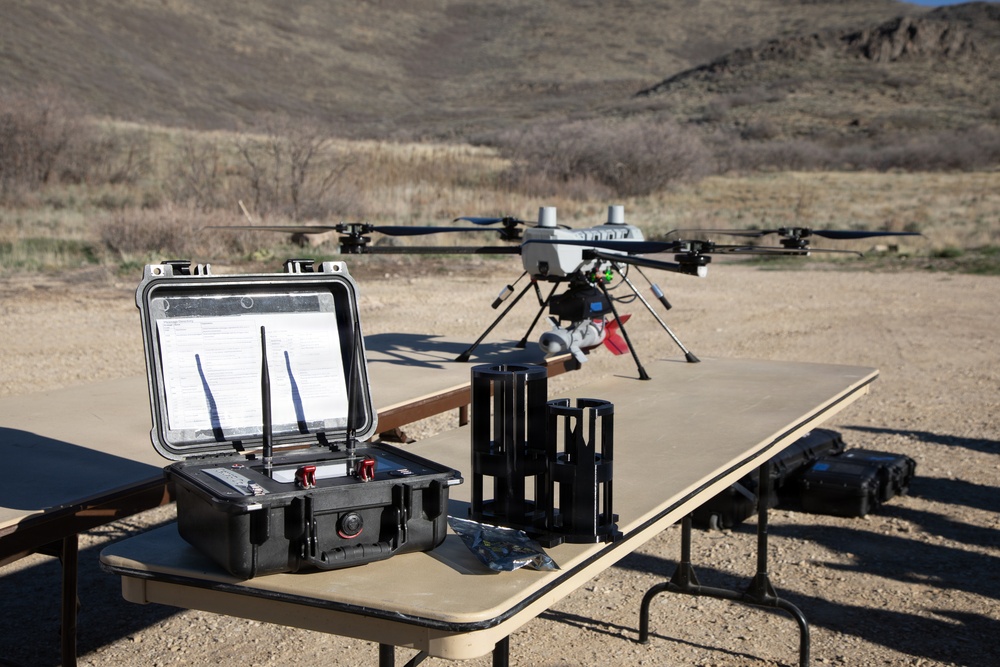
The aircraft themselves are not a single standardized platform, and that is part of the story. DroneXL describes a mix that goes well beyond the stock quadrotor. The headline airframe is a six-foot vertical-takeoff-and-landing drone that cruises at 45 mph and uses onboard LIDAR for navigation and obstacle detection — the kind of endurance platform suited to running long transmission corridors. Alongside it, the fleet includes a smaller quadrotor for close-up structural inspection, a walking drone the team calls "Odie," and submersible units pointed at a job most people never associate with drones at all: underwater inspection of transmission-tower foundations beneath rivers.
The mission list maps onto Dominion's physical footprint. Thermal imaging flies solar surveys — DroneXL specifically cites the 142-megawatt Colonial Trail West solar farm in Surry County, Virginia — hunting for the temperature anomalies that betray a failing panel or connection. Other flights handle transmission-clearance surveys, checking that vegetation and structures stay clear of energized lines, and post-storm damage assessment, where the speed advantage of a pre-positioned box is most obvious. The program also reaches offshore, extending 25 miles into the Atlantic off the Virginia Beach coast, where Dominion's offshore wind project sits and the same inspection model is pushed out over the water.
The people behind the fleet
It is easy to read "autonomous fleet" as "no humans," but the DroneXL account makes clear the program is still built around named operators. Pilots Aaron Colgrove and Joel Cashman are among the certificated crew flying the missions, and T.F. Butler manages Dominion's Unmanned Systems Group. The autonomy handles the rote flying; the humans handle authorization, exception cases, and the judgment calls that regulators still — rightly — insist a licensed pilot owns. The 5,000-plus logged flight hours are a reminder that even a heavily automated program accrues real operational experience the slow way.
How the regulatory piece fits
None of this is legal by default. Routine BVLOS flight in U.S. airspace runs through the FAA's advanced-operations framework, which defines the waiver and authorization pathways that let an operator fly where the pilot cannot see the aircraft. That framework is the legal substrate underneath Dominion's cellular-enabled, drone-in-a-box flights — it is what converts "persistent autonomous infrastructure monitoring" from a vendor slogan into a permitted operation. The FAA's advanced-operations guidance lays out the authorization route that programs like this one depend on, and it is the reason a single utility can stand up dozens of docked aircraft without each flight being a bespoke negotiation.
The unanswered question: who built the drones?
Here is where the report gets pointed. DroneXL notes that Dominion has not disclosed the manufacturers of the platforms flying over its critical infrastructure. For a consumer hobby flight, that would be a footnote. For a fleet operating over substations and transmission corridors — the literal critical infrastructure of an electric utility — vendor provenance is a security question, not a trivia question. The omission lands squarely in the middle of an industry-wide shift.
That shift is the subject of separate June 24, 2026 reporting from DroneLife, which frames the broader picture: utilities are scaling BVLOS programs at the same moment they are working to move off DJI hardware for storm-response and critical-infrastructure work. That reporting, centered on utilities like Entergy and Southern Company, describes two pressures at once: replacing DJI hardware with non-Chinese platforms such as Skydio X10s, Alta X, and SwissDrones heavy-lift aircraft, and managing the sheer volume of data a long BVLOS flight produces — a 20-mile inspection run can generate a terabyte of imagery that someone still has to review, which is why some utilities favor shorter flights for storm recovery. Against that backdrop, an undisclosed platform vendor over a power grid is not just a gap in a press release — it is a live question about supply chain, security review, and what "domestic" actually means once a fleet reaches this scale. To be clear, DroneLife's reporting describes the sector trend broadly and does not mention Dominion's specific deployment; the two together sketch the pressure utilities are operating under.
Why It Matters
Enterprise BVLOS has been "almost here" for years. A 50-drone fleet — 23 of them autonomous and docked, all of them supervised from a single remote center over cellular C2 — is what "here" looks like in practice. The significance is not any one capability but the integration: cellular command-and-control, drone-in-a-box autonomy, and FAA advanced-operations authorization combining into a program that runs as routine infrastructure rather than a demo. That is the model other utilities will copy, and it changes the economics of grid inspection, storm response, and offshore-wind maintenance.
It also sharpens a tension the industry has not resolved. The same autonomy that makes persistent monitoring affordable concentrates a lot of sensing capability over critical infrastructure — and the refusal to name the platform vendors, set against the broader scramble to move off DJI hardware, means the security questions are scaling right alongside the fleets. The technology is past the pilot stage. The governance, sourcing, and transparency around it are still catching up.
