
DAYTON, Ohio — The National Museum of the United States Air Force, better known for housing a static collection of the aircraft that shaped a century of American air power, spent this week hosting something considerably less static: more than 120 teams of engineers, hobbyists and aerospace professionals racing to build the next generation of heavy-lift drones.
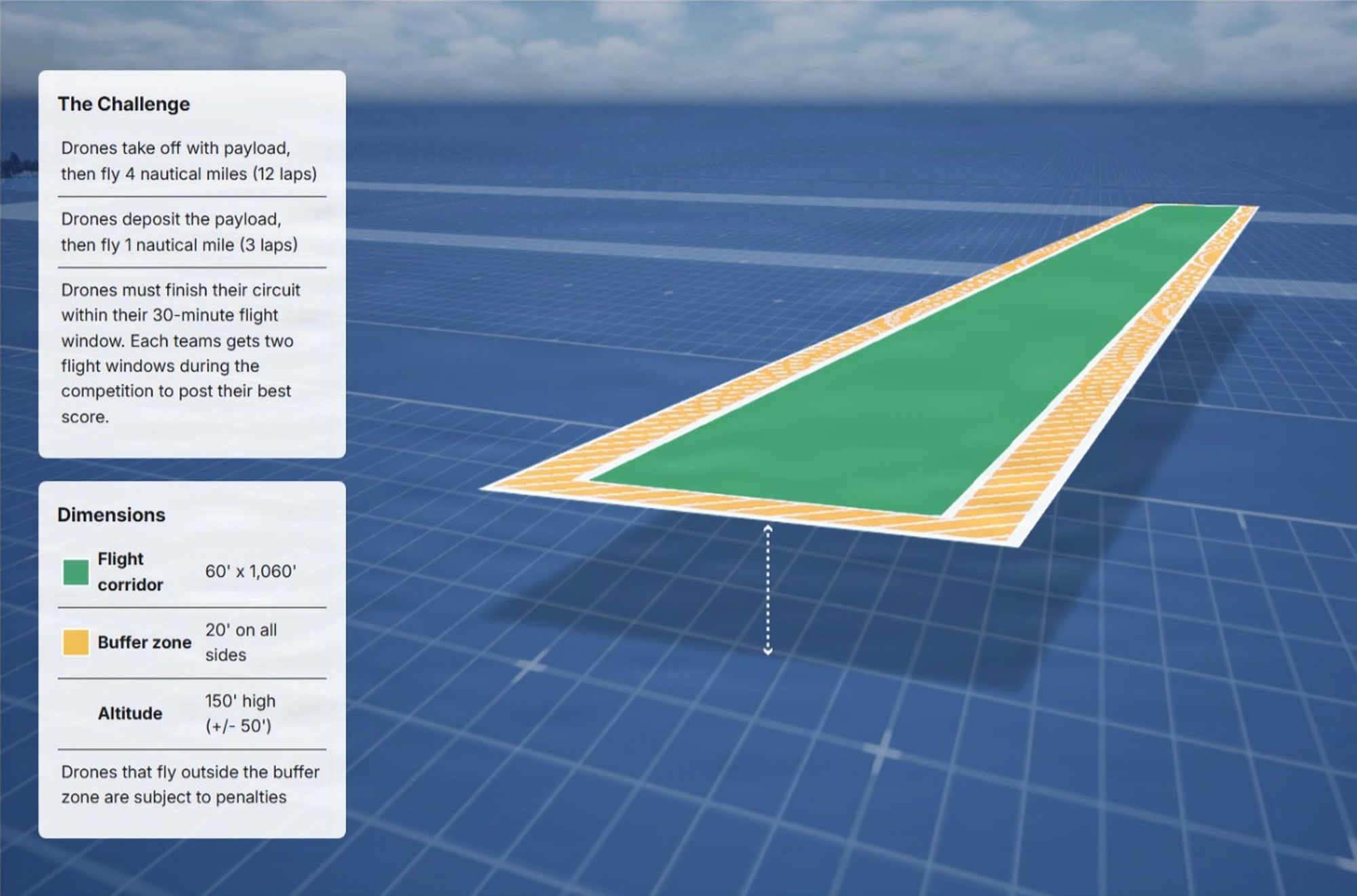
DARPA's Lift Challenge opened August 2 and runs through August 9 at Wright-Patterson Air Force Base, with a $6.5 million prize pool on the line and a technical bar that sounds almost contradictory on paper: build an aircraft under 55 pounds capable of hauling a payload of 220 pounds or more — four times its own weight — around a 5-nautical-mile course.
The competitor list, published by DARPA in a companion release, spans technology startups, established aerospace firms, university teams and independent inventors — drawn not just from across the United States but from more than 20 countries worldwide, according to DARPA. All of them will fly head-to-head in live performance trials during the event week, culminating in a public final flyoff on August 9 that coincides with the last day of Flite Fest, a separate radio-control and experimental aviation gathering also held at the museum August 6-9.
The Rules of the Game
According to DARPA's event announcement, the challenge's core constraint is a weight ceiling: any qualifying aircraft must weigh 55 pounds or less. From that fixed baseline, teams are chasing a payload target of 220 pounds — a 4:1 payload-to-airframe-weight ratio — carried over a 5-nautical-mile course. Prize categories go beyond a single grand prize; DARPA has also set aside awards for the most revolutionary aerodynamic design and the most revolutionary powertrain, signaling that the agency is fishing for unconventional engineering approaches rather than simply rewarding whichever team lifts the most weight fastest.
That structure matters. A pure "heaviest payload wins" contest would likely favor incremental scaling of existing multirotor or hybrid VTOL architectures. By carving out separate prizes for airframe and propulsion innovation, DARPA appears to be hedging against convergence on a single design pattern and instead trying to surface genuinely novel approaches — unconventional wing geometries, hybrid-electric powertrains, or lift mechanisms that haven't yet found their way into production drones.
Who Showed Up
The breadth of the 120-plus-team field is itself notable. Per DARPA's team roster release, the competitors range from well-resourced aerospace firms to university labs and solo inventors — a mix that suggests the agency deliberately kept the barrier to entry low enough to pull in garage-scale innovators alongside institutional players, drawing entrants from more than 20 countries in the process. That's a familiar DARPA playbook: previous agency prize challenges, from the DARPA Grand Challenge for autonomous vehicles to the Subterranean Challenge, have relied on exactly this kind of open-field format to surface approaches that wouldn't emerge from a traditional closed contractor solicitation.
Trade outlet DefenseScoop, previewing the event in early July, framed the competition's purpose around a specific engineering bottleneck: unlocking breakthroughs in payload-to-weight ratio for vertical-lift aircraft, with the agency's program manager describing the goal as slashing the military's cost-per-pound, per-mile for aerial resupply. DroneLife's coverage ahead of the event similarly characterized the challenge as an attempt to "reinvent" heavy-lift drone design rather than iterate on it.
Why a Museum, Why Dayton
The choice of venue is not incidental. Wright-Patterson Air Force Base sits at the historical center of American aviation research. Dayton was home to the Wright brothers' bicycle shop and their early wind-tunnel and glider experiments — the first powered flight itself took place hundreds of miles away at Kitty Hawk, North Carolina, but the engineering groundwork was largely worked out here. Hosting a cutting-edge drone competition at the National Museum of the U.S. Air Force ties the event to that lineage while also opening it to public viewing; DARPA has confirmed public access for the August 9 final flyoff, giving spectators a rare chance to watch a DARPA-sponsored prize competition in person rather than following it secondhand through agency press releases.
The overlap with Flite Fest — an established gathering for radio-control and experimental aircraft enthusiasts running August 6-9 — also positions the Lift Challenge finale in front of an audience already primed for aviation spectacle, likely amplifying turnout beyond what a standalone DARPA event would draw.
What Happens on the Course
Specific technical details of the 5-nautical-mile course itself — terrain, altitude requirements, timing windows — were not disclosed in DARPA's public materials reviewed for this article. What is confirmed is the shape of the contest: qualifying aircraft fly the course carrying payload toward the 220-pound target, with performance trials conducted live throughout the event week rather than in a single elimination round. That format gives teams multiple opportunities to demonstrate their systems and gives DARPA a broader dataset on which approaches actually work under real flight conditions, rather than crowning a winner off a single make-or-break run.
Why It Matters
Heavy-lift drone capability has been a persistent gap in both military and civilian unmanned systems. Most fielded multirotor and fixed-wing UAS platforms carry payloads that are a fraction of their own airframe weight — getting anywhere close to a 4:1 payload ratio at a 55-pound class size would represent a substantial leap in the physics that heavy-lift drone design has to work around, namely power density, structural weight, and propulsion efficiency at small scale.
For the military side, a compact aircraft that can move 220 pounds of cargo over several miles without a large logistics footprint has obvious appeal for contested or austere environments where manned resupply flights are risky or unavailable — DefenseScoop reported that DARPA's program manager framed the effort around cutting the military's cost-per-pound, per-mile for aerial resupply. On the civilian side, DroneLife's coverage pointed to heavy-lift agricultural applications such as fertilizer spraying, and DefenseScoop noted DARPA expects the technology to find broader use in the commercial sector, though neither outlet detailed specific use cases like disaster response or infrastructure inspection sometimes associated with heavy-lift drones generally.
Just as significant is the format itself. By opening the competition to more than 120 teams — including independent inventors and university groups alongside established aerospace contractors — DARPA is betting that a wide, low-barrier field will surface design approaches that a traditional, narrowly scoped defense contract would never reach. Whether any of the 120-plus entries actually hits the 4x payload target on the 5-nautical-mile course won't be clear until results come out of the August 9 flyoff, but the attempt alone signals where DARPA thinks the next real advance in small-UAS capability has to come from: not incremental scaling of existing multirotor designs, but a genuine rethink of airframe and powertrain architecture.
