Roughly 115 teams — university engineering labs, small drone manufacturers, garage tinkerers, and government organizations among them — are gathering this week at the National Museum of the U.S. Air Force in Dayton, Ohio, for the finals of DARPA's Lift Challenge. Running August 6-9, 2026 and co-located with Flite Fest, a grassroots radio-controlled aviation gathering, the competition puts a blunt engineering question to the test in front of a live audience: how much weight can a small, autonomous aircraft actually carry relative to its own?
The prize purse totals $6.5 million, with cash going to the top three teams ranked by payload-to-weight ratio. The bar DARPA has set is steep. Entrants must fly an aircraft that weighs no more than 55 pounds — including fuel or batteries — while lifting a minimum payload of 110 pounds. That works out to a 4:1 payload-to-weight ratio. Today's typical consumer and commercial multirotor drones manage roughly a 0.2-to-1 to 0.3-to-1 ratio, according to DARPA program manager Phillip Smith — meaning the Lift Challenge target is closer to 15 times what's currently achievable, not merely quadruple.
"Many problems could be solved if we just had a better payload-to-weight ratio," said Phillip Smith, the DARPA program manager overseeing Lift Challenge within the agency's Tactical Technology Office, in comments on the program's official page. That single-sentence framing captures why DARPA is running this as an open prize competition rather than a traditional contracted R&D program: the agency is casting as wide a net as possible for an unconventional airframe or propulsion breakthrough, rather than betting on a handful of established contractors.
What the Finals Actually Require
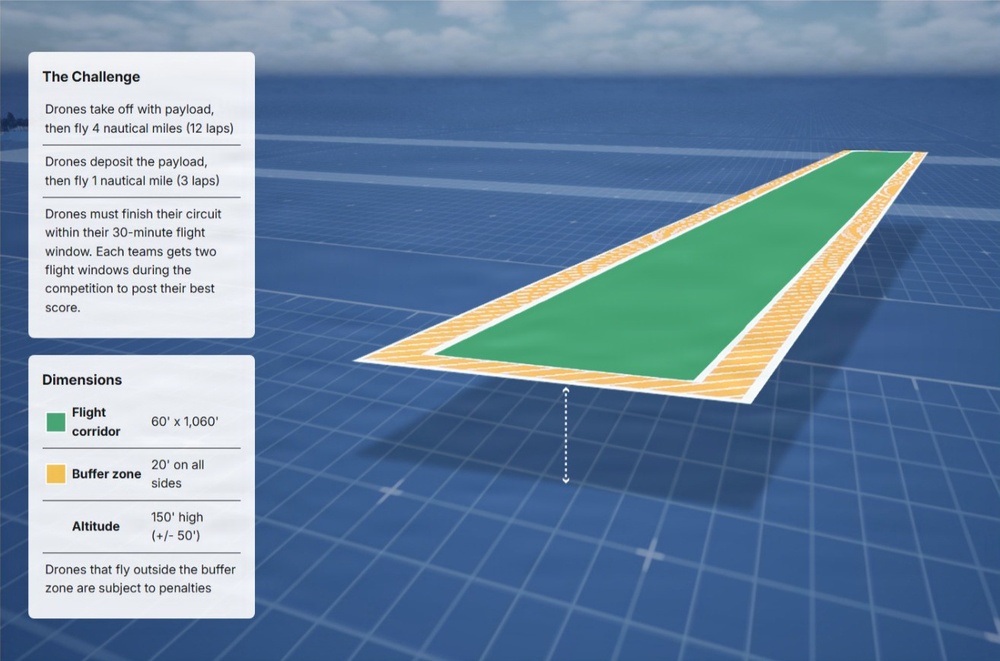
To score, a team's aircraft has to complete a full sequence rather than just hover under load. Finalists must demonstrate vertical takeoff and landing (VTOL), fly the aircraft through a course measuring roughly 100 feet wide by a little over 1,000 feet long, and then set it down inside a landing zone with just a 5-foot radius. DARPA's program materials describe the overall course distance as roughly 5 nautical miles. Every element — the loaded liftoff, the transit, the precision landing — has to work together, which rules out designs that can lift heavy but can't control the aircraft precisely once it's loaded.
The field narrowed considerably to get here. According to reporting from DroneLife, DARPA received more than 480 initial applications and qualified around 115 teams for the finals — a mix of universities, small and medium drone manufacturers, individual enthusiasts building in garages, and government entities. The competition is open internationally, but with a catch: foreign teams may only compete if led by a U.S.-based company, and Chinese firms — DJI named explicitly — are excluded from participating. Competitors, notably, retain intellectual property rights to whatever they build, a structure DARPA has used before to attract entrants who might otherwise be wary of handing designs to the government.
A Notable Withdrawal
Not every qualified team made it to the starting line. Jetoptera pulled its Project Pegasus aircraft from the finals shortly before the Dayton event, according to Defence Blog. The company cited new rules DARPA introduced ahead of the finals, specifically a 150-foot altitude cap on flights and new permission allowing competitors to jettison spent batteries mid-flight to shed weight — a provision Jetoptera considered a safety and liability risk given aircraft flying with more than 100 pounds of payload overhead. Jetoptera's exit removes one of the more closely watched entrants from a field that, by design, includes everything from student-built quadcopters to more exotic propulsion concepts, and it underscores a tension running through the whole competition: DARPA wants radical payload gains, but it also has to keep a field of experimental, first-of-their-kind aircraft safe to operate over a crowd at a public air museum.
Why a Payload Prize, Why Now
The 4:1 payload-to-weight target isn't an arbitrary round number. Most rotorcraft and multirotor drones in wide use today carry a fraction of their own weight — often well under parity — which is the central bottleneck DARPA is trying to break. A small aircraft that can lift more than its own body weight opens options that don't exist today: resupply drops to dismounted troops without a helicopter, casualty evacuation gear carried by something that fits in a truck bed, or heavier sensor and communications payloads on platforms cheap enough to lose. Smith's framing — that "many problems could be solved" by fixing this one ratio — is effectively DARPA betting that the payload constraint, more than speed, range, or endurance, is what's holding back a class of small-aircraft use cases.
Structuring this as a prize challenge rather than a program of record also lets DARPA sample far more design approaches than it could fund directly. With entrants ranging from university labs to individual builders, the agency is deliberately fishing outside the traditional defense-contractor pool, on the theory that an unconventional propulsion or airframe idea is as likely to come from a garage as from an established aerospace firm.
Why It Matters
The Lift Challenge is a direct bet that payload-to-weight ratio — not speed or endurance — is the binding constraint on what small uncrewed aircraft can do for logistics, resupply, and casualty evacuation in the field. A verified 4:1 result from any of the roughly 115 finalists would represent a substantial jump over current small-UAS norms and could reshape design assumptions across both military and commercial heavy-lift drone programs. The competition's open-IP, open-entrant structure also signals how DARPA is trying to source breakthrough aircraft designs: by casting a wide net across universities, small manufacturers, and individual builders rather than relying solely on established contractors. Jetoptera's withdrawal over the altitude cap and the new in-flight battery-jettison allowance is a reminder that safety constraints imposed to protect a live public event can themselves shape which propulsion and battery architectures are viable — a design tension that will likely follow any of these platforms toward operational use.