
The airspace over Palm Beach now has two layers of protection. One is on paper: a proposed Federal Aviation Administration rule that would create a permanent special flight rules area around Mar-a-Lago and the nearby airport, alongside the temporary flight restrictions that already apply there. The other is physical. Short-range air defense launchers sit on a floating platform in Lake Worth Lagoon, and counter-drone sensor kits have been sent to the site. The two arrived on different schedules, and both respond to the same concern. The Secret Service says it is operating in a heightened threat environment, and its request to the FAA cites unauthorized aircraft and drones near a site it is required to protect.
North American Aerospace Defense Command and U.S. Northern Command confirmed the deployment this week. They said they had placed "ground-based air defense [GBAD] assets and Counter-Unmanned Aircraft System capabilities" around the property at the Secret Service's request. The commands gave no further detail, citing operational security, according to The War Zone.
What is actually deployed
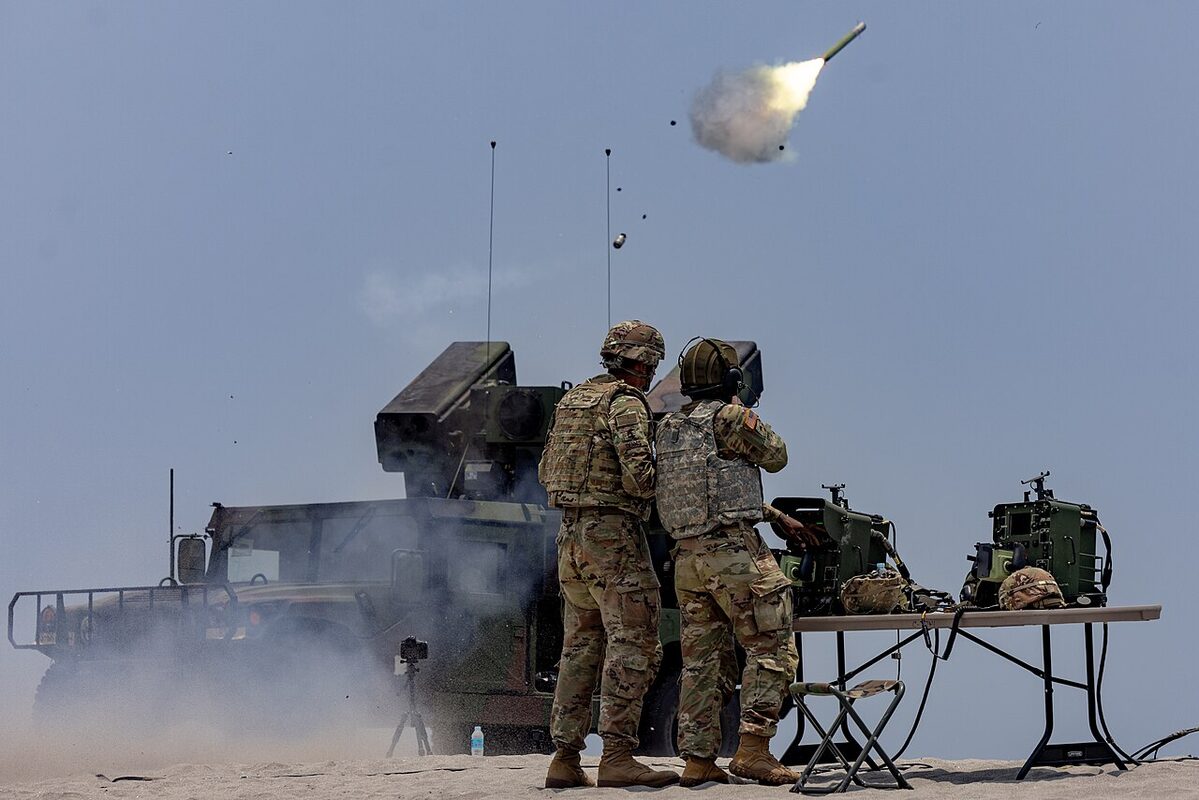
The most visible pieces are the missiles. Getty Images photographs reviewed by The War Zone show two AN/TWQ-1 Avenger short-range air defense (SHORAD) systems on a floating platform in Lake Worth Lagoon and a third on the beach. At least two more are at President Donald J. Trump International Airport, about three miles west of the estate. The War Zone reported that the systems went up about two weeks before its Oct. 30 report.
Each Avenger carries two launchers holding four Stinger missiles apiece. The War Zone notes that the Stingers have been upgraded to deal with drones. WPTV in West Palm Beach identified the Avengers on its own. Former Navy fighter pilot Matthew "Whiz" Buckley looked at the equipment for the station and counted what appeared to be a couple of Avenger batteries, with four Stingers on each side for eight in total, and possibly .50-caliber guns. Aviation expert Dewitt Ingram described the systems to WPTV as a final layer of protection.
The command also confirmed it had sent its C-UAS Fly-Away Kits, which The War Zone describes as rapidly deployable systems that react to drone threats or incursions, built around passive and active sensors:
- Electro-optical and infrared cameras, which help spot, classify and track drones.
- Ku-band radar, another sensor used to detect and track drones.
- Electronic support measures (ESM), passive sensors that pick up radio-frequency emissions.
- Electronic warfare, which The War Zone says can also be deployed as part of the kits. That would let a package go beyond detection to interfering with a drone, though the command has not said whether it has done so here.
"Fly-away" means the capability is built to be packed, flown in and set up at a location for a defined job rather than installed permanently. The War Zone says the assets are meant to augment the NORAD-enforced temporary flight restrictions over Mar-a-Lago, and that the deployment shows how seriously the Secret Service is taking the drone threat. The sources do not spell out how the kits and the Avengers divide the work, but the kits are described as detection and tracking tools and the Stinger-armed Avengers as the last layer.
The paper layer: a permanent special flight rules area
The FAA published a proposed rule in the Federal Register on Sept. 2 (docket FAA-2026-10827, document 2026-17957). It would create a President Donald J. Trump International Airport (DJT) Special Flight Rules Area: a cylinder of airspace with a one-nautical-mile radius centered at 26°40'37"N, 080°02'16"W, running from the surface up to and including 2,000 feet MSL. When a temporary flight restriction is active, operators would have to comply with the requirements in its NOTAM. When none is active, aircraft would have to meet specified conditions to transit the area, such as being on an active IFR or VFR flight plan for arrivals and departures at the airport, staying in two-way radio contact with air traffic control, receiving ATC authorization and squawking an ATC-assigned transponder code. Certain military, law enforcement, firefighting and air ambulance flights have their own conditions. The comment period closed Oct. 2.
The rule's justification comes from the Secret Service. In a Sept. 16, 2025 letter, Director Sean M. Curran asked FAA Administrator Bryan Bedford for a permanent restriction within one nautical mile of Mar-a-Lago, from the surface to 1,000 feet AGL. He cited "adverse threat intelligence" and the need to mitigate "persistent risks posed by unauthorized aircraft and unmanned aircraft systems (UAS) operating in proximity to sensitive areas." The FAA notice also records that the President has designated Mar-a-Lago as a non-Governmental property under the Presidential Protection Act of 1976.
The proposed ceiling of 2,000 feet MSL is higher than the 1,000 feet AGL the Secret Service originally asked for. The FAA notice says the Secret Service and FAA agreed on a 2,000 feet AGL ceiling for the interim restriction in effect since October 2025, because the higher ceiling would allow more time to respond to threats in the area. For drone operators, the practical effect would be that the altitudes where small UAS normally fly fall inside the regulated volume whether or not a TFR is in effect.
How the two layers fit together
The sources do not describe how the Secret Service intends the two layers to work together, so the following is analysis rather than reporting. A standing rule would plausibly help a counter-UAS operator in a few ways.
It could narrow the problem. If any small drone inside the one-mile cylinder is presumed to be there without authorization, sensor operators would likely spend less effort sorting legitimate traffic from suspicious traffic.
It would remove the gaps. Temporary restrictions switch on and off. A standing rule means the airspace is regulated whether or not a TFR NOTAM is active, so the boundary the kits are defending would stay fixed.
It could support escalation decisions. The Avengers are described as the last layer. Engaging anything over a populated coastline is a serious step, and a codified restriction with documented threat reasoning could give decision makers a clearer basis.
The pattern of incursions shows why the Secret Service wants both layers. AVweb, citing NORAD, reports that more than 60 aircraft have been intercepted near the estate since January 2025. On Oct. 24, an F-16 intercepted a civilian aircraft using a standard "headbutt" maneuver, and the pilot then made radio contact and left the restricted area. The War Zone also cites an Aug. 11 FAA court filing counting more than 160 planes and drones breaching Palm Beach airspace since the restrictions took effect in October 2025. Fighters are suited to crewed aircraft that can be intercepted and warned off. A drone has no pilot aboard to see a fighter's signal, which is the kind of gap counter-UAS equipment is meant to cover.
What has not been disclosed
Several important facts are still unknown:
- Cost. AVweb reports that the cost of the deployment has not been disclosed.
- Duration. The military has not said how long the systems will remain in place. Fly-away kits and mobile SHORAD are, by design, movable, but nobody has said when that will happen.
- The trigger. AVweb and WPTV report that officials have not said whether a specific threat prompted the deployment. The Secret Service refers to a "heightened threat environment," and the FAA docket refers to "adverse threat intelligence," but neither has said what the threat is.
- Rules of engagement and EW use. The War Zone says electronic warfare can be part of the kits, but the commands have not said whether it is in use. They have also given no information on how an engagement decision over Palm Beach would be made.
- The final rule. Comments closed Oct. 2, and none of the sources reviewed reports a final rule, so the permanent restriction appears to remain a proposal.
Why It Matters
Mar-a-Lago is a test of how the United States protects a fixed, high-profile civilian site against small drones. The approach being tried appears to have two parts. A proposed airspace rule would define a permanent protected volume, and a deployable sensor package with Stinger-armed Avengers serves as the physical layer, with detection from EO/IR cameras, Ku-band radar and ESM, optional electronic warfare, and the Avengers as the final layer. The Secret Service's own request names unmanned aircraft as a persistent risk, so the drone threat is not a side issue here. It is part of the stated reason for the rule, and The War Zone ties the hardware to drone concerns too.
For the wider drone community, the precedent may matter. A permanent Special Flight Rules Area around a private residence, justified partly by UAS risk and paired with military counter-drone kits, could become a model for other protected sites. Whether that happens will depend on details still withheld: what the deployment costs, how long it stays, and what threat intelligence prompted it. Until those are released, the public has little explanation of why the airspace over Palm Beach is getting this level of protection.
Sources
- Establishment of Special Air Traffic Rules in the Vicinity of President Donald J. Trump International Airport (DJT), FAA proposed rule, Federal Register, Sept. 2, 2026
- Surface-To-Air Missiles Deployed To Protect Trump's Mar-a-Lago Estate, The War Zone, Oct. 30, 2026
- Air Defense Systems Deployed Near Mar-a-Lago, AVweb, Oct. 30, 2026
- Surface-to-air missile systems deployed near Trump airport, Mar-a-Lago in Palm Beach, WPTV
