
Counter-drone sensors have a bird problem. Radar returns, acoustic signatures and electro-optical tracks from birds fill operators' screens with clutter, and every C-UAS system has to decide which small, slow, low-flying objects to ignore. A Los Angeles startup called Ornadyne is building a drone meant to be one of the objects those systems ignore.
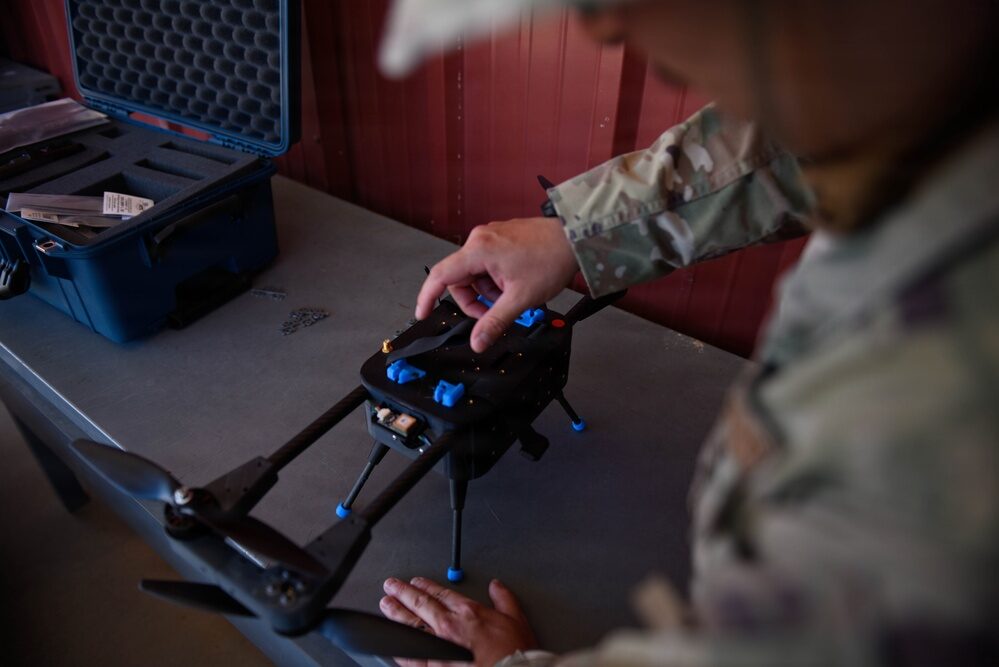
According to a Defense Contract Management Agency story posted to DVIDS on Oct. 30, Ornadyne flew its O1 ornithopter at the "Game of Drones" event at Edwards Air Force Base, Sept. 14-18. The O1 flies by flapping semi-rigid wings rather than spinning propellers. CEO Geourg Kivijian said the other vendors' sensors at the event "could not establish our drone," and that it "registered as a bird, which is exactly what we wanted."
That is a striking claim, and it should be read for what it is: a company's own account of its first appearance at a government-sponsored event, relayed in an agency news story. The idea underneath it is not new, though, and it points at a real gap in how counter-UAS systems classify targets.
What Happened at Edwards
The DCMA story, written by Jason Kaneshiro, says the event was developed and sponsored by DCMA's Blue List team together with the Air Force 412th Test Wing's Experimental Test Force and the Griffiss Institute. It was Ornadyne's first appearance at the event.
The detection result comes from Ornadyne's leadership. Kivijian is quoted on the sensor outcome, and CTO Armen Arakelyan on acoustics: he said the O1 is quieter because flapping wings replace propellers. The public account names no specific sensors and gives no ranges, aspect angles, weather or other test conditions, and it does not quote another vendor or a government evaluator confirming the classification. That doesn't make the claim false. It does make it a single, self-reported data point, not a validated performance figure.
The Company Behind the Bird
Ornadyne is very new. Its StartupHub.ai profile lists it as a Los Angeles-based B2B robotics company founded in 2026 that develops autonomous ornithopters designed to mimic the appearance, flight and sound of birds. The profile, last updated June 21, 2026, lists Skydio, Anduril and XTEND among its competitors.
An Autonomy Global profile of the company, based on an interview at SOF Week 2026, fills in the founders' backgrounds. Kivijian and Arakelyan met in middle school. Kivijian earned a master's degree at Cal Poly with a focus on flapping-wing robots and later worked at NASA's Jet Propulsion Laboratory. Arakelyan studied astronautics at USC and worked at SpaceX. The company was accepted into Y Combinator's Spring 2026 batch.
At the time of that interview, Ornadyne said the O1 was at Technology Readiness Level 4-5: a flying prototype, not a fielded product. The company said it aimed to deliver a high-fidelity system to operators within six to 12 months and was looking for demonstration partners. The Edwards appearance is consistent with that search.
Why Flapping Wings, and Why Now
Ornadyne's pitch, as Autonomy Global describes it, rests on the same weakness C-UAS vendors work hardest to fix: birds trigger false positives across radar, acoustic and electro-optical detection. Kivijian called birds "the noise of counter-UAS detection systems" and said the goal is to blend into that noise. Every system tuned to reject bird clutter has, in effect, a category of target it is designed not to care about. A drone that convincingly falls into that category exploits the filter rather than defeating the sensor.
Each sensing method has its own way of telling a quadcopter from a crow, and the O1 is aimed at all of them. Acoustic sensors depend on sound, and Arakelyan says the O1 is quieter because it has no propellers. Optical and radar classifiers weigh shape, motion and flight behavior. An ornithopter that gets the wingbeat, silhouette and sound close enough could, in principle, confuse all three at once. That is the bet.
Ornadyne is not the first to make it. Autonomy Global points to AeroVironment's DARPA-funded Nano Hummingbird as a precedent for flapping-wing reconnaissance aircraft. Kivijian also told the outlet that he saw China's People's Liberation Army taking a serious interest in the technology, which frames the O1 as both a U.S. capability and a preview of a threat. On why the concept is more workable now than before, the profile credits battery improvements. Endurance has long held back bird-sized platforms.
Questions a Buyer Should Ask
For a program office or operator looking at the O1, the Edwards anecdote raises more questions than it answers:
- Which sensors, and how many? "Other vendors' sensors" could mean a few systems or a dozen, tuned well or badly, run by experienced teams or by vendors focused on their own demos.
- Under what geometry? Range, altitude, flight profile and how long the sensors watched all affect whether a classifier settles on "bird."
- Was it detected and then dismissed, or never detected? Kivijian's wording, that it "registered as a bird," suggests the sensors saw something and labeled it wrong. That is a different and arguably more interesting failure than not seeing it at all.
- What does the mission actually need? Mimicry matters most for a reconnaissance platform that has to operate close to people who may be watching. Autonomy Global describes a one-meter wingspan and a 50-to-100-gram payload capacity supporting a camera, but endurance, data links and controllability in wind matter just as much, and the sources give no figures for them.
Why It Matters
For C-UAS buyers, the O1 is a reminder that classification is now as important as detection. Much of the counter-drone market has competed on detection range and how fast a system alerts. A target designed to look like the clutter those systems throw away shifts the problem to discrimination: separating a real bird from a machine pretending to be one, preferably across several sensor types at once. Any system whose bird-rejection logic is a fixed filter rather than a fused, behavior-aware classifier should expect this kind of target eventually, whether it comes from a U.S. startup or a foreign military.
For Ornadyne, the result is a useful early credential and nothing more. One self-reported outcome from a first event, with a prototype the company itself put at TRL 4-5, is a long way from an operationally proven system. The 6-12 month timeline to a high-fidelity system for operators is the next claim to test.
For the test community, the Edwards event shows what such events are meant to do: put a strange new aircraft in front of vendors' sensors and show where assumptions break. The DCMA story describes the event as a way to see how different drone capabilities fare against each other in different scenarios. If Ornadyne is right, the C-UAS vendors in attendance have a specific gap to examine, though only the vendors and evaluators can say whether it holds up.
