
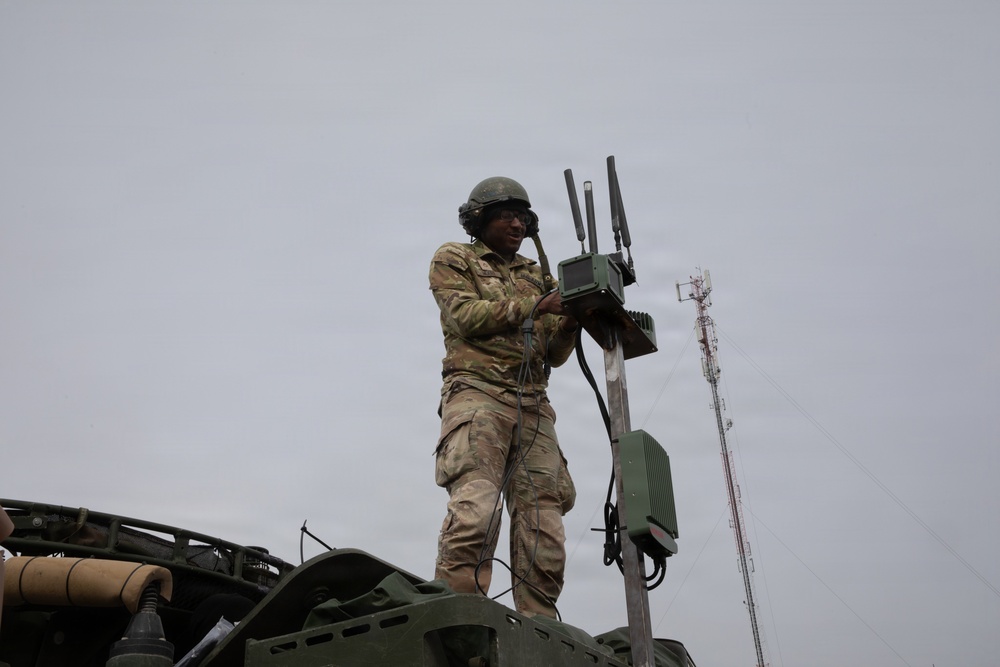
On Oct. 30, NATO allies and roughly 100 defence companies met at Adazi Military Base outside Riga for a field day that tested counter-drone technology. The trials included jamming a swarm of hostile drones that appeared suddenly, connecting a drone-detection system to an air-defence gun battery, and using a 5G mobile network as a passive drone sensor.
The field day was part of DiBaX 2026, the fifth edition of a NATO experimentation series that Latvia has hosted at Adazi since 2022. This year two other strands ran alongside it: the Layered Counter-UAS Initiative (LCI-X), which tests sensors and effectors, and Next Generation Targeting (NGT), which covers deep-strike trials. According to the Latvian Ministry of Defence, the work was split between Adazi and a second site, Military Base Selija.
What was actually tested
Unmanned Airspace reported that in one trial, participants jammed a swarm of hostile drones that appeared suddenly over the battlefield. In another, a drone-detection system was linked directly to an air-defence gun battery. The second trial is less flashy, but it tackles a hard problem in counter-UAS: passing a track from the sensor that sees a target to the weapon that has to engage it, fast enough to matter.
The report also describes a demonstration in which AI-based detection systems could neutralise an adversarial surveillance drone and then launch a targeted strike on the position it was launched from. That ties the counter-UAS strand to the NGT deep-strike work running in parallel. In this setup, defeating a drone is not the end of the engagement, since it also points to where the operator is.
Hungary's BPNE Zrt supplied the radio-frequency detectors. RF detection listens for the control and video links between a drone and its operator, so it pairs naturally with sensors that do not depend on the drone communicating with its pilot.
Turning cell towers into a sensor grid
The 5G element is the technically novel part. Unmanned Airspace explains that the method is passive and does not depend on the drone communicating with the pilot. Radio waves transmitted by 5G base stations are reflected by flying objects, and a network of base stations detects the reflections and tracks them to estimate the size, speed and direction of the drone. The publication adds that there is a cost advantage, since the approach exploits radio signals typically used for communications to enable real-time environmental sensing.
Salvis Skladovs, director of LMT Defence, said the capability does not yet exist in NATO. "None of the NATO nations currently has the capability to use mobile network infrastructure with off-the-shelf components to detect flying objects," he said. He also called it "not a new concept," saying the discussion is about who will deploy it first. LMT Defence is working with Thales Italia on joint development of 5G and 6G drone detection capability. Skladovs said the technology would use commercial off-the-shelf infrastructure that can be closely integrated with the command-and-control system.
The appeal is easy to see. A national mobile network already blankets cities, highways and much of the countryside. If base stations can serve as a distributed sensor layer, a country could in principle get wide-area coverage from infrastructure it already has. Unmanned Airspace also noted that Ericsson demonstrated a prototype 5G detection network at DiBaX 2025, combining sensing-enabled radio transmissions with signal processing and AI-enabled algorithms to detect, locate and track drones in real time.
Why Latvia, and why LMT
LMT, the Latvian mobile operator, serves as technology integrator and co-host through its defence unit, LMT Defence, according to the ministry. In its June announcement, the ministry said LMT Defence is consolidating the competences of critical-infrastructure operators to support the development and testing of layered counter-drone systems. LMT vice president Ingmars Pukis pointed to Latvia's experience in creating and developing a 5G military testbed as a reason Latvia has become a key partner in strengthening NATO's digital capabilities.
Allied Command Transformation, NATO's command for developing future capabilities, leads DiBaX 2026 with the Latvian Ministry of Defence and the National Armed Forces. Defence Minister Raivis Melnis was quoted in the ministry's announcement. The ministry described the 2026 focus as integrating sensors and effectors, with particular emphasis on sensing to detect, identify and respond to emerging threats. The activities it listed included field tests, network infrastructure trials, and integrated scenarios combining sensors, communications, unmanned systems, decision-support tools and counter-UAS capabilities.
Bigger than before
In June, the ministry said DiBaX 2026 would have twice as many partners as 2025. By the time the experiments started the week of Oct. 20, a ministry release published through LV portals put the figure at almost three times as many partners as earlier editions, with nearly 100 defence-industry companies from more than 20 countries working alongside representatives of allied armed forces. The release said the series would close at the end of October with an event called "NATO FUSE."
The 2025 edition gives a sense of the trend. Defence Industry Europe reported that it ran from Oct. 27 to Nov. 7, 2025, at Adazi and ended with a live counter-UAS demonstration followed by an explosive ordnance disposal mission. Participants included Ericsson, Nokia, Thales and Origin Robotics. Data from systems built in different countries was fused over 5G and satellite communications into a shared picture, and LMT served as technical integrator for the fourth year in a row. Judging by the reports, the 2026 edition adds trials in which sensors are linked to guns and detections lead to strikes, a step beyond fusing data into a common picture.
Why It Matters
The stated goal of DiBaX is to accelerate emerging technologies from Technology Readiness Level 4, where components or breadboards are validated in a laboratory environment, to TRL 8, where an actual system is completed and qualified through test and demonstration. One NATO commander at the event said that in the past it would take months or even years to bring this kind of technology to maturity, but that in central and eastern Europe such technologies must now be accelerated at speeds never seen before.
The Riga trials suggest several lessons for NATO's eastern flank. First, layered defence depends on integration as much as on any single sensor or effector: an RF detector, a jammer and a gun only form a layered defence once they share tracks. Second, the swarm scenario reflects the expectation that drones can appear suddenly and in numbers. Third, passive 5G sensing could, if it matures, turn civilian telecom infrastructure into part of the air-defence picture, though that would also tie national air defence more closely to commercial operators.
Skladovs' claim that no NATO nation can yet do this with off-the-shelf components is the vendor's own claim, and the sources do not report detection ranges or performance figures for the 5G system. Still, the fact that the concept was part of a live field day alongside jammers and guns suggests it is being taken seriously enough to test.
Sources
- Using 5G networks for drone detection – two major steps forward in one day (Unmanned Airspace, Oct. 30, 2026)
- NATO's DiBaX to return to Latvia for 5th anniversary with biggest edition yet (Latvian Ministry of Defence, June 3, 2026)
- Adazos un Selija norisinas lidz sim verienigakais NATO jauno tehnologiju eksperiments (LV portals, Oct. 20, 2026)
- NATO's largest DiBaX to date tests AI and unmanned systems integration in Latvia field trials (Defence Industry Europe, Nov. 13, 2025)
