
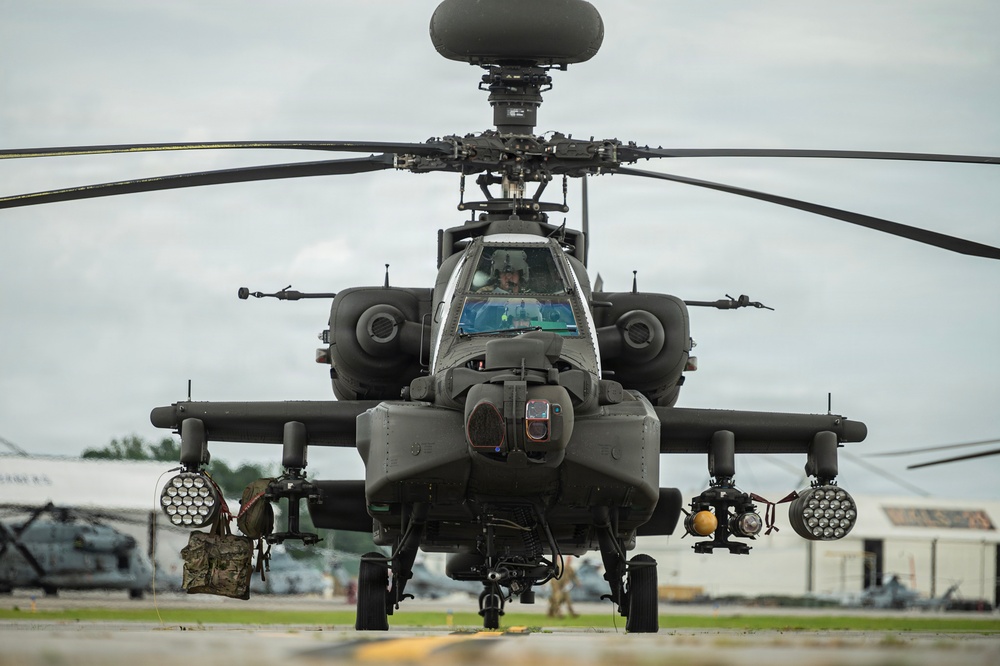
Singapore's air force spent part of this spring in the Australian outback working out what its helicopters should do in a war full of drones. The two answers it tried were very different. In one, attack helicopters hunt drones. In the other, transport helicopters carry their own.
At Exercise Wallaby 2026, held at Shoalwater Bay in Queensland from 6 September to 2 November, the Republic of Singapore Air Force (RSAF) trialled two helicopter-UAS operating concepts, Janes reports. AH-64D Apache Longbows flew counter-UAS air-defence drills against a large unmanned aircraft. Separately, a CH-47F Chinook flew with at least one quadrotor first-person-view (FPV) drone that a crew member hand-launched from the rear ramp while the helicopter was airborne.
Singapore's Ministry of Defence (MINDEF) described the Apache drills in one sentence: "Such training adapts the current capabilities of the RSAF for the evolving threat environment."
The Apache Drill: What We Know and What We Don't
MINDEF has said little about the Apache trial. It gave no details of the target system or the weapons used. According to MINDEF's fact sheet, the AH-64D "was also employed in an air defence role against larger UAS, a class of threat seen in many recent conflicts." The only further clue is footage. Janes says the video appears to show an AH-64D tracking a large delta-winged UAS and firing its primary cannon at it, and that the target resembles the Shahed-136.
That leaves a lot open. MINDEF has not said whether the target was a purpose-built aerial target shaped like a Shahed or something else entirely. It has not said how the Apache's sensors detected and tracked the drone, how many engagements took place, or whether any munitions other than the cannon were used. All Janes can say is that the footage "appears" to show a gun engagement. Until MINDEF publishes more, that is as far as anyone can responsibly go.
The choice of target still says something. A large delta-wing drone is a very different problem from the small quadcopters that dominate most counter-drone discussion. It is bigger, probably faster, and flies more like a small aircraft than a hovering camera. If Singapore's Apache crews are rehearsing against that profile, the RSAF appears to be treating rotary-wing gun engagements as one possible layer against larger drones, not just against battlefield quadcopters.
The Chinook Trial: A Drone Off the Ramp
The second concept goes the other way. Instead of the helicopter defending against drones, it carries one. In the CH-47F trial, a crew member hand-launched a quadrotor FPV UAS from the Chinook's open rear ramp in flight, per Janes' reading of the video.
MINDEF said the drones could "extend the aircrew's visual coverage and provide last-mile surveillance for complex operations." In practice, that would let a Chinook crew look over a ridge line, check a landing zone, or scout the final stretch of a route without bringing the helicopter itself any closer. AsiaOne's coverage of the exercise briefing describes it the same way: drones launched from CH-47F helicopters to extend aircrew visibility and provide surveillance during complex operations.
Singapore is not the first to try this. Janes notes the trial resembles an experiment the UK Royal Air Force ran in May 2025, in which FPV drones controlled by an operator seated aboard a Chinook were hand-launched from the rear ramp. Two air forces with heavy-lift helicopter fleets landing on similar ideas hints that the concept may be moving past a one-off stunt.
The drone trial was not the only new technology on the CH-47F. AsiaOne reports that Singapore also trialled an AI-enabled Helicopter Decision Support System with its CH-47F fleet to support mission planning and decision-making. It also tested a Digitally-Aided Close Air Support app developed jointly by the RSAF, the Defence Science and Technology Agency (DSTA) and ST Engineering.
An Exercise Built Around Unmanned Systems
The helicopter trials were part of a much bigger event. According to MINDEF's fact sheet on the exercise, Wallaby 2026 is the 36th edition of an exercise held annually since 1990. It is the Singapore Armed Forces' (SAF's) largest overseas unilateral exercise, involving approximately 6,000 personnel and 1,200 platforms from the Singapore Army, the RSAF and the Digital and Intelligence Service (DIS).
The exercise ran in three frames, and unmanned systems featured in the later ones:
- Frame 2 (27 September–17 October) included the RSAF's DROID capability, short for Drone Rapid Operationalisation, Integration and Deployment, alongside ground-based air defence (GBAD) systems, the RBS 70 and Orbiter 4 UAVs. The DIS's Digital Defence Command defended against electronic attacks such as jamming and spoofing, and the Apache air-defence role against larger UAS is described in this frame.
- Frame 3 (18 October–2 November) has HQ Signals and DSTA evaluating a 5G-enabled Aerial Communications Node and counter-unmanned aerial systems (C-UAS), "to validate their operational utility and potential integration into SAF operations." The 5th Battalion, Singapore Infantry Regiment (5 SIR) is using unmanned systems and digital capabilities to test the Next-Generation Infantry Battalion concept. The fact sheet's account of the RSAF's CH-47F drone trials appears in the Frame 3 section.
MINDEF also says new technology applications developed by its Defence Technology Community will be trialled in areas including unmanned systems, artificial intelligence, counter-unmanned aircraft systems and next-generation battlefield connectivity.
Frame 3 director Colonel Joshua Goh briefed reporters on 22 October, AsiaOne reported. The outlet said 5 SIR's drone teams had completed theory lessons, simulator training and practical flying before arriving in Australia. It also reported that 5 SIR was due to conduct platoon urban-operations live-firing on 28 October, the first time full-time national servicemen would live-fire at the facilities.
MINDEF has not named the counter-UAS systems that Signals and DSTA are evaluating, and it has not publicly tied them to the Apache drills. On the public record, the helicopter gun engagements and the dedicated C-UAS evaluations are separate strands of the same exercise.
Why It Matters
Exercises like Wallaby are where militaries find out whether ideas from briefing slides survive contact with real terrain, real weather and real crews. Singapore's two helicopter trials are a small-scale test of a question every force with a rotary fleet now faces: how do expensive manned helicopters stay relevant, and survivable, when cheap drones can both threaten them and do part of their job?
The Apache drill points to one answer: give existing attack helicopters a counter-drone role against larger drones that resemble one-way attack types. The Chinook trial points to another: use a small FPV drone as a forward set of eyes that lets the crew see more while exposing the aircraft less. Neither appears to need a new airframe, which fits MINDEF's own description of the work as adapting "current capabilities."
The surrounding programme matters too. Running DROID, GBAD, electronic-warfare defence, a 5G aerial communications node and dedicated C-UAS evaluations in the same exercise suggests Singapore is testing unmanned and counter-unmanned systems as a connected set, not as isolated gadgets. How far any of this gets beyond trials will depend on results MINDEF has not yet released. For now, the most concrete detail is the least official one: footage that appears to show an Apache firing its cannon at a delta-wing drone over Queensland.
