
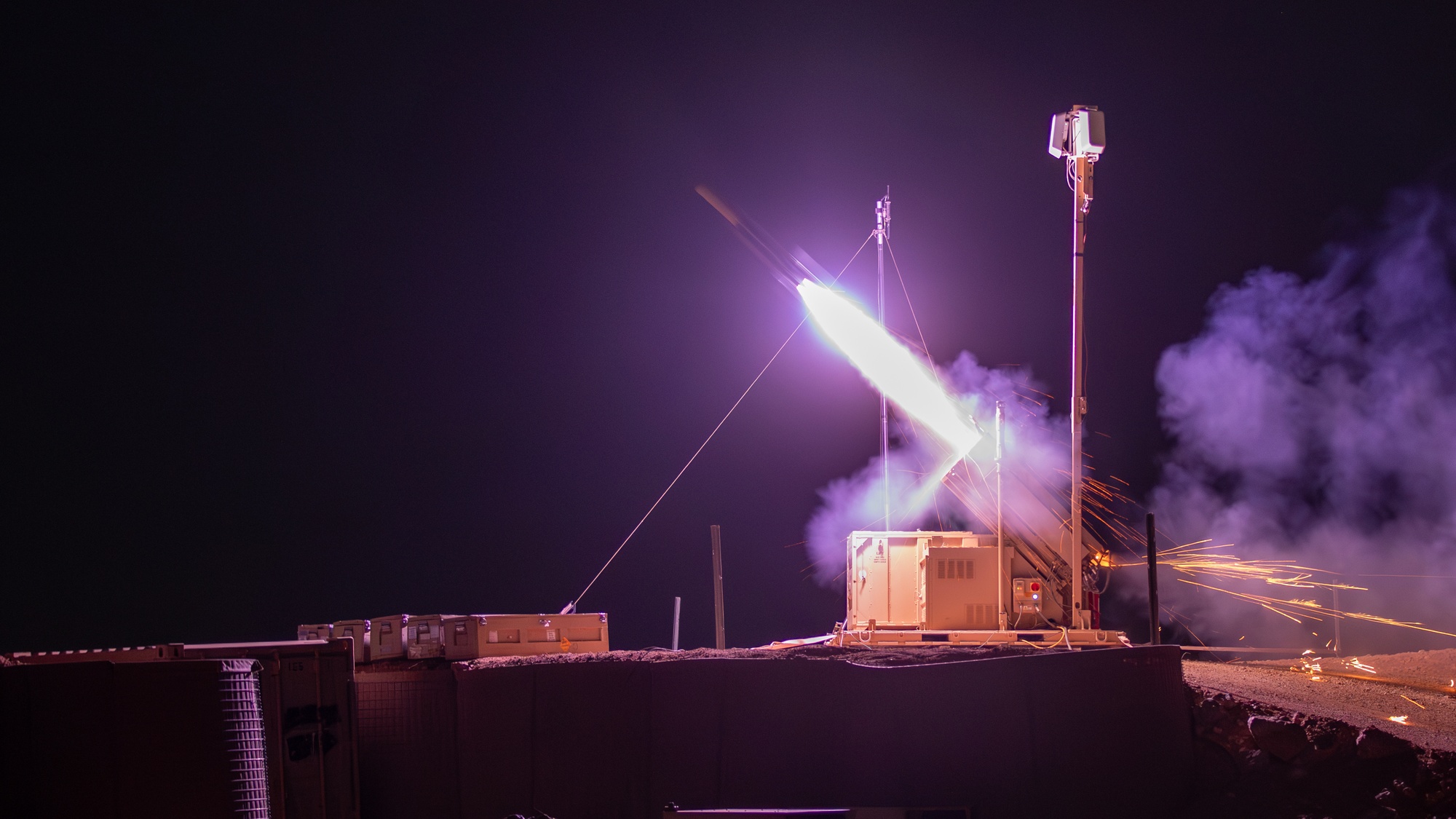
On Oct. 13, RTX's Raytheon said it had secured $729 million in contracts to supply parts of the Army's Low, slow, small-uncrewed aircraft Integrated Defeat System (LIDS) to three customers: the US Army, Qatar and Jordan. The company described the deal as the first international sales of two of the system's main parts, the Coyote interceptor and the Ku-band Radio Frequency Sensor (KuRFS) radar.
The announcement left out most of the details that would show what $729 million actually buys. According to Defence Industry Europe, Raytheon did not disclose quantities, delivery schedules or how the money is split among the three customers. For one of the two export customers, though, an older public document gives some idea of scale.
What Raytheon announced
According to DroneDJ's report, the contracts cover LIDS components in both fixed-site and mobile configurations. Two products are named:
- KuRFS, a Ku-band radar that Raytheon says provides 360-degree detection.
- Coyote, a family of effectors that includes both kinetic and non-kinetic versions. Raytheon says Coyote can engage single drones and swarms.
Raytheon also says Coyote has made "hundreds" of combat intercepts. The company did not give an exact count or say where those intercepts took place, so the number cannot be checked from the announcement.
Tom Laliberty, president of Land and Air Defense Systems at Raytheon, presented the system as an affordable layer of defense. "LIDS provides a proven and cost-effective layer of defense that ensures allied forces have the protection they need against hostile drones," he said, as quoted by Defence Industry Europe. Raytheon offered no cost-per-intercept figures to support the "cost-effective" claim.
RTX also said it is investing in more production capacity. Planned Coyote upgrades include a faster launch, higher speed and greater range at higher altitude. The company gave no timeline for those upgrades and did not say whether the export customers will receive current or upgraded interceptors.
What the Qatar paper trail shows
Qatar's interest in LIDS is on the public record. On Nov. 29, 2022, the Defense Security Cooperation Agency (DSCA) sent Congress Transmittal No. 22-36. It covered a proposed sale, through Army Letters of Offer and Acceptance, of a Fixed Site-Low, Slow, Small Unmanned Aircraft Integrated Defeat System (FS-LIDS) to the Government of Qatar. The unclassified text was later printed in the Federal Register on Sept. 12, 2024.
The notification set the estimated value at $1.000 billion, broken down this way:
- Major Defense Equipment: $0.075 billion. The only item in this category is 200 Coyote Block 2 interceptors.
- Other: $0.925 billion. This covers Coyote launchers, counter-UAS electronic warfare systems (CUAEWS), Ku-band Multi-function Radio Frequency System (KuMRFS) radars, Forward Area Air Defense Command and Control (FAAD C2), communications equipment, software, training, and US government and contractor engineering and logistics support.
The interceptors themselves account for only 7.5% of the notified value. Most of the $1 billion goes to sensors, command and control, electronic warfare, launchers and long-term support. If Qatar's share of the new award follows a similar pattern, the headline dollar figure says relatively little about how many Coyotes are going to Doha.
The 2022 notice named Raytheon, SRC and Northrop Grumman, all in Huntsville, Alabama, as principal contractors. It stated that no offset agreements had been proposed.
Reading the $729 million against the $1.0 billion
The obvious approach is to set the new award against the notified ceiling, but the comparison has clear limits.
The figures don't measure the same thing. A DSCA notification estimates the maximum value of a possible government-to-government sale, including support services that may never be ordered. Raytheon's $729 million is a set of contracts for LIDS components, and it covers three customers, one of which is the US Army.
The split is unknown. Raytheon has not said how much of the $729 million is for Qatar. The announcement does not show how much of the 2022 notified ceiling is now on contract.
The names differ slightly. The 2022 notice lists "KuMRFS" radars, while Raytheon's 2026 announcement uses "KuRFS." Raytheon has not explained the difference in the material we reviewed, so we do not assume the two are identical configurations.
Raytheon has not linked the two. The 2022 notification is the most likely documentary background for Qatar's purchase, but Raytheon's announcement does not cite it. The link here is UASFeed's reading of the public record, not a company statement.
Jordan's part of the deal is even less clear. None of the sources reviewed for this article include a Jordan-specific arms sale notification for LIDS, so the size and contents of Jordan's order cannot be estimated from public documents.
Why It Matters
LIDS has been a US Army program, and its main effector and radar had not been sold abroad before this award. Qatar and Jordan are now the first export customers for Coyote and KuRFS.
The timing matches demand in the region. Defence Industry Europe tied the urgency to Iranian drone attacks that damaged sites in US-allied Gulf countries. It also pointed to the war in Ukraine and the recent US-Iran confrontation in the Gulf as broader reasons for demand. Fixed-site counter-UAS defense, the configuration Qatar asked about in 2022, is aimed at exactly that kind of threat to military bases, critical infrastructure and other installations that can't be moved.
The deal also puts Raytheon's capacity plans to a public test. Selling Coyote to two foreign buyers while supplying the US Army, as RTX says it is expanding production and preparing a faster, longer-range interceptor, adds demand on the same production line. Delivery dates, quantities and the per-customer split are the details to watch, because they will show whether the $729 million is a first tranche against Qatar's $1 billion notification or something closer to the whole order.
Sources
- Raytheon wins $729 million to arm three countries against drones (DroneDJ, Oct. 13, 2026)
- Raytheon says Coyote and KuRFS enter export market with Qatar and Jordan contracts (Defence Industry Europe)
- Federal Register, Sept. 12, 2024: DSCA Arms Sales Notification, Transmittal No. 22-36 (Qatar, FS-LIDS)
