
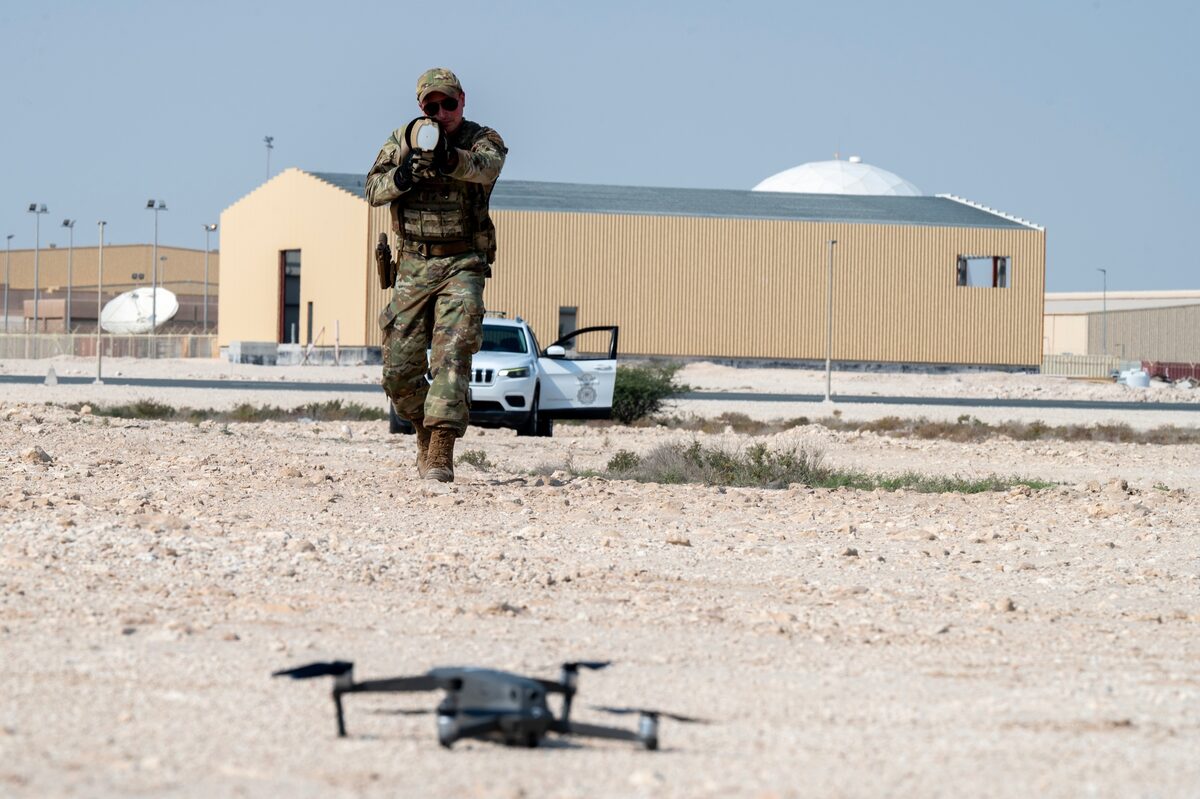
For years, the answer to a drone loitering over a power plant, rail yard or substation in Europe was the same: call the police, and wait. That arrangement is starting to break down. According to a Reuters report published October 21 and based on interviews with more than 30 executives, officials and experts, several European governments are now moving to give the operators of critical infrastructure something close to military-style counter-drone authority, including the power to jam aircraft and, in some cases, shoot them down.
The shift is uneven, legally untidy and not universally welcome. But the direction is clear, and France has already crossed the line.
France goes first
In August, the French parliament passed a law allowing approved critical-infrastructure operators and their contractors to detect, jam and shoot down drones near designated facilities. The legislation followed a run of incursions, including over the Ile Longue submarine base in December 2025. One French official, quoted in the Reuters report, put the pre-law situation bluntly: "We were defenseless in the face of the (drone) threat."
Paris is not treating the law as a one-off. France wants an expanded list of sensitive sites equipped with counter-drone capability by 2027, along with a catalogue of approved systems that operators such as EDF and SNCF could draw from. Both companies declined to comment to Reuters.
Some of the groundwork for that catalogue is already visible. A Paris-Region test program at Bretigny-sur-Orge has so far catalogued three systems integrators and 17 counter-drone systems, giving operators and regulators a defined pool of equipment to evaluate rather than an open market of vendor claims.
Who else is moving
France is the furthest along, but it is not alone. The Reuters reporting describes a spectrum of approaches across the continent:
- Poland has authorized operators' security units to destroy, disable or take control of drones in restricted zones. Two sources at transmission companies told Reuters they want assurances on liability before acting on those powers.
- Austria announced similar plans in September. Defense Minister Klaudia Tanner said the state could not protect every site on its own.
- Germany is still at the review stage. Its interior ministry is examining how operators could be legally involved, a non-trivial question in a system where counter-drone action is treated as a policing function.
Austria's move follows earlier groundwork. On October 29, 2025, the Austrian cabinet decided on a cross-ministry effort to develop a drone-defense strategy, presented by Tanner alongside State Secretary Joerg Leichtfried. That government announcement described drones as among the greatest threats facing the country, pointed to an existing drone detection system at Vienna-Schwechat airport and a drone defense center within the Interior Ministry's special-forces directorate, and said the strategy would cover detection of airspace violations, assessment of the risk and the response to them. It also stressed coordination with operators of critical infrastructure. The September 2026 plans, as reported by Reuters, go further in giving operators powers of their own.
The threat operators are planning for
The policy movement is being driven by what executives describe as a changed threat picture. In August, an explosives-laden drone was found near a Ukrainian cargo plane at Leipzig/Halle airport. Germany blamed Russia; Moscow denied involvement.
Industry leaders are now speaking openly about hybrid attacks on energy systems. Kristian Ruby of Eurelectric told Reuters that heating outages this winter caused by such attacks are a "theoretical, and increasingly a practical, possibility."
E.ON chief executive Leonhard Birnbaum offered a sober illustration of the scale problem. His company operates about 2,720 substations in Germany, and he said in September that operators must assume some attacks will succeed rather than plan on stopping all of them. Security officials and technology firms quoted by Reuters say operators cannot station specialist teams at every site, which is the gap that pushing authority down to operators is meant to fill.
The objections
Not every operator wants the job. Asta Sihvonen-Punkka, CEO of Finnish grid operator Fingrid, told Reuters that responsibility for countering drones should stay with the authorities, calling the proposed shift "a very, very big change."
Her objection points at the core unresolved questions. If a utility's contractor jams or downs a drone and something goes wrong, who carries the liability? Who has the authority to order the response: the operator, the police, the military? The transmission-company sources seeking liability assurances are, in effect, asking the same thing from the other direction. The powers exist on paper; the willingness to use them may depend on who is left holding the consequences.
There is also a timing problem that no statute fixes on its own. Rheinmetall told Reuters that the biggest hurdle for civilian operators was often the delay between detecting a drone and deciding whether to deploy a countermeasure, as legal responsibilities remain fragmented. Detection hardware is maturing quickly. The chain of decision-making behind it, particularly when it spans private operators and public authorities, is not.
Why It Matters
Europe's counter-drone debate is moving from "how do we detect drones" to "who is allowed to act." That is a more consequential question. Handing jamming and kinetic powers to utilities and transport operators turns private companies into front-line participants in what governments increasingly describe as a hybrid conflict, and it does so before liability frameworks and command arrangements have been settled.
France has chosen speed, pairing legal authority with a state-curated catalogue of approved systems and a 2027 target for wider deployment. Poland has granted powers that, according to two transmission-company sources, operators may be reluctant to use without clearer liability cover. Germany, where counter-drone work remains a policing function, may move slowest. And Fingrid's resistance is a reminder that some infrastructure owners do not want the role at all.
For the counter-UAS industry, the practical consequence could be a new class of customer: utilities, grid operators and rail companies buying approved systems to protect fixed sites. For policymakers, the harder test will be closing the gap Rheinmetall identified, between seeing a drone and being authorized to stop it, without creating a patchwork of national rules that leaves operators unsure what they are permitted to do when one appears over a substation.
Sources
- Europe weighs giving utilities, infrastructure companies more powers to bring down drones (C4ISRNET / Reuters)
- Europe weighs giving utilities, infrastructure companies more powers to bring down drones (Defense News / Reuters)
- Bundesregierung beschliesst Entwicklung einer Drohnenabwehrstrategie (Austrian Federal Chancellery)
