
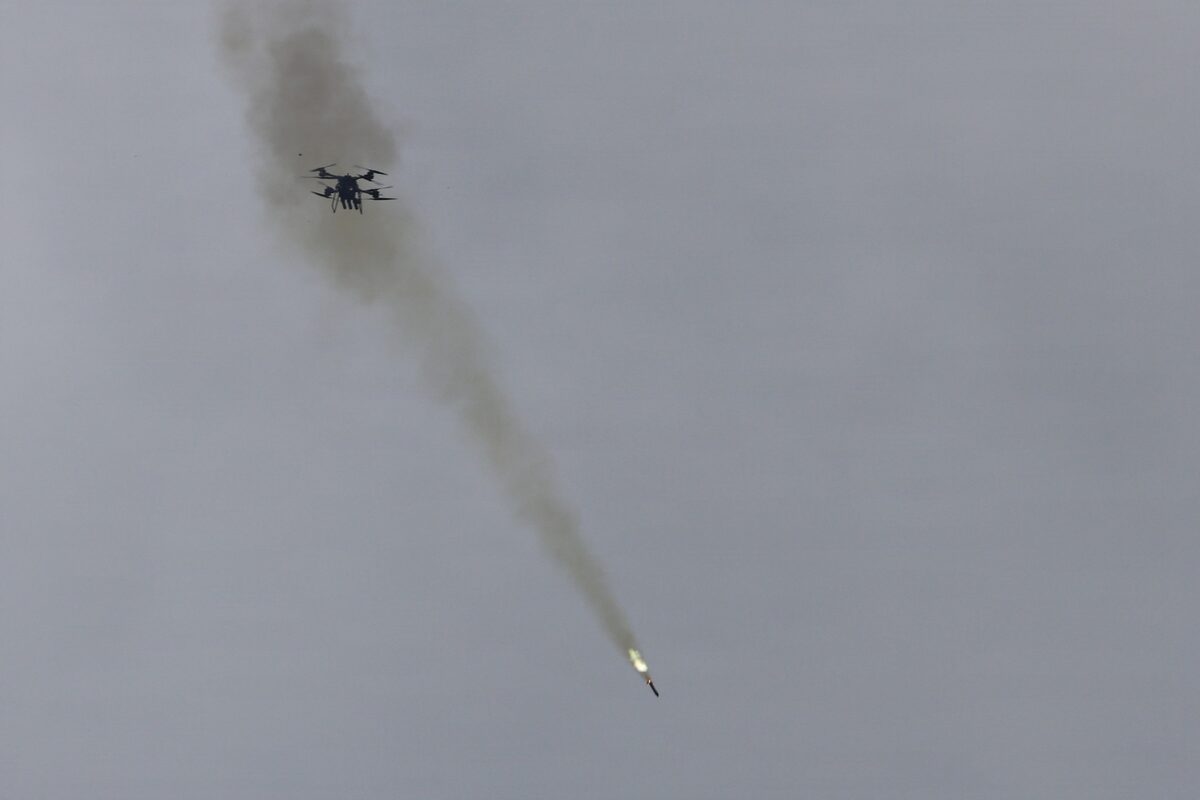
Malloy Aeronautics built the T-150 to carry supplies. In late September, at Eglin Air Force Base in Florida, a military version of it shot down drones. BAE Systems said on Oct. 21 that the TRV-150, a modified T-150, intercepted multiple one-way attack drones with 70 mm APKWS laser-guided rockets. The rockets came from a production-ready three-pod launcher, and the aircraft engaged several targets in succession without landing or reloading.
The test took place during the U.S. Office of the Under Secretary for Research and Engineering's Mission Capabilities Joint Readiness Experimentation, according to EDR Magazine. Unmanned Airspace dates the trials to Sept. 21–25. BAE said little else. None of the four sources gives a number of intercepts, a number of rockets fired or a description of the targets.
Here is what the trial showed, what it did not show, and why the idea of a quadcopter firing rockets is getting serious attention.
What exactly flew at Eglin?
The aircraft is the TRV-150, a modified military version of Malloy Aeronautics' T-150 heavy-lift drone, Janes reports. Two companies split the work. SURVICE Engineering, based in Maryland, adapted the T-150 to US Army requirements. BAE's FalconWorks unit developed the kit that lets the drone carry and fire APKWS.
The new element this time was the launcher. Janes reports that the September tests were the first time a production-ready three-pod launcher had been used on the TRV-150. Earlier trials fired a single APKWS rocket from a specially adapted container. The three-pod setup let the drone engage targets one after another on one sortie, without landing or reloading between shots.
How did the program get here?
The program has moved quickly. In July 2025, an adapted T-150 carried out what BAE describes, as reported by Janes and Unmanned Airspace, as the first firing of a precision munition from that airframe. That was a single-shot firing.
Earlier in 2026, Malloy CEO Neil Appleton said three firings in quick succession had been proven, Janes reports. He also gave a timeline: by the end of this year, the team expects to have a rocket at Technology Readiness Level 9 integrated with a TRL9 drone, plus a kit ready for customers. Janes glosses TRL9 as full operational status.
The Eglin trial is the step between those two points. It moved from a proven firing sequence to a production-ready launcher, fired against attack-drone targets during a government-run experiment.
Why put rockets on a cargo drone?
Before it had a launcher, the platform was hauling supplies. EDR Magazine reports that the TRV-150 moved supplies between ships during the Royal Navy Carrier Strike Group's eight-month Indo-Pacific deployment last year. So it has already worked on real operations, at sea, under military logistics demands.
That history explains the appeal. A heavy-lift multirotor that crews already maintain and fly, and that can operate around ships, is a ready-made carrier for a weapon kit. Counter-drone capability might not need a new airframe, a new training pipeline or a new logistics tail. In principle, the same aircraft could carry cargo one day and an interceptor kit the next. EDR's headline calls the result a "low-cost counter-drone capability." The sources do not give a unit cost for the kit or the aircraft, so that claim cannot be checked yet.
The urgency is real, as BAE describes it. "Our customers are facing drone threats right now," said Thomas Lancashire, Head of UAS Business Development at BAE FalconWorks, in remarks EDR Magazine reported. SURVICE President Gregory Thompson talked about bringing the TRV-150 to the US warfighter and adding APKWS to the platform, according to Defence Industry Europe.
What did BAE not disclose?
The announcement leaves out the details an evaluator would want most:
- Intercept count. "Multiple" and "several" are the only quantities given. The sources do not say whether every rocket hit, or whether some targets took more than one shot.
- Rocket count. None of the sources says how many rockets were fired. The launcher has three pods, but the sources do not say whether each pod holds one round or more.
- Target type. The targets are described only as "one-way attack drones." Nothing is said about their size, speed, altitude or flight profile, or whether they flew straight or maneuvered. These factors decide how hard an intercept is.
- Engagement geometry. The sources do not explain how the targets were found and tracked, what laser designated them, or how far away they were engaged.
Without these figures the results cannot be compared with other counter-drone options, such as guns, directed energy or interceptor drones. "Engaged several targets in succession without landing or reloading" shows the system works. It does not show how well.
Where does it go next?
EDR Magazine and Unmanned Airspace both report that the partners plan to take the counter-drone role into the maritime environment. That fits the platform's history: it has already flown ship-to-ship resupply for the Royal Navy. A ship-launched multirotor carrying guided rockets could give a vessel another defensive layer, launched from its own deck.
The other near-term marker is Appleton's end-of-year goal of a TRL9 rocket on a TRL9 drone with a customer-ready kit. The Eglin trial suggests the hardware is moving toward that point. Whether the team hits the date, and who buys the kit first, will show whether this becomes a fielded capability or stays a series of demonstrations.
Why It Matters
Counter-drone defense has a cost problem. Shooting down cheap one-way attack drones with expensive interceptors cannot be sustained. The TRV-150 concept tries to address that. It pairs a laser-guided rocket BAE pitches as a low-cost precision weapon with a mobile, recoverable aircraft that already does logistics work. Firing several shots per sortie matters because attack drones often come in numbers. A platform that has to land after every shot would fall behind quickly.
The concept also points to a wider trend: weapons kits that turn existing utility airframes into combat assets. The T-150 was built to carry supplies. If a bolt-on kit can make it a counter-drone shooter, the same approach could spread to other heavy-lift drones that militaries already own.
The caveat is the one BAE left open. Until the companies or the government release intercept rates, rocket counts and target profiles, outsiders cannot judge how effective the system is. Eglin showed the TRV-150 can engage several targets in succession on one flight with a three-pod launcher. The undisclosed figures are what would show whether it is good at the job.
Sources
- BAE Systems advances APKWS counter-drone trials from TRV-150 UAS (Janes)
- UK built Uncrewed Air System advances low-cost counter-drone capability (EDR Magazine)
- BAE Systems tests T-150 drone with multi-shot counter-drone capability (Unmanned Airspace)
- BAE Systems' TRV-150 intercepts multiple attack drones with APKWS rockets in U.S. trials (Defence Industry Europe)
