
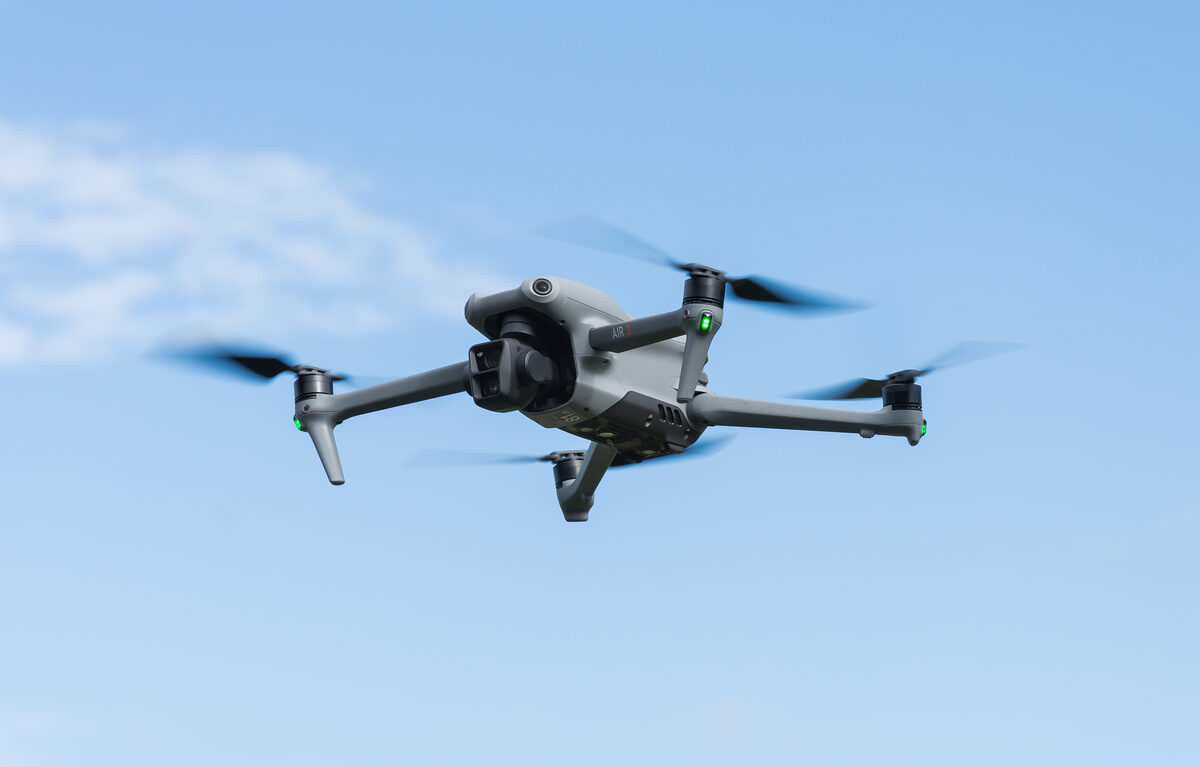
Seven months after drones over Barksdale Air Force Base put the home of Air Force Global Strike Command under a shelter-in-place order, federal prosecutors have charged someone. The case is narrower than the headlines might suggest, though. The indictment names Fuad Mousa Naji, also known as Adam. He was arrested in Michigan and is accused of flying an unregistered consumer drone near the Louisiana bomber base. The flights it describes took place in late March, after the incursions that drew national attention had already ended.
Below is what the charging documents and the public record show, and what they leave out.
What Is Naji Charged With?
According to KSLA, the case was filed in U.S. District Court for the Western District of Louisiana, Shreveport Division. It has two counts: failure to register an aircraft and violation of national defense airspace. Each count carries a forfeiture notice. Judge Jan Hook has the case.
The registration count is the more specific of the two. Prosecutors allege that Naji knowingly and willfully operated a DJI Air 3, a drone eligible for FAA registration, while knowing it was not registered. That is a violation of 49 U.S.C. 46306(b)(6)(A). The airspace count rests on the separate statute covering knowing or willful violation of national defense airspace.
The Shreveport-Bossier Advocate reports that Naji was arrested in the Eastern District of Michigan on Sept. 29. A federal magistrate signed an order transferring him to the Western District of Louisiana that same day. The indictment was made public only recently, and it alleges flights between March 22 and March 26. His initial appearance is set for Dec. 2 at the Tom Stagg U.S. Courthouse in Shreveport.
These are allegations. Naji has not been convicted of anything.
How Much Prison Time Is at Stake?
The Advocate reported that a conviction can bring up to a year in prison. As DroneXL notes, that number matches the airspace statute. The registration statute carries a higher maximum.
- National defense airspace, 49 U.S.C. 46307. According to the statute text, a knowing or willful violation is punishable by a fine under Title 18, up to one year in prison, or both. A second or later offense now carries up to five years. Congress added that enhancement in Pub. L. 119-60, enacted Dec. 18, 2025.
- Operating an unregistered aircraft, 49 U.S.C. 46306(b)(6)(A). Under the registration statute, knowingly and willfully operating an aircraft eligible for registration while knowing it is unregistered is punishable by a fine and up to three years in prison.
So the count tied to a missing registration has a maximum three times longer than the first-offense maximum for flying into protected airspace. DroneXL notes that recreational FAA registration costs $5 and covers a pilot's drones for three years. The DJI Air 3 weighs 720 grams, well above the 250-gram threshold for registration. A heavy charge resting on a $5 fee is unusual. One plausible reading is that registration status is a documentary fact that is comparatively easy to prove, while intent to enter defense airspace is harder to show. That is an inference; the sources do not say why prosecutors chose these counts.
Statutory maximums are not sentencing predictions. Nothing in the reporting suggests Naji has a prior airspace conviction that would trigger the five-year enhancement.
Is This the Barksdale Swarm Case?
Nothing in the public record says so, and the dates point the other way.
Barksdale's own account puts the start of the unauthorized incursions on Monday, March 9. In a March 31 statement reported by KSLA, the base said the incursions varied in duration and in the number of drones. It said the shelter-in-place order was lifted the same morning it was issued and that operations continued unabated. The base also said the incident was under active federal investigation. Air Force Global Strike Command temporarily deployed additional counter-small UAS capability, and the details and locations were withheld for operational security.
The events that made Barksdale a national story were concentrated in the week that followed. DroneXL reports that Sen. Bill Cassidy said on March 27 that there had been "five or so at Barksdale from the 9th through the 15th." DroneXL also cites an ABC News briefing dated March 15 that described waves of 12 to 15 drones. According to that briefing, as DroneXL describes it, the aircraft showed non-commercial signal characteristics and resisted jamming. On March 27, according to the Advocate, Cassidy and a Barksdale spokesperson said two drones had been recovered.
Set those dates against the indictment:
- March 9: Incursions begin and the shelter-in-place order is issued and lifted.
- March 9-15: The period Cassidy described, with reported waves of jamming-resistant drones.
- March 22-26: The flights alleged against Naji.
- March 27: Officials say two drones have been recovered.
- March 31: Barksdale issues a statement addressing inaccuracies in local and national coverage.
As DroneXL points out, the charged period starts a week after the incursion window closed. The drone named in the indictment is an off-the-shelf DJI Air 3. The ABC briefing described drones with non-commercial signal characteristics. Neither local report says whether Naji's Air 3 was one of the two recovered drones.
None of this rules anything out. Indictments often charge only what prosecutors can prove cleanly, and an investigation can continue past a first filing. But the documents now public charge one consumer drone over a five-day stretch in late March. As reported, they do not allege anything about the earlier incursions.
Is There Precedent?
DroneXL compares the case to Yinpiao Zhou, who was arrested in December 2024 over a drone flight at Vandenberg Space Force Base and pleaded guilty to the airspace count. The charges are the same airspace-and-registration pairing, according to DroneXL. Zhou's case also alleged an altitude-limit override, and nothing reported about Naji's case does. DroneXL's own read is that this is a hobbyist case until the government says otherwise.
Why It Matters
For the counter-UAS community, Barksdale was a test of whether a strategic base could detect, attribute and respond to repeated drone intrusions. Detection and response produced visible results: a shelter-in-place order, additional counter-sUAS capability and two recovered drones. Attribution is still the open question. The only prosecution made public so far concerns a single commercially sold drone flown after the most serious activity had ended.
That gap matters. If the only courtroom outcome is a case against one hobby-class drone operator, it will be hard to tell how much of the March activity has been explained. It is possible that the more capable drones described in the ABC briefing have not been publicly tied to anyone, and anyone treating Naji's arrest as the answer to Barksdale is ahead of the record.
The case also shows the legal tools prosecutors have. The airspace statute's first-offense maximum is one year, and Congress added a five-year repeat-offense enhancement in December 2025. For a first-time operator, the registration count carries the longer maximum, up to three years, and turns on whether a $5 registration was filed.
For operators, the lesson is simpler. A drone over 250 grams flown near a military installation can bring two federal counts, and the paperwork count can carry the longer sentence.
The next public step is Naji's initial appearance in Shreveport on Dec. 2.
Sources
- Man faces federal charges after allegedly flying drone near Barksdale Air Force Base (KSLA)
- Man faces federal charge over alleged Barksdale drone flight (Shreveport-Bossier Advocate)
- Barksdale Indictment Alleges DJI Air 3 Flights After the Incursions (DroneXL)
- Barksdale fact-checks drone coverage (KSLA)
- 49 U.S. Code 46307 - Violation of national defense airspace (Cornell LII)
- 49 U.S. Code 46306 - Registration violations involving aircraft not providing air transportation (Cornell LII)
