
The Association for Uncrewed Vehicle Systems International (AUVSI) has picked a counter-drone executive to run it. On Nov. 9 the trade group announced that Brett Feddersen will become president and CEO effective December 1. Feddersen is vice president of strategy and governmental affairs at D-Fend Solutions, which is now a Motorola Solutions company. He replaces Michael Robbins, who left to lead the Semiconductor Industry Association.
According to DroneXL, the news came Monday, the opening day of AUVSI's Drone & AAM Policy Symposium in Washington. His first job will be speaking for an industry that is still working through major regulatory questions.
Who Feddersen Is
His résumé is unusual for the head of a trade group. He began as a Pennsylvania State Trooper and helicopter pilot. He later served as an Army lieutenant colonel and as a senior advisor to the Chairman of the Joint Chiefs of Staff. At the White House he was director for transportation and border security, and AUVSI says he "authored the national framework for mitigating drone threats" in that role. He also served as the Federal Aviation Administration's executive director for national security programs.
AUVSI describes a career of more than three decades in public safety, the military, and federal aviation and security policy. Before getting the top job, Feddersen was already an AUVSI insider: he rose from active member to the Board of Directors. Board chair John "JC" Coffey is quoted in the announcement backing the choice.
The Leadership Gap
The sources give slightly different dates for Robbins' departure. AUVSI says he left in October. DroneXL reports he left at the end of September and that Chief Operating Officer Heather Lee has been interim leader since October 1. Either way, the association will have been without a permanent chief for about two months when Feddersen starts on December 1.
The Counter-Drone Connection
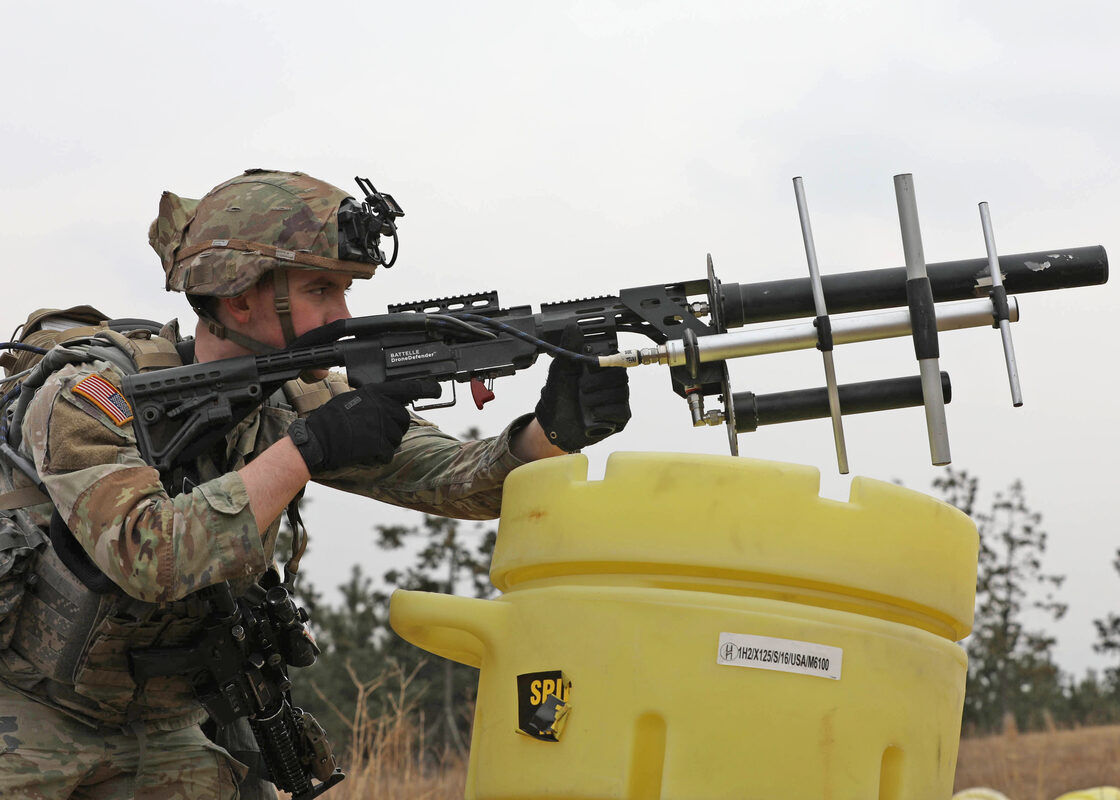
Feddersen's employer explains why this pick is getting attention. D-Fend makes RF cyber-takeover systems. Instead of jamming a drone or shooting it down, the technology identifies a rogue drone, takes control of it, and directs it to land safely. Motorola Solutions completed its acquisition of D-Fend on August 20 for $1.5 billion. Motorola says the technology has been deployed in more than 30 countries at airports, critical infrastructure, stadiums, military bases and borders.
Counter-UAS companies and drone manufacturers do not always want the same things. Operators and builders generally want more airspace access and fewer restrictions, while counter-drone vendors benefit when more agencies are legally allowed to detect, track and mitigate drones. Putting someone from the mitigation side at the head of the industry's main association does not mean those interests will clash. It does mean his views on that line will be watched closely.
Those views are already on the record. In September 2025, Feddersen testified before the House Judiciary Subcommittee on Crime and Federal Government Surveillance. The official hearing transcript is published on GovInfo. DroneXL reports that he asked Congress to give state and local police and trained security staff at critical infrastructure detect-and-track authority, which is the kind of expanded counter-UAS access his company's market depends on. The transcript records him saying "Aircraft is the right designation" for drones, and DroneXL reports he argued the aircraft designation gives operators more protection. That is a position many drone operators would welcome, because it treats uncrewed systems as legitimate users of the national airspace and not just as threats to be managed.
Congress has since acted on part of that request. DroneXL notes that the FY2026 National Defense Authorization Act gave trained state and local police some counter-drone authority. That is the kind of narrow, step-by-step expansion Feddersen argued for.
What the Announcement Says, and What It Leaves Out
AUVSI's release lists the priorities it expects to pursue under Feddersen: moving autonomous systems into routine, scaled deployment, expanding dual-use initiatives, strengthening domestic and allied manufacturing capacity, and driving commercial viability for advanced air mobility (AAM), surface and undersea platforms, robotics and physical AI.
As DroneXL points out, the announcement does not mention the FCC Covered List, which DroneXL says has kept new foreign-made drones off the U.S. market since December 2025. For many AUVSI members, especially commercial operators and the service companies that support them, that is likely to be an important regulatory issue. Leaving it out of a release about the association's direction does not tell us what Feddersen thinks about it. But members will likely want an answer soon. DroneXL also notes that the transcript of his testimony shows no position on DJI or the Covered List.
Why It Matters
AUVSI is the main voice for the uncrewed systems industry in Washington. Who leads it affects how the industry's case reaches Congress, the FAA and the Pentagon. Feddersen brings unusual credentials: by AUVSI's account he has worked inside the White House, the FAA and the Joint Staff, and he authored the national framework for mitigating drone threats. That experience gives him a close view of how drone policy gets made and where it gets stuck.
He also comes from a company Motorola Solutions just paid $1.5 billion for, which sells counter-drone technology to governments. His testimony suggests he sees no conflict between treating drones as legitimate aircraft and giving more agencies the tools to stop the ones that misbehave. Whether AUVSI's members, from small operators affected by the Covered List to defense manufacturers chasing dual-use contracts, see it the same way will be the first real test once he takes over on December 1.
Sources
- AUVSI Selects Brett Feddersen as President and CEO to Lead Next Era of Scaled Autonomy (AUVSI, Nov. 9, 2026)
- AUVSI Hands CEO Job To Counter-Drone Executive Brett Feddersen (DroneXL)
- Motorola Solutions Completes Acquisition of D-Fend Solutions (Motorola Solutions, Aug. 20, 2026)
- House Judiciary Subcommittee Hearing Transcript, Sept. 16, 2025 (GovInfo)
