
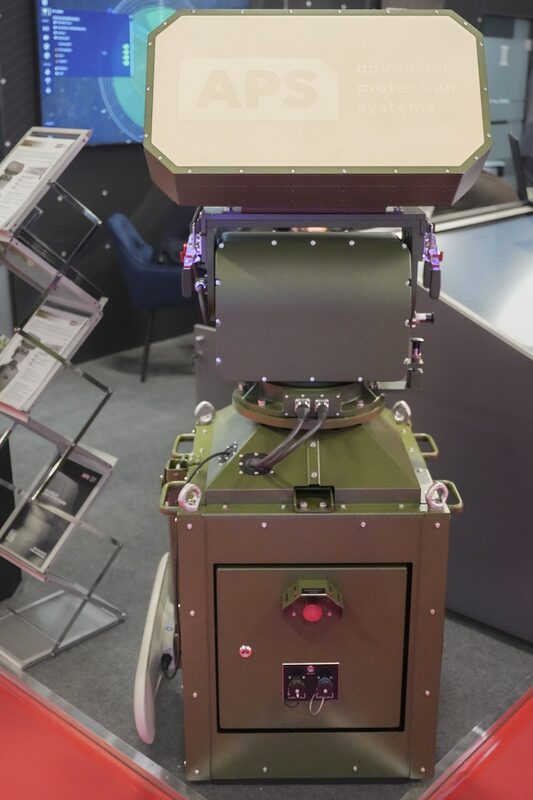
Shield AI, best known for its V-BAT drone and Hivemind autonomy software, is buying the radar company whose sensors are used to find and track small drones. On Nov. 5 the company announced a definitive agreement to acquire Kirkland, Washington-based Echodyne in a transaction valued at $5.3 billion. It also announced a $2.5 billion capital raise that values Shield at $28.8 billion post-money.
The deal is expected to close in early 2027. It gives Shield something it has not had before: an in-house counter-UAS product line built around Echodyne's metamaterial electronically scanned array (MESA) radars.
The Deal Terms
According to Echodyne's announcement, $4.8 billion of the $5.3 billion headline value will be paid or issued at closing. Up to $500 million more is contingent on performance targets. That earnout means roughly a tenth of the price depends on how Echodyne performs after it joins Shield.
The $2.5 billion raise has three parts:
- $1 billion Series H at a $28.8 billion post-money valuation, co-led by Disruptive and Innovation X Capital.
- $1 billion in structured equity from funds managed by Blackstone.
- $500 million in debt, led by JPMorgan Chase.
The companies say both businesses expect triple-digit revenue growth this fiscal year. None of the sources reviewed gives a dollar figure for revenue, so outsiders cannot yet see how the valuation compares with sales.
What Shield Is Getting
Echodyne's MESA radars are already built into hundreds of counter-UAS and security systems in more than 40 countries, the company says. Defense News reports that the radars can track small quadcopters and more than 1,000 objects at once. Echodyne's announcement says the radars are integrated onto remote weapon stations, high-energy lasers and high-power microwave systems, and cue interceptors toward incoming drones.
The deal also brings a fresh government contract. In September, the Joint Interagency Task Force 401 (JIATF-401) chose Echodyne's MESA radar to supply counter-drone systems to the U.S. military. Defense News puts that award at $250 million over 36 months, and Echodyne describes it as a $250 million ceiling.
Shield is also getting factory capacity. Echodyne points to a new 86,350-square-foot plant in Kirkland, a $40 million investment that can produce about 30,000 radars a year.
How It Fits Shield's Strategy
Shield has grown through acquisitions before. Breaking Defense notes that the V-BAT itself came from Shield's 2021 purchase of Martin UAV, and that Shield closed its acquisition of Aechelon Technologies earlier in 2026. Its product line now runs from the V-BAT and the X-BAT to the Hivemind autonomy stack.
CEO Gary Steele said in a statement that the company now sorts its business into three groups: autonomy software, autonomous systems, and mission systems. Echodyne will operate as a business unit within mission systems. Eben Frankenberg, Echodyne's CEO, stays on and will report to Steele.
Shield says it is not swallowing the product line. Echodyne's announcement says MESA radars will still be sold as standalone products. Echodyne says its radars go to integrators and end customers across defense, government and commercial sectors, and some of those integrators could end up competing with Shield. A Shield spokesperson told Breaking Defense there are no planned workforce reductions and no requirement for Echodyne staff to relocate.
The companies are not announcing any specific aircraft integrations right now, Breaking Defense reports, though it adds that longer term there will likely be greater integration of Echodyne products across Shield's portfolio. A Shield spokesperson also said the separate decision to work with RTX on a radar for X-BAT is not affected by the deal.
Why It Matters
The deal is a big bet that counter-drone sensing is turning from a niche into a core part of defense spending. Frankenberg made that case to Defense News in July. He called demand for counter-drone radar "red hot" and said it could grow tenfold by 2030. "The Ukraine war made it obvious to everyone that drones had changed the face of warfare," he said, "but the Iran war made it obvious that everything's at risk."
Owning a radar line changes what Shield can offer. Until now it has sold mostly aircraft and the software that flies them. With Echodyne, it can also sell the sensors that detect and track hostile drones, and that can cue lasers and microwave weapons to engage them.
The financing is notable too. A $28.8 billion post-money valuation, backed by Blackstone structured equity and JPMorgan-led debt, is a sign that large investors and lenders are willing to back a deal of this size in the counter-drone sector.
What to Watch
- Closing: The deal is expected to close in early 2027, subject to regulatory approvals and other customary closing conditions.
- The earnout: Up to $500 million depends on performance targets. The sources reviewed do not say what those targets are.
- JIATF-401 execution: The $250 million, 36-month counter-drone contract will be the first real test of whether Echodyne can deliver at volume under its new owner.
- Integrations: Any announcement putting MESA radar on Shield aircraft, or pairing it with Hivemind, would show how far Shield plans to merge the two product lines.
- Standalone sales: Whether outside integrators keep buying Echodyne radars from a company that may now compete with some of them.
