
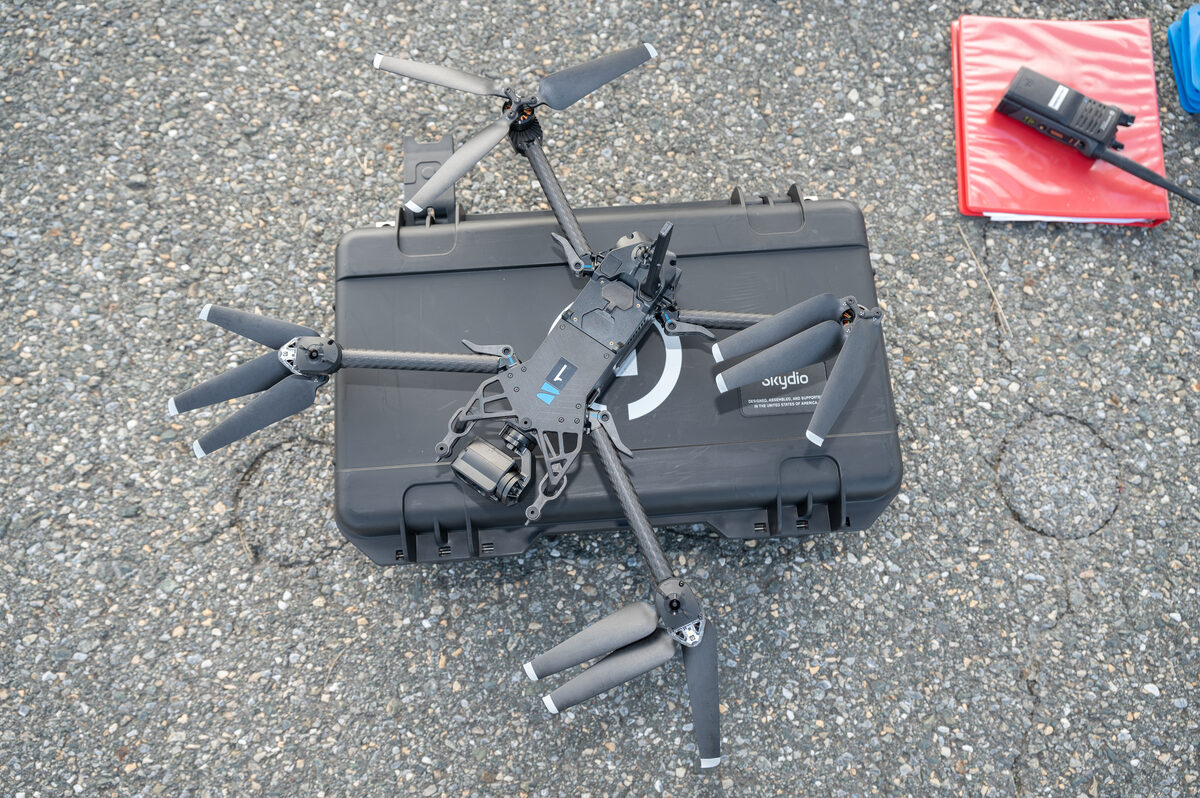
Axon, the company behind the Taser and a major maker of police body cameras, announced on Nov. 5 that it is putting about $1.2 billion more into Skydio, which describes itself as the largest US-based drone manufacturer. The deal values Skydio at $5.2 billion before the new money comes in. It also changes how police buy drones in North America. Axon is now the exclusive distributor of Skydio drones to public-safety customers in the United States and Canada.
The $1.2 billion figure is real, but most of it does not go to Skydio. Filings described by DroneXL show that only about a fifth of the money is new capital for the drone maker. The rest buys shares from existing holders. Separately, Axon's stock fell about 18% in Friday trading, though DroneXL ties that drop mainly to Axon's third-quarter results rather than the Skydio deal.
What exactly did Axon buy?
Axon's press release says the investment adds approximately 20% to its fully diluted ownership of Skydio. It describes the package as a mix of cash and Axon stock, subject to final transaction terms, that "includes both primary capital to Skydio and the purchase of shares from existing Skydio shareholders." DroneXL reports that Axon's stake goes from about 15% to about 37% once every tranche closes.
According to DroneXL's reading of Axon's SEC 8-K filing, the deal is structured like this:
- First tranche (closed Thursday): Axon paid $254.9 million for 25 million newly issued, non-voting Series G preferred shares at $10.19617 each, half in cash and half in Axon stock. This is the only part of the deal that puts new money into Skydio.
- Later tranches: Axon will buy shares from existing Skydio stockholders through a tender offer for up to 68.45 million Series G shares, plus further secondary purchases. These are expected to close in the fourth quarter of 2026 and the first quarter of 2027.
- Payment mix: About 60% of the total, roughly $720 million, is cash. The rest is Axon stock.
The split matters. Of the headline $1.2 billion, about $255 million goes onto Skydio's balance sheet. The remaining roughly $945 million buys shares from existing Skydio shareholders. DroneDJ notes that some of the funding goes to Skydio for product development and business expansion, which fits the primary tranche.
Why did Axon's stock fall about 18%?
According to DroneXL, the drop came alongside Axon's third-quarter report, not from the Skydio deal alone. Axon reported record revenue of $909 million, up 28% but below the $934 million analysts expected, and cut its full-year outlook to $3.61 billion to $3.63 billion. Orders for its Dedrone counter-drone products worth $130 million slipped out of 2026, and the stock closed at $382.56 on Thursday before trading near $314 on Friday. Axon executives called the Dedrone slip a timing issue tied to federal procurement.
The Skydio stake adds its own constraints. Axon is spending about $720 million in cash and issuing new Axon shares for a minority stake in a private company. DroneXL reports that CFO Brittany Bagley said Axon has neither control of Skydio nor the kind of influence that would make it consolidate Skydio's results, and that the Series G shares are non-voting.
Axon also pre-funded part of the purchase. DroneXL notes that it priced $1.15 billion of zero-coupon convertible notes due 2031 on Sept. 15, and Bagley said the proceeds fund part of the Skydio investment.
How does the valuation compare with Skydio's last round?
DroneXL reports that Skydio raised a $110 million Series F in April at a $4.4 billion post-money valuation. Six months later, the Axon deal prices the company at $5.2 billion pre-money, about 18% above the Series F figure. Skydio expects about $1 billion in total bookings this fiscal year, according to the Axon release. That figure and Skydio's other operating numbers are the companies' own.
What does "exclusive distributor" change for police departments?
In practice, this formalizes an existing arrangement. DroneXL notes that Axon has sold Skydio aircraft through its Axon Air channel since 2021 and added a docked drone-as-first-responder (DFR) package in June 2024. What is new is exclusivity: Skydio CEO Adam Bry says Axon is "becoming our exclusive channel for U.S. and Canadian public safety." DroneXL reports that neither company has said what happens to agencies that bought Skydio directly or through another reseller.
For agencies already using Axon's evidence-management software and body cameras, one vendor for drones may simplify procurement. DroneXL's editor argues that Axon now controls Skydio's public-safety business "in everything but the org chart," and that a Skydio DFR program is now effectively an Axon contract. Agencies that want Skydio hardware but not Axon's software ecosystem may have fewer ways to get it.
What is drone-as-first-responder, and how big is it?
DFR programs place drones in docks around a jurisdiction. DroneDJ describes the concept as a drone stationed in a docking system that launches automatically when an emergency call comes in and can reach the scene ahead of ground units, giving dispatchers and officers an aerial view before they arrive.
The companies' own figures, repeated in the Axon release and both trade-press reports, describe the scale:
- More than 1,500 public-safety customers use Skydio.
- More than 28 million Americans live within two miles of a Skydio DFR dock.
- Priority response times have dropped by as much as 65%.
- The drone arrives before officers on roughly 80% of the calls where it is deployed.
Axon puts the DFR market in the US and Canada at about $13 billion. Like the performance figures, that estimate comes from the companies.
The press release includes statements from Axon CEO Rick Smith and Skydio CEO Adam Bry. Smith said that "within a decade, millions of drones will be working across America," and Bry said the investment strengthens Skydio's ability to accelerate its technology roadmap and scale its public-safety impact.
Why It Matters
The deal is a strong sign that Axon sees drones as part of its core public-safety product line, alongside body cameras, Tasers and evidence software. Making Axon the only public-safety channel for Skydio extends that bundle into the air.
The structure also shows where Skydio stands. Skydio took about $255 million of new funding while Axon bought most of its stake from existing holders. Whatever the motive, the numbers show the deal is mostly a secondary purchase rather than a large capital raise. For Axon, the cost is a large minority position it cannot consolidate or control, paid for partly in shares at a time when its stock has just dropped sharply.
For agencies, the trade-off is convenience against dependence. One vendor for cameras, evidence storage and now drones may make it easier to set up a DFR program. It could also mean that pricing and product choices for a fast-growing part of policing are shaped largely by one company, a concentration that procurement officers will likely want to weigh.
Sources
- Axon Invests $1.2 Billion in Skydio to Build the Future of Drone as First Responder (Axon via PR Newswire, Nov. 5, 2026)
- Axon Puts $1.2B Into Skydio, and US Police Now Buy Only Through Axon (DroneXL, Nov. 6, 2026)
- Skydio's public safety drone business just got a $1.2 billion boost (DroneDJ, Nov. 6, 2026)
