
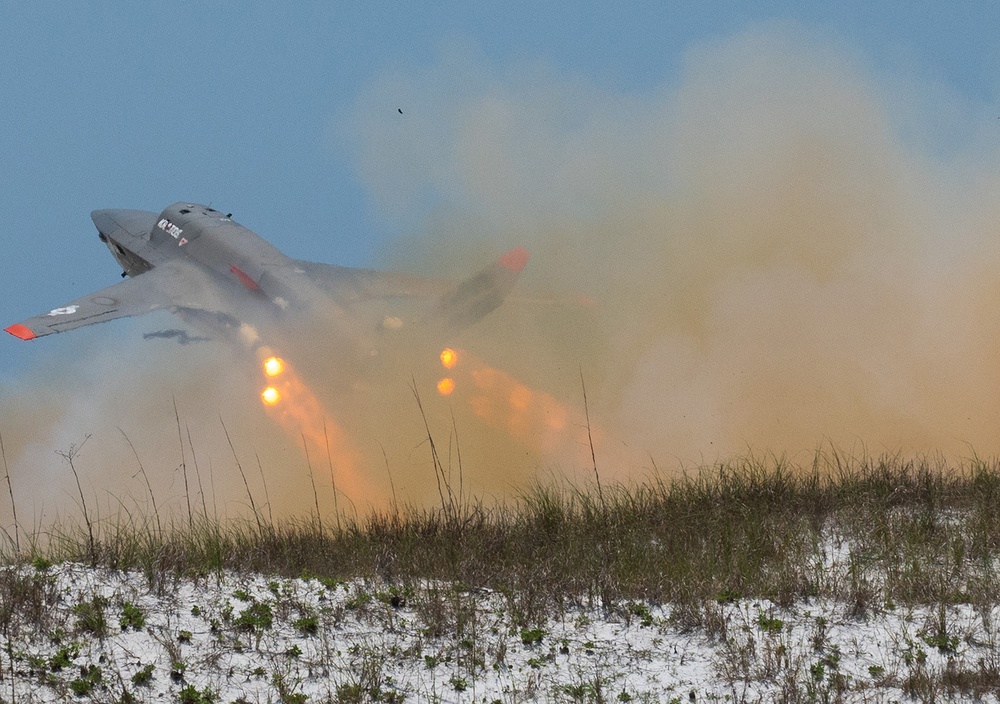
Kratos Defense & Security Solutions has never been shy about the XQ-58/MQ-58 Valkyrie's main selling point, which is that it costs little enough to lose. On the company's third-quarter 2026 earnings call on Nov. 5, CEO Eric DeMarco attached a current number to that claim. He also mentioned, without much detail, that the aircraft had moved into low-rate initial production for a customer Kratos can't name.
"The Valkyrie that's in production, that comes off the line, white tail, $6 million or something like that, maybe $8 million depending on configuration, missionized it's more, affordability is going to win," DeMarco said, according to the call transcript.
That one sentence holds two numbers that matter for the collaborative combat aircraft market, and two caveats that matter just as much.
What "white tail" actually buys
In aerospace, a "white tail" generally means an aircraft built without a specific customer's configuration. DeMarco's $6 million is a price for the aircraft before mission systems are added. The $8 million upper figure depends on configuration, and he said plainly that a "missionized" aircraft costs more. He didn't say how much more.
The War Zone, which reported the figures on Nov. 9, described the range as roughly $6 to $8 million per Valkyrie depending on configuration and without certain mission systems. Anyone comparing these figures to other programs should keep that qualifier in mind. A flyaway price for a combat-ready aircraft and a price for a bare airframe are different things.
How the price has moved
The Valkyrie's cost has drifted over the years, and the direction is worth noting. TWZ recounts that Kratos's early goal was about $2 million per aircraft. In 2023 DeMarco cited roughly $6.5 million. In 2024 he gave $4 million to $6 million for rocket-assisted takeoff (RATO) versions, the runway-independent configuration Kratos has promoted since the program began.
Read against that history, the new number isn't a reduction. It is roughly where the aircraft has been priced for several years, now covering a broader set of configurations and stated as a production price instead of a target. It sits well above the $2 million aspiration and close to the 2023 figure, and the range has widened at the top end.
For comparison, TWZ notes that the U.S. Air Force is targeting an average unit cost of about $20 million for its Increment 1 CCAs, the Anduril FQ-44A and the General Atomics FQ-42A, with a goal of at least 500 of those aircraft in inventory by 2032. Even if a missionized Valkyrie costs well above $8 million, Kratos is still pitching an aircraft that could come in at a fraction of that benchmark. That is the context for DeMarco's argument that affordability will win.
The contract nobody will name
The more significant disclosure may be one Kratos said little about. DeMarco told analysts the company had "very recently received" a Valkyrie Low Rate Initial Production, or LRIP, contract award. He said he could not disclose details because of customer-related restrictions, so the customer, quantity and value all went unstated. He said the company expects additional Valkyrie orders in 2027, including international orders.
LRIP is generally the step between prototypes and full-rate production. Kratos hasn't said who placed the order. Two known customer threads give context but don't answer the question. TWZ reports that the U.S. Marine Corps is acquiring a conventional takeoff and landing variant, sometimes called the MQ-58B, with Northrop Grumman technically the prime contractor under the MUX TACAIR program. Separately, the Valkyrie has flown in Europe with Airbus. DeMarco mentioned that partnership on the call, and TWZ reports that the Airbus-associated U740 flew in northern Europe in October.
TWZ also notes that, as of August, Kratos's stated goal was an annual production rate of 40 Valkyrie airframes by 2028. That is a modest rate next to the Air Force's CCA ambitions, but it would be a large step for a program that has spent most of its life as a demonstrator.
The engines behind the airframes
Much of the call dealt with the industrial base behind the drones. DeMarco said Kratos plans to roughly triple FireJet manufacturing capacity in Oklahoma City by the end of 2027. FireJet is Kratos's jet drone line, and DeMarco said the company builds 150 to 200 jet drones a year across its products.
Propulsion is the other constraint. According to StockStory's summary of the call, Kratos expects its Michigan facility to produce up to 3,000 turbojet engines in 2027. StockStory ties the engine output to programs such as the Air Force's Family of Affordable Mass Missiles.
The quarter in numbers
The financials behind the drone story were strong on paper. StockStory reports third-quarter revenue of $471.8 million, up 35.7% year over year, or 23.2% on an organic basis. Adjusted earnings per share were $0.24 and adjusted EBITDA was $50.9 million. Bookings reached $1.04 billion, a book-to-bill ratio of 2.2 to 1, and backlog hit a record $2.6 billion. Kratos guided to fourth-quarter revenue of about $495 million at the midpoint.
Shares still fell after the report, according to StockStory. Kratos itself cited supply chain and labor constraints alongside the ramp.
Why It Matters
The CCA debate has been framed around a single question: how cheap does an uncrewed combat jet have to be before commanders will actually risk losing it? The Air Force answered with a roughly $20 million average for Increment 1. Kratos is answering with an airframe it says costs $6 million to $8 million before mission systems. The real comparison depends on what "missionized" adds, and Kratos hasn't published that figure.
The LRIP award matters more than the price, because it suggests at least one buyer has moved beyond experimentation. Its value as evidence is limited while the customer and quantity stay secret, and the promised 2027 awards will be the better test. If they arrive and the Oklahoma City and Michigan expansions stay on schedule, Kratos will have shown that a low-cost attritable jet can be built in volume. If the missionized price climbs toward the CCA benchmark, the affordability argument gets much weaker.
The Valkyrie's price history also argues for caution. The aircraft was supposed to cost $2 million and now costs three to four times that as a bare airframe. That is still cheap by fighter standards. What buyers will watch is whether the number holds once the aircraft is carrying mission equipment and flying in operational units.
