In March 2014, four engineers — Keller Rinaudo Cliffton, Keenan Wyrobek, Ryan Oksenhorn, and Will Hetzler — founded Zipline with a premise that sounded almost self-evidently impossible: use fixed-wing autonomous drones to deliver medical supplies to hospitals in countries where the road network could not be relied upon. By May 2025, their San Francisco-based company had flown over 100 million autonomous miles, completed one delivery every 60 seconds at peak cadence, and served more than 4,000 hospitals and health centers across seven countries. No other autonomous logistics operation on Earth has moved more packages over more distance under less human supervision.
From Silicon Valley to Rwanda's Blood Network
Zipline's first commercial partnership launched in 2016, when the company struck a deal with the Rwandan government to supply hospitals with blood products — becoming the world's first commercial drone delivery service. The operational logic was stark: Rwanda has limited cold-chain infrastructure outside the capital, Kigali, and transfusion-critical blood products had to be either stockpiled at peripheral hospitals where they expired, or driven in over roads that became impassable in rain. Zipline replaced both failure modes. By 2024, it was delivering 75% of Rwanda's national blood supply to facilities outside Kigali, scaling from one partner hospital at launch to 400 facilities across the country.
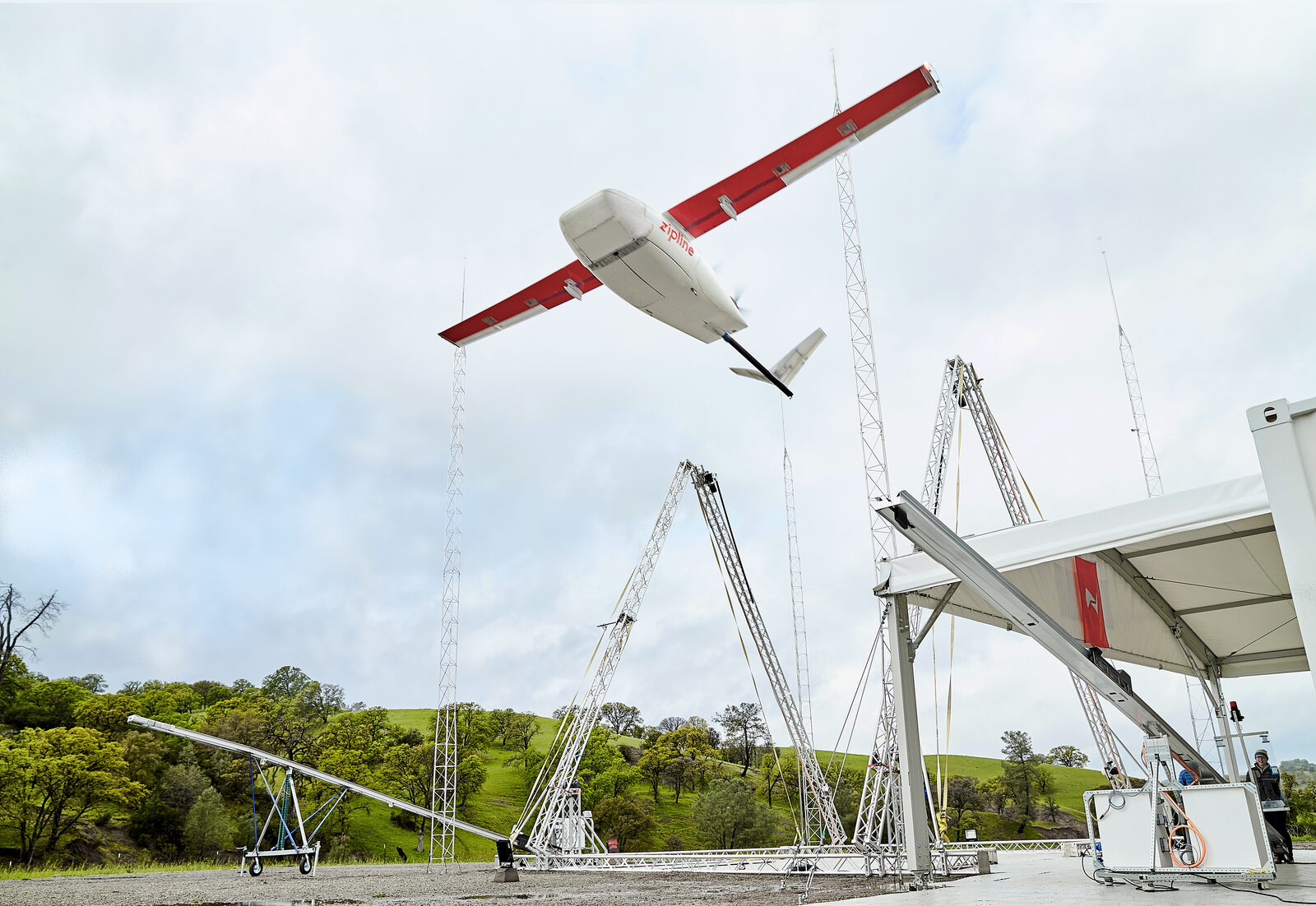
The machine that built this network — Platform 1, or P1 Zip — is an electric fixed-wing aircraft launched from a pneumatic catapult charged by a supercapacitor bank. It cruises at 100 kilometers per hour, reaches 120 meters of altitude, carries up to 1.3 kilograms (enough for two units of blood), and can reach hospitals up to 80 kilometers away. Delivery is not a landing. The drone releases its payload in a small cardboard box fitted with a paper parachute that floats down to a marked target area while the aircraft continues past. Recovery — known internally as "Tall Bob" — uses two 10-meter towers and a cable that snags a 3-centimeter tail hook on the returning drone, stopping the aircraft without a runway.
The energy physics underlying this design are not accidental.
"Watt-hours per kilo...that's what's going to make or break your system." — Michael Newhouse, Engineer, ZiplineA fixed-wing form factor achieves dramatically better energy efficiency than multirotor alternatives at range, which is why P1 can cover 80 km where a comparably sized quadcopter cannot.
Rwanda validated the approach in peer-reviewed literature. A Lancet Global Health study found that blood product expiration decreased by approximately seven units per month after drone delivery began, and waste dropped from 7% to 0% in 2018.
A Decade of Health Outcomes
Ghana became Zipline's second major national partner in 2019 under a $12.5 million, four-year contract with the Ministry of Health. The system now serves 2,000 health facilities. When COVID-19 lockdowns disrupted road transport across the country in 2020, demand for Zipline's vaccine delivery surged tenfold — a real-world stress test of what the company means when it talks about supply-chain resilience.
"We can cover hundreds of health facilities or other delivery drop points with a single distribution center." — Miki Sofer, Senior VP of Global Health Partnerships, Zipline
A peer-reviewed study indexed in PMC/NIH examined 103 health facilities in Ghana's Ashanti Region following the launch of Zipline's Mpanya distribution center. Maternal deaths fell by 56% (relative risk 0.44). Facility deliveries increased 26%. Antenatal visits rose 20%. Referrals — a proxy for improved triage capacity — increased 3.41-fold. These are not marginal improvements; they are transformations of baseline health outcomes attributable, at least in part, to the existence of reliable, on-demand aerial logistics. Healthcare workers at surveyed facilities described the change in concrete terms: "Zipline has curbed [referrals due to lack of medicine] because in just 30 min maximum, you are being supplied." A patient described the difference: "Previously, drugs were not here and treatment was very slow. Now if they don't have the drugs, within 10 minutes they can request and then the drugs come."
Platform 2 and the Turn Toward Consumer Delivery
Platform 1 was optimized for range in low-infrastructure environments. The suburban delivery problem presents a different set of constraints: shorter distances, tighter precision requirements, private property, and residents who have no interest in a cardboard box landing anywhere near an imprecise point. Zipline's answer is Platform 2 — P2 Zip — which it launched in 2023.
P2 is a hybrid aircraft. The main body cruises at 112 kilometers per hour with a payload of 2.5 to 3.5 kilograms across a service radius of roughly 16 kilometers. When it reaches a delivery address, it transitions to a hover at several hundred feet and deploys a small autonomous robot — the Droid — on a tether lowered from the belly of the aircraft. The Droid descends to street level, releases the package with half-meter precision, and is winched back up. The aircraft never lands. The customer never has to leave the backyard.
FAA certification to operate this system in the United States required a milestone the agency had not previously granted. On June 21, 2022, Zipline received Part 135 air carrier certification — the first granted through the FAA's BEYOND program. The initial authorization covered a nearly 8,000-square-mile operational area centered on a hub in Kannapolis, North Carolina, with permission to fly over people and beyond visual line of sight (BVLOS) at ranges of up to 26 miles round-trip. In September 2023, the FAA separately authorized BVLOS deliveries in Salt Lake City without observers, an expansion of operational latitude that most US drone operators are still working toward.
On April 8, 2025, Zipline launched commercial P2 Zip service with Walmart in Mesquite, Texas, offering residents within two miles of a Walmart Supercenter access to 65,000-plus items delivered in 30 minutes or less, initially at no charge. US health-system partners now include Novant Health, Magellan Rx Management, Cardinal Health, and Intermountain Health. Consumer food partners include Sweetgreen.
Why It Matters
Zipline's business sits at the intersection of two narratives usually told separately. The first is a humanitarian story: a logistics platform that measurably reduced maternal mortality in sub-Saharan Africa and built an on-demand medicine network in countries where the alternatives were failing. The second is a commercial story: $821 million in total funding, a $4.2 billion valuation at its April 2023 Series F, and investors including Sequoia Capital, Andreessen Horowitz, and GV (Google Ventures).
The company employs approximately 1,364 people and is targeting a production rate of one new drone per hour by end of 2025. It operates in the United States, Rwanda, Ghana, Nigeria, Côte d'Ivoire, Kenya, and Japan. The shared engineering platform between P1 and P2 means that scale in one market — whether humanitarian or consumer — builds operational and regulatory capability for the other.
What distinguishes Zipline from the broader drone-delivery ecosystem — which has spent years cycling through regulatory pilots, business model pivots, and quiet shutdowns — is that it built the operational baseline first. The 100-million-mile figure is logged autonomous flight, not a projection. The health-outcome data is peer-reviewed, not press-released. The FAA certifications are in hand. For the autonomous logistics sector, that is the real signal: not that drone delivery is coming, but that it has already run at national scale in multiple countries, the US regulatory framework is opening, and the gap between proof-of-concept and operational network has been closed — at least by one company.
Sources
- Contrary Research — Zipline Company Profile
- IEEE Spectrum — In the Air With Zipline's Medical Delivery Drones
- IEEE Spectrum — Zipline Drone Delivery (2023)
- Think Global Health — Drones Deliver Humanitarian Aid in Africa
- FreightWaves — FAA Certification Puts Drone Firm Zipline in a League of Its Own
- Flying Magazine — Zipline Drone Delivery Takes Flight in Texas With Walmart
- PMC / NIH — Peer-reviewed study: Zipline impact on maternal health outcomes, Ghana Ashanti Region (2025)